Everyone loves an extended warranty, but, as Glenn Pochocki, national sales manager for Crane Carrier, points out, they cover failure only as a result of faulty components or bad workmanship; they don’t cover due to lack of maintenance. As he points out, “The owner has a responsibility.”
Because trash trucks operate in extreme, “very severe conditions with a high repetitive cycle count,” as Pochocki says, daily checks and a regular maintenance routine are imperative to keeping collection vehicles on the road. In such a dirty environment, they can ingest contaminants and debris. “Most failures are a result of contaminants. Valves, pumps, motors—none of them like dirt and debris.”
Unfortunately, it’s the nature of the business, notes Dave Went, head of maintenance for the Public Works Department with the City of Olathe, Kansas. “Thousands of start-stop repetitions each week, the dirty environment, the heavy work the brake systems go through…the automated arms take a lot of heavy use. This is all tied back to the main frame of the vehicle, which takes its share of abuse as well…plus the cycling of the compression equipment, which squashes trash into a tighter space each cycle.”
To-Do List
Virtually every component and system on a collection vehicle requires regular inspection and maintenance, but Pochocki mentions a few specific components that often need lubrication but are commonly missed, such as the cab tilt, steering joints and mechanisms, slack adjusters, pivot joints, and drive shafts. “There are a lot of joints in dual-steering trucks. They’re susceptible to corrosion.” If not checked, they can contribute to stiffer steering.
Some municipalities grease points twice a day, says Steve Cole, field service technician for Heil Environmental. He references one hauler in Duluth, MN. When they go to the landfill to dump, they “raise and grease. If you don’t grease regularly, you get dirt that causes wear. Metal-to-metal rubbing allows rust to set it.”
Frequent greasing also keeps the salt flushed out of the system, Cole adds. It’s an issue everywhere: in the south, it’s caused by saltwater spray; in the north, salt comes from the roads during the winter.
Lubrication isn’t the only job to do on these big trucks. Pochocki mentions the importance of checking torque, wheel nuts, fluid levels, lighting, electrical, controls, tires, and frame hardware. If you don’t re-torque the wheel nuts, he explains, they can elongate holes, resulting in the need for new wheels and studs.
All these checks and tweaks take “a couple hours,” Pochocki estimates, “but preventive maintenance is less expensive than repair.”
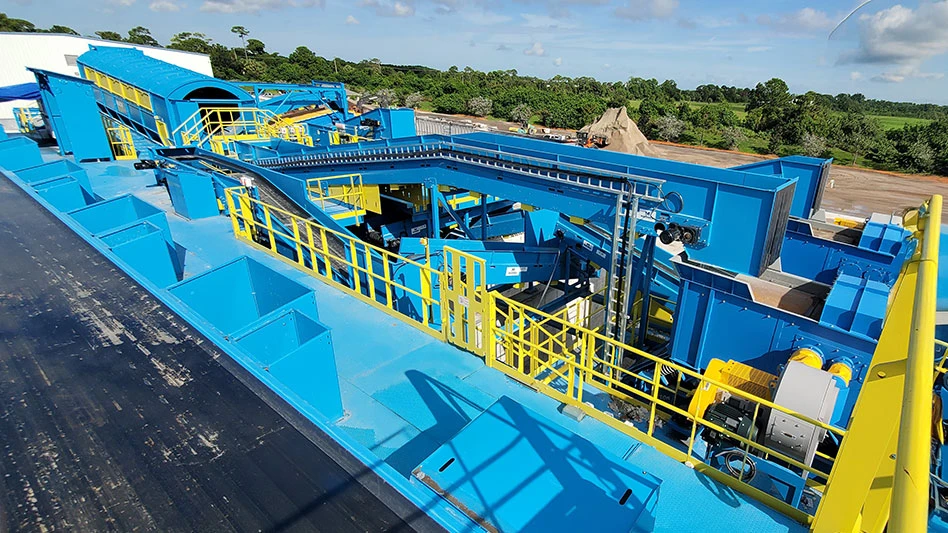
Good maintenance begins with a well-organized facility.
Scheduling
Each equipment manufacturer provides a schedule of recommended preventive maintenance. “OEM manuals have a schedule chart: our recommendation is to go with their recommendation,” Cole says. “I wouldn’t stretch it.”
Ignoring manufacturer recommendations could lead to unexpected down time and expensive repairs. “It’s important to keep trucks on their routes,” Cole states, “and parts are very expensive!” However, he acknowledges that some places have their own schedule, often based on the service manager’s experience.
The best scenario, Pochocki believes, is for the maintenance department to look at the trucks at 30, 45, or 60 days, not just annually. “They must be proactive, not reactive. Breakdowns cost more [than routine maintenance]: the tow bill, loss of productivity, downtime, and the cost of the repair…”
Rumpke Consolidated Companies Inc. is an 80-year-old, family-owned firm based in Cincinnati, where it maintains a fleet of approximately 1,500 trucks that consists primarily of frontloaders, rearloaders, manual sideloaders, manually automated sideloaders, automated sideloaders, and rolloffs. Over the past three years, the company has begun purchasing CNG front- and rearloaders.
Rumpke serves residential and commercial customers throughout Ohio, Kentucky, Indiana, and West Virginia. “We have a pretty good balance of urban and rural areas,” says Jeff Lay, corporate fleet manager, noting that subscription and municipal customers are included in the mix. “We service customers in major cities such as Columbus, Cleveland, Cincinnati, Louisville and Lexington, and all the suburbs, while hitting most of the areas in between. We are ranked as the 10th largest waste and recycling firm in the US. We are known as one of the largest recyclers in the Midwest-and, specifically, Ohio’s largest residential recycler.”
To keep that diverse fleet on the widespread routes, Rumpke incorporates multiple types of preventive maintenance programs. “Our most common is a 30-day inspection of our entire truck fleet,” Lay says. “This inspection process has been a big part of our success in reducing downtown and DOT violations.”
Similarly, in Olathe, each vehicle is brought in for inspection on a 250-hour PM schedule. “We do A, B, C PMs, with “˜A’s being basics (oil change, fluid checks/top off). Every PM gets a thorough safety systems check,” Went elaborates. The “C” PM is the most intense, he says, because it includes changing all fluids and filters, worn belts, wipers, hoses, and tires. In addition, hydraulic systems get a thorough check.
The City of Olathe uses automated side loaders for mainly urban residential waste pickup, serving approximately 130,000 residents of the suburban city southwest of Kansas City, MO, just over the Kansas state line.
Reminders
At a recent conference, Pochocki says the big haulers emphasized the importance of preventive maintenance. “[They] are frustrated if the components fail as a result of lack of proper maintenance. If they’re considering a new acquisition, they look at the garage,” he says. “If it’s in order, they assume the vehicles are in order.”
There are many reasons maintenance is not done, Pochocki continues. “Shops may be short on personnel or equipment. Or they can’t get ahead of the curve because older equipment needs so much work.”
A PM chart reminding service techs to change the oil and filter and grease points can be helpful, says Cole, who supervises Heil’s free onsite service training for dealers. “Pre-inspection and post-inspection sheets help operators remember what to look for. There’s paperwork to turn in anyway, so a handy checklist isn’t burdensome.”
In these situations, Pochocki believes it’s critical for the mechanic to follow up and verify that the items were actually checked. Drivers are less likely to check things like tires and grease, he says. “When technicians do it, shops are in better compliance.”
Accountability can be an obstacle to proper routine maintenance. “Many refuse departments and companies have a fleet maintenance department for equipment and another department responsible for drivers,” Pochocki outlines. That gives rise to an inherent conflict. Sometimes issues are not reported, and therefore, not repaired. “Instead, there’s a lot of finger pointing.”
Drivers often ignore electronic messages, Pochocki continues. On collection vehicles that do little or no highway driving, exhaust treatment systems get dirty from running “cold.” The all-day stop-and-go operation keeps them from running “hot,” which allows the system to self-clean.
Drivers could initiate a manual regeneration in such circumstances. “They park, flip a switch and wait 45 minutes while the engine runs up to a fast idle, generates heat and cleans out the exhaust system,” Pochocki details. However, he says, many of them simply turn off and restart the vehicle instead, in an effort to trick the system.
Unfortunately, the exhaust system just gets dirtier and dirtier, until it can’t run at all. Not only is it costly to replace filters, but Pochocki says that ignoring these maintenance reminders prohibits technicians from detecting other potential problems such as leaky axle seals and brake wear. It also keeps supervisors from adjusting the route to avoid the “pack at idle” problem of low engine speed by including some highway time so the vehicle can generate enough heat to trigger the self-cleaning feature.
Borrowing an Idea From In-and-Out Burger
One of the biggest reasons routine maintenance gets slighted is reluctance to pull trucks off the route, even though everyone realizes the potential consequences. No one likes down time. Therefore, speed is a key to convincing shops to perform regular maintenance.
Chicago Pneumatic’s CP7600 non-impact, heavy-duty wrench tightens nuts without impact stress.
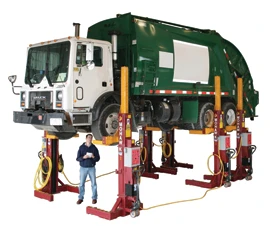
“It’s all about getting it out faster,” states Steve Perlstein, sales and marketing manager for Mohawk Lifts. Mohawk offers several types of lifts that enable fast, safe service of refuse vehicles. Mohawk manufactures two-post and four-post lifts, parallelograms and mobile columns. All of their 30,000- through 75,000-pound four-posts have recently been certified through third-party compliance testing to meet the new ANSI/ALI ALCTV-2011 national safety standard. “A productive shop is a happy shop.”
“Lifts are more productive and result in faster repair times,” Perlstein says. While the vehicle is six feet up in the air, a service technician can look underneath. “He may see other things to repair before they break down.”
Drive-on four-post lifts and parallelograms provide visibility and access for quick service. “Just drive onto the ramps,” Perlstein says. “It’s the fastest lift available.”
The Speedlane is an adapter for a drive-on two-post lift that eliminates time to position the swing arms. The lightweight adapter is made of rugged aluminum and is capable of full lifting capacity. Because no accidental damage can occur as a result of incorrect positioning of the arms, it’s safe. Durable rubber pads raise the vehicle from designated lift points, protecting it from scratches and dents.
Another way to save time is by using mobile columns. “The hydraulic lift goes up and down in about a minute,” Perlstein estimates. “A screw lift takes about three [minutes]. Multiply that by how many times you lift a truck and it adds up. That’s unproductive time.”
Productivity is enhanced in other ways by use of the weight gauge. This scale screws into a lift, measuring vehicle weight to within 3% accuracy. It keeps technicians and equipment safe by not overloading the lift. It also indicates if the vehicle is overloaded-information that can benefit a customer complaining of poor fuel mileage or short brake lift…information that could also help shops sell heavy-duty shocks and brakes.
“There are four tires on the rear axle, each with an imprint of its maximum load capacity,” begins Perlstein. “You need long enough forks to handle the inner and the outer tire or the shop manager won’t use the lift. Because of tire pressure ratings, techs are using jacks and jack stands instead of lifts. This can safely put a truck in the air without overloading the tire.”
The weight gauge on mobile lifts can also confirm a balanced load from side to side, which ensures better drivability, extended tire life and safety, including less chance of rollover.
Quick Tips
Because Dave Went says the city of Olathe sees a lot of electronic/electrical and hydraulic issues, he stocks plenty of electrical and hydraulic components for emergencies. “Since solid waste is a day-certain business, meaning the public expects pick up on their day of the week, every week, week in and week out, we cannot afford to have several side loaders down at one time. We attempt to solve this by keeping extra parts on hand and have technicians that are skilled in solid waste equipment. It is not a job for the weak of heart.”
As Went acknowledges, electrical and hydraulic systems on automated side loaders are “extremely complicated” and in-depth diagnostic skills are needed. Diagnostic equipment gives telltale signs of developing issues, but as Pochocki notes, the codes can be very complicated to decipher. However, due to the reintroduction of 2010 emissions regulations, he says, onboard diagnostics are required in 2013, so it’s a situation that all shops have to contend with.
The new emissions standards have led to an increase in downtime for Rumpke, Lay reports. Other issues he’s seeing include failure of exhaust gas recirculation coolers. “We have seen EGR coolers fail time after time,” he confirms. Rumpke continues to work with the OEMs to assist with product development to “help improve the quality of the coolers. Rumpke is focused on continuous improvement. We are always identifying best maintenance practices, educating our employees and enhancing our service. We are always looking for ways to improve are preventive maintenance program to be able to provide optimal customer service, while ensuring compliance and safety.”
Safety is Cole’s focus as a Heil trainer. From troubleshooting hydraulic and electrical schematics to simple things like cleaning decals so they can be read, safety goes hand-in-hand with productivity and efficiency.
He recommends weatherproofing connectors such as the electrical harness to avoid corrosion. “If you’re in the rain when you plug it in, moisture is trapped (if you have to take it apart on the road),” Cole elaborates. “Make a note to blow out with the air hose back at the shop. Connectors can operate in salt or snow for two years, as long as they’re dry…but when you violate the seals, they’re no longer watertight. That can lead to problems. If there is intermittent contact, it is very time-consuming to diagnose.”
A smart-looking facility is an asset when it comes to maintenance.
With computers now responsible for the engine, transmission, brakes, chassis and body control, it’s important to take extra care when servicing or repairing them. Pochocki suggests disconnecting the circuit boards if welding repairs are necessary. “If you don’t, you could damage the boards.”
Become familiar with equipment-particularly new equipment, Pochocki urges. “Look for preventive maintenance issues. For new equipment, there’s a break-in period: remember not to rev the engine. You’ll have shorter oil change intervals and you need to check power steering and hydraulic fluid and filters.”
Filter and oil change intervals can get pricey whether the equipment is old or new, but, says Cole, they extend equipment life. He spends a lot of time training maintenance crews to keep track of items like this. In fact, he says, “Heil has a tech training somewhere every week. We recently spent three weeks in Florida to train 150 people.”
Some of the tips they share during these sessions is to be sure to inspect pins when greasing. “Don’t just shoot grease; make sure it’s getting to the pin. It should come out around the pin if you’re doing it right.”
He mentions one municipality that had a problem with tailgate pins breaking. “It took me 10 minutes to pull the cylinder off. When I got it off, I saw half an inch of caked, black, solid mess. They tried to grease, but weren’t getting it where it was needed, so it got no grease for eight to nine months and eventually seized up.”
Cole’s final tip is to maintain the tools used to maintain the trucks. If the tools aren’t in good working order, they can’t do their jobs of keeping the equipment in good working order. Calibrate the tire gauges, for example. “Verify them weekly so you can accurately record pressures morning and night in the log.”
Latest from Waste Today
- Vecoplan to present modular solutions at IFAT 2026
- Terex Ecotec appoints Bradley Equipment as Texas distributor
- My Green Michigan expands depackaging capacity
- Washington selects Circular Action Alliance as PRO
- Ten-8 Industrial opens new central Florida service center
- Triumvirate Environmental acquires Environmental Waste Minimization
- Official NYC Bin availability expands ahead of deadline
- US Food Waste Pact’s 2025 Impact Report shows decrease in food waste