It’s the daily drudgery of every landfill: keeping them covered to prevent gases from escaping, suppressing offensive odors to keep neighbors happy, and making trash look, well, not like the mountain of unsightly detritus it is. It’s a relentlessly monotonous and repetitive task that brings film Groundhog Day to mind with the daily grind of apply, cover, close up shop, and then do it all over again the next day.
Although landfill owners must apply coverage each day, and dirt is often the go-to option, the current menu of commercial alternative daily covers (ADCs) can simplify and moderate this necessary task. While most owners are already familiar with its mandate, the benchmarks to attain as spelled out in the nearly 30-year old, 1992 EPA regulations for ADC have nonetheless remained virtually unchanged.
A Film You Only See Once
At EnviroCover, J.D. Mohr, a business development executive, says, “Our product compellingly meets or exceeds the EPA requirements for ADC at landfills.”
“Our parent company is a leader in the specialty polymer industry, with headquarters in Vancouver, Canada,” says Mohr, adding that “Our EnviroCover system is ideally suited for landfills experiencing odor issues.”
Mohr explains that their ADC product is a proprietary film produced in 18-foot-wide rolls, with each roll covering more than 93,500 square feet, just slightly over 2 acres of surface.
He says companies struggling to meet ADC compliance must face the daily problem of odor and leachate on their working cells.
“If you have a working face that is only 2% of your footprint, it is still responsible for 90% of the odors. There are many solutions for odor control, but the answer is to contain it so effectively the odor becomes a non-issue.”
The film, he explains has no interconnected pores through which gas and fluids may flow. In a phenomenon known as permeation, fluid molecules move slowly through this type of film in a vapor phase via molecular solubility and diffusion. When water droplets collect on the underside of the film that would otherwise dissipate in the environment, the odors are contained. On the other hand, Mohr adds, “Soil barrier covers can wash away, and when disturbed by equipment the next day, odors can easily escape.”
Describing how the film is deployed with the ECD 700, Mohr says it is a matter of “hooking up the specially designed Deployer to the front of your primary mover, such as a bulldozer or compactor.
“Then, with a hook on the front of the blade, you back over the garbage, and as the film unrolls from the Deployer to cover, the hopper dispenses a continuous stream of ballast material to hold the film in place simultaneously. This proprietary system works for smaller landfills but for the larger and super landfills our flagship Model ECD 800 is a fully automated unit and perfect for big jobs.”
In terms of personnel, the process involves one operator on the deployer to operate the machine and one person on the ground to cut the film and then reposition the operator for the next pass.
“After each film piece is laid down, you continue to lay down the next piece with an overlap to give you continuous coverage. Meanwhile, the ballast that is applied keeps everything in place.”
While it is a somewhat newer type of system to the ADC arena, Mohr urges owners to give it a try because the results and control are superb.
“Everybody has a unique requirement, and this is a turnkey cover solution. It only takes about 15 minutes to do at the end of each day, in any kind of weather, it doesn’t wash away, and does a fantastic job adhering to any kind of debris to help you get the most revenue out of your space as possible.”
Safety Spurs Innovation
Nearly 25 years ago, one individual became concerned at the rate of injury faced by landfill crew. Observing how they were put at risk dragging tarps over dangerous landfill terrain, Mike Slutz set out to make improvements by designing a self-contained unit allowing tarps to be rolled out over trash versus being dragged. This innovation and Slutz’s business ingenuity became the genesis of Tarpomatic Inc.
Marlon Yarborough, marketing and sales manager of the Canton, OH-based firm, says that the process of the patented Automatic Tarping Machine (ATM) launched the company in 1995 with machines that “give landfill owners a safe, quick, and cost-effective means to cover their working face at the end of each workday, or whenever they need to.
“The machine works by hooking a tubular heavy steel frame onto a trash compactor or a dozer blade. By using our adjustable guide brackets, you can attach quickly and easily to your onsite machine blade. Then the rolling and retrieving are performed by the operator from inside the cab, or remotely with the onboard wireless unit which lets you adjust the tilt, height, and speed of the operation,” explains Yarborough. The tarp is laid down 2–3 feet above the trash surface to prevent it from snagging on any debris, then it will settle as the machine goes backward.
The process, Yarborough says, is powered by a 26.5 hp Cat Tier 4 Diesel engine, and once the engine is started, “you engage the hydraulic system that next raises the tarp tube.
“Since there are 100-foot long-chain weights inside the tarp panels, the machine is designed to be used in high winds, and these weights make for an even distribution of the panels that operators will overlap in the deployment to create a good seal.”
Yarborough says the working face can typically be covered in 15–20 minutes, and depending on landfill size and needs, customers can choose from a variety of machine sizes ranging from 20-, 30-, 40-, and 50-foot-wide widths. The spools can hold up to 300 linear feet and are detachable, “so once you deploy one spool of tarps, you can just actuate the next roll and keep on working.”
The tarp material itself, he explains, “is a very tough woven and coated polyethylene with coating on both sides.
“This is also flame-resistant; it passes the most stringent flame tests you can find; it’s just a superb, super strong fabric,” he says.
“We make all our machines in the USA and purchase the best steel. It’s designed and built to be extremely sturdy because these machines take a beating daily and must hold up. The Cat diesel engine is the power plant of the system that runs the spool unit by using the connected hydraulic power assist and its fuel tank is built right into the frame, so nothing can puncture the tank or be a potential risk.”
When you use this system, Yarborough says, “You’re going to save money as there will be considerably less fuel used than hauling and spreading dirt.”
Listening and Responding
Southeast of Louisville, KY, is neighboring Somerset, just shy of 12,000 residents. It’s a small town, but the products of local manufacturer AmCon Environmental Inc. have had a big impact across the continental US and foreign markets, says Superintendent David Bell.
Bell says, “With EPA mandates that landfills cover working faces each day, we learned our customer needs and met those challenges with an objective to producing a superior alternate daily cover design.”
He explains that their tarps are constructed of 9-ounce polypropylene fabric and a finished thickness of 35 mils—tough and rugged to “allow water to easily sheet off and control odor.
“We also reinforce our corners with strapping that is a 15,000-pound webbing material that is quadruple stitched with high stress-bonded polyester thread—the strongest thread available. What this does is allow the tarp to withstand the rigors of heavy machinery pulling on it repeatedly, yet it is still light enough to be handled manually.”
The linear installation of tarps has expanded since the first introduction in 1988. Products now include geosynthetic liner membranes suited for landfills, new cells, ash piles, and more; and geotextiles with fabricated panels for stadium parking lots, runways, transit parks, and agricultural applications; the company is one of only a handful of certified installers of AgruAmerica Sure Grip concrete liners. AmCon also works in containment applying liners and capping materials for landfills and power plant coal ash collection facilities, providing and installing liners in wastewater lagoons ensuring leakproof systems.
“We are also very proud of our reputation in workmanship and customer service. For example, we make these right here in Kentucky and our dedicated workforce is unparalleled—many have been here since day one—and they commit to turning out an exceptional product.
“Once we buy the fabric, we assemble and sew them here with our long arm sewing machine. Then, every inch of the finished piece is inspected to check for flaws. If there is a problem with the weave or yarn is missing, that will only spell trouble down the line for a customer, so we catch any problems before they leave our plant.”
Bell says the tarps can last 6–9 months, but “The smaller ones might last a little longer, depending on the deploying equipment used, and how well they are taken care of on each site. We offer a variety of sizes including 50 by 100, 100 by 100, 100 by 150, and 150 by 150 which are our stock tarps. They weigh about 400 pounds, and they are rugged and will meet your ADC needs.”
Mix, Spray, Walk Away
Placing 6 to 12 inches of soil on a landfill working face every day to meet the daily cover compliance can work pretty well, but as Joel Lanz, President of Apalachin, NY-based LSC Environmental, says, “You want to use a cover that can help you extend the life of the landfill cell.”
The trick, he says, is to cover the trash effectively and uniformly, but with a product that does the job in controlling odor, blowing litter, vectors, scavenging, and fires…and doesn’t eat up what could be income-producing airspace. A tall order in any case.
“Here’s where our LSC Posi-Shell Environmental Coatings comes in,” says Lanz.
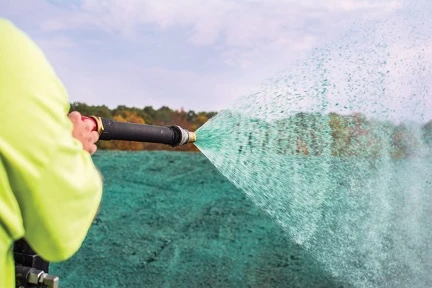
“The spray coats evenly, uniformly, and forms a thin shell cover for daily or intermediate. The material is a high-tech mineral binder, reinforcing fibers with a little coloring to give the appearance of soil. It takes 10–15 minutes to mix up a batch of it and depending on your site and needs, you just tow the sprayer, which is our own patented model, behind a bulldozer, or mounted on trucks, and simply spray the trash. It’s fast, it coats uniformly, and does what you need it to.”
The Posi-Shell is an environmentally friendly material that, once applied, is left on and crumbles with the next day’s work right into the debris, Lanz reports.
It’s all about reducing fuel, maintenance, and labor cost and extending landfill life, he says. In cost-benefit analyses completed for landfill sites, he sees repeatedly that “landfills can extend their life up to 20% and reduce fuel, maintenance, and labor costs up to 75% when the replace ‘free soil’ with Posi-Shell.”
He adds that they are unique in that they developed both the spray product and the equipment to apply it.
“You could use this in a hydroseeder, but of course our sprayer equipment is designed for the rugged demands of everyday landfill rigors, and wear and tear on nozzles and other system components.”
Lanz says that the company now has approval for another intermediate spray cover that can be left on for weeks or months.
“There may be occasions where you might not use that space for some reason, or maybe you are ready to seed but the weather hasn’t cooperated. Ordinarily, this must be covered using 12–18 inches of soil for an extended time. But that will still be subject to erosion. Now, you have the option to apply the harder, thicker version of Posi-Shell containing a durability enhancer, and you can leave it on for a year. Then, whenever you do decide to seed or work the site, all you do is just run a bulldozer over the surface and since it is powdered clay and lime, the surface just grinds up into the soil and you can apply your seeds directly onto this.”
Adding that the technique uses fewer natural resources and energy, with no negative impact on the environment, “You can even use the brown water runoff and leachate to mix the product rather than a freshwater source, so it is truly a low- to no-impact process.
Efficiency Pays for Itself
In our ever-increasing quest for convenience, the unwanted trade-off has created an epidemic of cast-off lithium-ion batteries. From phones and remote control to large appliances and tools, these often reach a landfill and pose hazards.
According to Shannon Harrop, sales and marketing manager of tarpARMOR, “Once these break when force is applied, such as by a compactor or dozer, the chemicals come together and ignite like a flare, which is just one of the many compelling reasons we have increased the fire retardant properties of our landfill tarps,” he says.
TarpARMOR is a Rogers, AK-based company that makes multiple landfill and industrial products. Their mainstay product offers landfill owners premium quality reusable ADC tarps and tarp deployment technology. Harrop elaborates on the tarp attributes and benefits.
“Many of the largest landfills in the US consider tarpARMOR tarps a great choice for ADC coverage. Unlike other tarps that are made from coated fabrics, our fabric is woven which gives you a much tougher, rip-stop effect to resist tears and punctures.”
He says it all starts in the manufacturing process “where we add our formulation for fire retardancy and UV stability to a polypropylene resin that is extruded and then woven. The protection, therefore, is built-in, so to speak, and that is why we think Tactical Textile is an appropriate name for the proprietary grey fabric.”
However, Harrop says the perception that permeability increases without coating is not entirely true. “The weave of our tarps is so tight that very little rainwater penetrates through the fabric.”
Harrop explains, “Most of the landfills we deal with use multiple tarps every day. Whether we’re working with the largest landfills in Southern California, for example, which take in up to 17,000 tons a day, or an average-sized site with 2,500 tons per day, covering the work face can be a large task, and maximizing airspace is essential.
“Using an automated tarping system allows you to deploy tarps at a rate of almost 1,000 square feet per minute using an in-cab remote control from the cab of standard onsite work-face equipment such as a dozer or compactor. The machine quickly connects to the blade of the equipment and makes short work of what would otherwise take hours to load and cover with dirt or biomass.”
The TDS also has an optional Odor Neutralizer Spray System that can cover nearly 13,000 square feet of reusable daily cover for odor control by simultaneously spraying a 30-foot-wide swath.
Harrop says they are introducing their latest model, the tarpARMOR TDS40XS, in early 2020, which will allow for even greater efficiency with the flexibility of exchangeable spools. The new design will only require one operator to load and unload the exchangeable spools all from the cab of the host equipment. Additional spools pre-loaded with tarps can quickly be exchanged to add as much coverage as needed for the day.
Latest from Waste Today
- Vermeer announces plan to build new facility in Des Moines metro area
- Buffalo Biodiesel shares updates on Part 360 application to DEC, Tonawanda facility progress
- Capstar Disposal expands roll off dumpster rental services
- Supreme Court strikes down IEEPA tariffs
- Casella details facility closures, expansion efforts
- Zero harm: Building a SIF prevention program for waste and recycling operations
- Casella posts a loss in Q4 2025
- McNeilus names Haaker Equipment first Dealer Partner of the Year