On one hand, waste management operations are doing what they can to ensure that bulky items are disposed of properly and not ditched on the side of the road, and that other special wastes receive proper disposal. Still, most waste managers would prefer to see fewer bulky items headed for the landfill and more put to good use for someone else.
Suki Janssen, interim solid waste director for Athens-Clarke County, GA, says the term “bulky waste” makes her uncomfortable. “It’s not waste,” she says. “It’s just items that have been misplaced or not in the reuse stream.”
Stephen Gillette, solid waste director for Colorado’s Larimer County, concurs: “I think people keep forgetting the three Rs: it’s reduce, reuse, and then recycle—and if all else fails, landfill. I think sometimes we just jump to number four.”
Waste management directors such as Debbie Krogwold, recycling coordinator for Waupaca County, WI, are educating the public on sustainable practices that reduce waste.
“I believe user fees are important—not only for garbage, but the special wastes like hazardous waste, so they don’t feel like: ‘I’m going to have this; I’ll just get rid of it, and it’s not going to cost me anything,'” she says. “If it does cost a little bit, it will make them think that they’ll just buy what they need.”
Many municipal waste operations are partnering with non-profits to reuse and recycle unwanted waste that still has some useful life. Some areas are ramping up efforts to recycle.
In response to its residents’ passion for recycling, Athens’ solid waste department is opening up a center for hard-to-recycle materials this year.
“It will be taking items that we know there are outlets for in Atlanta, but we historically haven’t had the space to save it in a dry area where it can be sold or picked up for cost neutral to go to a recycler,” explains Janssen.
Colorado’s paint stewardship bill goes into effect July 1. The state will become the eighth in the US to implement PaintCare, a paint recycling program.
PaintCare is a non-profit organization created in 2009 by the American Coatings Association to represent paint manufacturers in states that pass paint stewardship laws. The Colorado Paint Stewardship Law implements an industry-operated and financed postconsumer paint management system that decreases cost and responsibility for local and state governments and makes paint recycling more convenient.
Half of products received through municipal household hazardous waste programs are paints. Some 10% of paint is leftover and unused. Some 65 million gallons of paint are leftover annually in the United States, including 1.2 million gallons in Colorado.
While normal waste collection is conducted through fairly predictable routes on specified days in most communities, when it comes to special wastes, operations should always be prepared for the unusual, Gillette points out. “You never know when someone is going to call and say, ‘I’ve got this,’ and you say, ‘You’ve got what?’ Have your regulators on speed dial so you can help your customer in tight situations,” he says.
One of the most unusual special wastes with which Gillette has had to deal came at the request of a veterinarian school. “They had an elephant to bring out that had passed away from TB,” he says. “They called the state, and they thought the best thing to do was to bury this animal, because who has a regulation about do you accept an elephant? Be prepared, and think outside of the box.”
Bulky waste items can present a challenge for many waste operations. In Athens, Janssen faces a particular challenge, though she adds it’s not insurmountable.
Athens is home to the University of Georgia. And like at any campus anywhere in the US, once students leave at the end of the school year, they leave behind a trail of waste.
“During move-out time, which is typically in the spring and into early June as well, there is an exceptional amount of useable bulky waste,” says Janssen. “People who don’t live in college towns would be mortified at what students regard as waste. A lot of the students’ parents have a lot of wealth or gave them money to buy mini-fridges, couches, chairs, end tables, coffee tables—you name it. Some of the kids I’ve talked to once they graduate college don’t want that stuff anymore. They feel like they’ve become an adult, and they want to get new stuff.”
In so doing, many don’t try to seek out reuse options, she says. “A lot of good stuff still gets trashed in our community, and I’m sure we’re not the only one,” says Janssen.
The university, which operates its own recycling and trash crews, is trying to combat that, and Athens’ solid waste department tries to assist, she adds.
Athens has a high poverty rate, “so getting that useful material that they would throw out into the hands of our impoverished citizens is something that we need to do a better job with at move-out time,” says Janssen.
The challenge is that the move-out time occurs in a brief time period. “It’s hard for all of us to get enough equipment, or equipment that doesn’t tear up the material,” she says. “We have a lot of rolloff containers, but those aren’t necessarily the best equipment to be hauling mini-refrigerators because it moves around, so having proper equipment, such as box trucks, would be a better way.”
Additionally, it requires a lot of staff, or a group of volunteers, to handle the large load of useful material.
Goodwill has tried to make it easier by putting a tractor-trailer on campus to take some of the usable material.
The campus’ program, “Dawgs Ditch the Dumpster,” encourages students to donate unwanted material at the end of the year at dropoff sites in each residential community.
One particular challenge is dealing with unwanted items from off-campus housing. “That’s a project that our staff has talked about that we really need to work on, to get apartment complexes to get on board with move-out programs,” says Janssen. “That is another level of complexity, because you’re dealing with private entities, apartment complexes, that often don’t want to pay to get rid of that stuff. They take the easy way out. They hire private companies and slap a 20- to 40-cubic open-top container and tell the kids to have at it.”
Since there is no legislation on the books that says the apartment complexes can’t do otherwise, Athens-Clarke County’s solid waste department does not have an option for them, Janssen says. “It’s hard to compete with some of the low prices trash haulers offer. A lot of them don’t have a place to store it, even if we asked them to, so we could get around with a box truck to pick it up.”
Athens-Clarke County’s solid waste department tries to encourage the apartment complexes to work with places such as Goodwill and Habitat ReStore, “but that is a work in progress,” notes Janssen. “A lot of them don’t want to store the material—they just want the fastest way to get rid of the material, and, unfortunately, that’s a Dumpster.”
There also are students who are “impatient and don’t want to work within the confines of their apartment complex, so we have 11 dropoff sites in our community just for recycling material, so during move-out time we get hit pretty hard at our dropoff sites with bulky waste,” notes Janssen.
The solid waste trucks try to get it picked up and to a reuse option if possible, but sometimes it’s sitting out in the weather, and in even 24 hours it could be ruined, Janssen says.
On a day-to-day basis, the Athens-Clarke County Solid Waste Department owns and operates a landfill, collects residential waste in a defined area and commercial waste throughout the county, has a recycling division, and operates “Keep Athens-Clarke County Beautiful.”
Janssen says that if one of the customers in the service area of 10,000 residential accounts wants to get rid of bulky waste, the solid waste department picks it up for an additional cost.
While 115,000 people live in Athens, fewer than half live in single-family homes. The others live in low-income housing or multifamily dwellings, which are considered commercial entities and are serviced by the city’s solid waste operation or private haulers.
“We operate our landfill and our collections division as Enterprise Funds, so we have to collect all of the money like a private entity would,” says Janssen. “We charge a pickup fee and a disposal fee if it has to be disposed of in a landfill. If it can be recycled, then potentially there would be no disposal fee. But first and foremost, we do encourage all of our residents through education.”
Athens has a number of nonprofit community reuse options for useable bulky waste, and the solid waste department encourages residents to first consider those options before landfilling. Those who want to landfill, but avoid the pickup fee, can self-haul to the landfill and are charged $42 a ton.
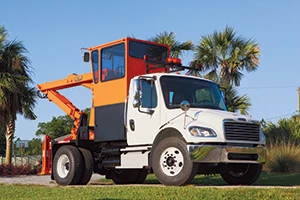
In Temple, TX, bulky waste is collected twice a month from residential customers using a boom truck: a regular truck chassis with a 20- to 30-cubic yard bed and a large grapple claw/boom to pick up items curbside. The city also picks up brush, which is taken to the local wastewater plant where it is chipped and mixed to make compost.
The city has handled bulk and brush waste in this manner for more than 25 years, notes Lisa A. Sebek, director of solid waste services. “We believe this type of operation meets the needs of our department and our city. It is a safe and efficient operation,” she says.
To those looking to create an effective program with such lasting power, Sebek advises other waste managers to do research. “Research what other cities are doing, research the needs of your own city, and then see what operation will work best in your city to meet the needs of your city operations and those of your citizens.”
In Bunnell, FL, the solid waste department offers grapple service to the city’s residents and businesses. Residents are allowed to put bulk waste, such as non-construction debris, out on the second pickup day of the week, 52 weeks a year. The items must have replacement value, such as rugs, mattresses, and furniture.
Bunnell offers twice-weekly waste collection services; the fee for bulky waste pickup is included in the monthly charge. An extra charge is assessed for businesses and residential households requiring service for items too small for a rolloff container. In that case, the customer may hire for grapple service, which is generally construction and demolition (C&D). Fees are based on the composition of the debris—C&D heavy class or industrial medium/light, says Perry Mitrano, director of solid waste.
Heavy mixed C&D materials that are not segregated from debris and cannot be recycled cost more to dispose. Lighter materials that cannot be recycled and must be landfilled are calculated as less, based on cubic yards. “Our experience in our market shows us the average cost is $11 per yard, for both heavy or light,” adds Mitrano.
The driving factor behind the program is “cutting costs out of the higher disposal wastestream,” he says. “We are continuing to reduce our front-end commercial Dumpsters’ weights by identifying debris that is really not Class one garbage, but Class three, which is less expensive to dispose of versus Class one.”
Additionally, the practice keeps debris out of the waste hauling truck that may cause damage to the truck body, he adds. “Steel and wood debris, often, finds its way behind the blade or through the side of the body, thereby damaging the truck,” says Mitrano.
For its operations, Bunnell uses two grapple trucks—one newer, and the older one Mitrano describes as “likely the most reliable truck we own. Department employees find the lower longer body is better operationally. We often have to work under wires and low branches. We recommend an 18- to 22-yard body.”
In ensuring that the current program fits the community’s needs, Mitrano says that Bunnell’s solid waste department strives for efficiency, capacity, and quality of service, and that the program is highly successful with no need to make changes. “Efficiency—we do pick it up fast. Capacity—we need to get it on one load, or have a transfer station or landfill nearby if we can’t; this consideration helps decide the type of truck to purchase. Quality of service—Bunnell requires the service to pick up everything by close of business Friday,” lists Mitrano. “The trashy country road pile in the city is not the look the department wants people to see, so we are self-inspecting and self-managing the trucks constantly, and communicating pickups during the day to ensure proper pickup.”
In Midland, TX, the solid waste department has a call-in program for special and bulky wastes. “We have designated employees who are devoted to large-item pickup, and we also utilize inmate labor,” notes Morris Williams, director of solid waste. “The city does not charge any additional fees for large-item pickup. The items are collected in the order that they were called in.”
The original program was set up as a way to occasionally collect large items and “keep our alleys clear of large debris and our three-cubic yard alley containers from being filled with the items,” notes Williams, adding that the city has substantially expanded the program over the years.
Midland utilizes two rear-load trucks and three pickup trucks that haul 16-foot enclosed trailers to handle the collection.
Williams says the program is falling short of meeting the community’s needs. “The growth of our community has increased faster than our labor force,” he points out. “This, in turn, keeps us running behind. Our program could improve with specified collection times and areas for citizens and education as to what is considered a large item that can be collected.”
The city of Charlotte, NC, has been collecting bulky items as early as 1989, using the scheduling system, notes Brandi Williams, public affairs manager for Charlotte. Prior to that, bulky items were collected as garbage through the twice-a-week backyard garbage collection program.
The city began using an automated routing system in 2000. The service is provided weekly and at no extra charge to the city’s 750,000 residents, who call in to schedule the items for collection.
“When they call in to schedule, we route each day for the most efficient collection,” says Williams. “This system allowed us to schedule bulky using three categories: bulky garbage, recyclable bulky white goods, and tires.”
Three different trucks are dispatched for the separate wastestreams, which are then disposed in three different places in Mecklenburg County to county-owned landfills and MRFs. The white goods and tires are treated as recyclable material and sold on the recyclable market.
Prior to the current system, the requests were phoned in, and the trucks’ routes were manually mapped the day prior to collection, says Williams. “Around the same time in 2000, we began to route the requests using a GIS-based solution that saved hours in map creation,” she says. “The routing system improved over the years and in 2010, we began automated routing of the stops that further improved productivity by making the routes more efficient.”
In addition to helping to decrease illegal dumping, the program also has helped keep white goods, tires, and electronics out of the landfill, Williams points out.
There is no extra charge for the service, but the waste hauling operation faces a challenge shared by many others. “We find that we have a large percentage of white goods and non-recyclable items such as couches, chairs, and tables that are not at the curb when we come to collect them,” says Williams. “We believe this is because of scavenging. We would like to resolve this issue, because routing for and going to the location to pick up something when it is not there is an investment of time, fuel, and resources that is wasted when a considerable number of stops have already been collected. We’re still in the brainstorming phase and exploring options for how to deal with this.”
Berkeley County, SC, provides sanitation services to about 81,000 residential and commercial customers. Special waste must go through a screening process that includes a Toxicity Characteristic Leaching Procedure (TCLP) and a verification process to ensure that it is non-hazardous and able to go into a Subtitle D landfill, notes Mark Schlievert, director of solid waste for Berkeley County Water and Sanitation.
In South Carolina, sludge is considered a special waste, he says. “Periodically, have to run a fingerprint test on material as it comes in, and then every so often you have to do a TCLP,” says Schlievert.
In general, the sludge is directed to the landfill and mixed in with the regular waste. “Asbestos in South Carolina has to have a license and manifest coming from our regulator, which is the South Carolina Department of Health and Environmental Control,” says Schlievert. “It has to be immediately buried three feet and covered. You also have to take the GIS location and elevation, and that’s got to be documented to go along with the manifest.”
As for bulky waste, depending on what it is, it may go into a Class 2 landfill, says Schlievert. “Otherwise, if it’s MSW bulky waste, we just put it up on the landfill and mix it in with the rest of the waste,” he adds. “We try to keep stuff like that as far away from side slope as possible. It can wick and cause leakage.”
The Augusta County Service Authority in Virginia landfills bulky couches and mattresses that are placed into a rolloff box. All white goods are recycled. The program has been in place since the landfill was constructed in 1971.
Some of the bulky waste is placed into a Goodwill pod located at the site. That program has been in place for six years.
“They will take gently used furniture, and things of that nature, that they can put into their store or recycle,” notes Greg Thomasson, director of solid waste management for the 125,000-resident service area. “They take electronics, books—it’s amazing how many things they will take.”
The Authority also does an annual collection for paints, solvents, batteries, and other special wastes. Thomasson says the program works well, as it gives residents two options for their waste: to bring for no charges items that can’t be otherwise recycled or to donate them to Goodwill.
In the past couple of years, the Fort Collins, CO, area has had what Gillette describes as FEMA-type events that generated a great deal of debris: a fire in 2012, and a flood in September 2013. The latter event created mostly woody debris in the service area of 315,000 people.
“A county next to us chose to attempt to grind it and compost it, and then the people weren’t too happy because they weren’t sure this wasn’t contaminated from a flood,” says Gillette.
“We looked into grinding the material, but because of the double handling, we chose to bury it,” he adds. “We asked people to cut the trees to six-foot sections, and we buried it. It worked for us. It saved our citizens money to be able to bring this material in because they were able to handle it more readily, and the debris company we hired was able to get it cleaned up quicker than had we done other things with it.”
In general, Larimer County’s landfill compactor takes to large furniture and other bulky items brought in, while appliances are segregated and recycled.
Waupaca County in Wisconsin has had a transfer station, since 1994, at which bulky waste that can go to a landfill is brought in by residents and businesses, and is weighed on a certified truck scale with fees charged by the pound. “We have compactor boxes, and we contract with a private hauler who takes them to the Outagamie County landfill,” says Krogwold. The department’s service area includes 52,000 residents.
Some people will contract to have a private hauler transport the bulky waste either to the transfer station, or landfill.
Krogwold believes the program fits the community’s needs. “At our transfer station we not only have the bulky waste that would be destined for a landfill, but we also collect fluorescents, oil filters, waste oil, recyclables, appliances, and electronics,” she says. “There are user fees for that. But there is a program available for pretty much any waste residents have.”
But, she sees room for improvement. “I wish we could handle it better and have more time to do that,” she says. “In the hazardous waste program, we do accept hazardous waste from households, and there is a user fee on that program. That imparts the knowledge to people that they will have to pay for the waste—it’s not free.”
And it may get people thinking that they should buy just what they need as to not have to deal with getting rid of it later on, Krogwold says.
Outagamie County’s solid waste collection service area covers 550,000 people. The county also partners with neighboring Brown and Winnebago counties. Most of the material that comes into Outagamie County is trucked in, notes landfill superintendent Bill Long.
“We do have private vehicles that come in with bulky material, and we help them unload—either with one of our landfill dozers, or with our excavator,” says Long.
Special waste must meet one of three protocols and be approved for the landfill, Long says. The protocols are labeled A, B, and C, and correspond with chemical concentration limits regulated by the Wisconsin Department of Natural Resources.
The program enables Outagamie County residents to get rid of their special waste products without a significant expense, says Long. It is the owner’s responsibility to have the waste tested before bringing it to the landfill.
“It gives them an opportunity to have their material tested to see exactly what the content of that material is for both the landfill, and their own knowledge,” adds Long.
In Lincoln County, WI, the%2
Latest from Waste Today
- Vermeer announces plan to build new facility in Des Moines metro area
- Buffalo Biodiesel shares updates on Part 360 application to DEC, Tonawanda facility progress
- Capstar Disposal expands roll off dumpster rental services
- Supreme Court strikes down IEEPA tariffs
- Casella details facility closures, expansion efforts
- Zero harm: Building a SIF prevention program for waste and recycling operations
- Casella posts a loss in Q4 2025
- McNeilus names Haaker Equipment first Dealer Partner of the Year