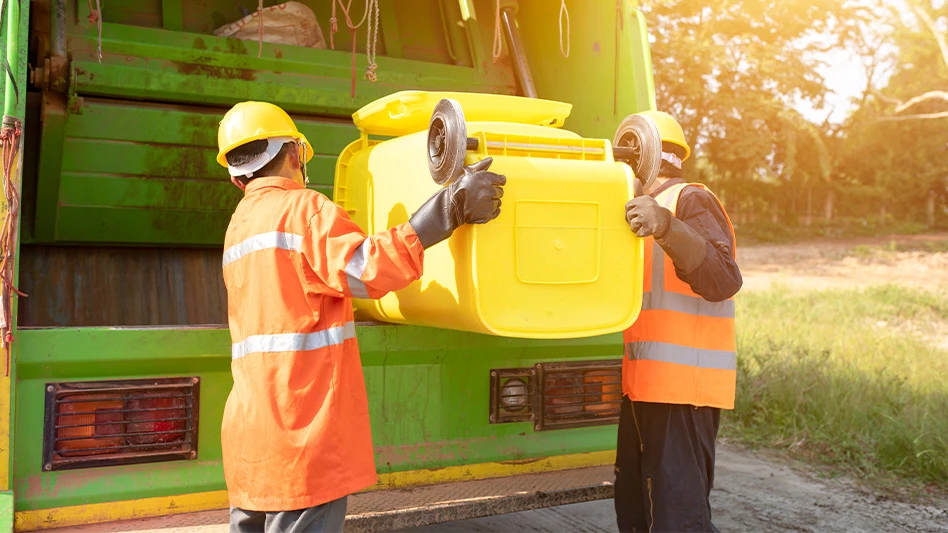
When one considers the term ergonomics, perhaps an initial thought focuses on the safety, well being, and comfort of the operator. And well it should: Although the rate of injury and illness among waste-collection workers is slowly inching downward, the industry still has one of the highest injury rates in the country, as reported by the US Bureau of Labor Statistics (BLS).
In 2007, the BLS recorded 6.4 cases per 100 workers of days away from work, transfer, or job restriction due to illness and injury. That’s down from 6.5 in the previous year.
But vehicle ergonomic design also significantly affects the number of lifts that can be accomplished in any given time period, and that goes full circle back to operator safety and comfort.
“Everything we can do in our industry to make our customers’ lives simpler is going to benefit everyone,” says Bob Kuch, vice president of engineering for the commercial group at McNeilus Truck and Manufacturing. “In this day and age, with the technology that’s available, there’s a lot we can do going forward to make everybody’s job simpler, and that’s what it’s all about: productivity and simplicity.”
To that end, as waste collection gets more automated, productivity increases along with operator safety.
Case in point is that of Moline, IL. The city utilizes automated waste collection with trucks that feature arms extending from the vehicle to pick up specialized 48- or 96-gallon carts.
While two workers were needed to operate rear-loading garbage trucks, automated trucks utilize only one.
The city lists other advantages:
- A safer work environment for refuse workers, reducing the number of back, leg and shoulder injuries that have resulted from previous collection methods
- Reduced exposure to potential injuries from sharp objects such as hypodermic needles and broken glass
- Reduced Workers’ Compensation costs
- Higher productivity with a reduced labor force
- Annual budget savings of $100,000, not including reduced risk management costs, which quadruples the figure
“There were a variety of influences that were moving us in the direction of automated waste collection,” says J.D. Schulte, fleet manager for solid waste collection for Moline.
“We had a goal of containerizing all of the trash and not having the variety of different containers,” he says. “We had semi-automated prior to this. We had rear loaders with two folks on each truck and folks had the option of using a 96-gallon container or something similar that we could dump with our cart-tippers, or they could continue to use trash containers. The ordinance didn’t allow for them to just put out bags, but a lot of folks would just bag their garbage and put it out.”
Workers were subjected to needle sticks.
“Not a lot, but obviously one is too many,” Schulte points out.
Workers’ Compensation claims were annually in the six figures.
“That was a huge driving factor,” says Schulte. “All things considered, we made the decision to move toward automated collections.”
There was some initial pushback by the union.
“They were worried about folks losing their jobs,” Schulte says. “They were assured by management it would be through attrition and folks would be reassigned to other divisions, but still the resistance was there because of the unknown.”
In the meantime, Schulte began investigating waste collection practices in surrounding cities that make up the Quad City area of Moline and Rock Island, IL, and Davenport and Bettendorf, IA.
Rock Island was looking to go to an automated collection system at the same time and Bettendorf already had trucks with an automated arm, although drivers still exited the truck to pick up extra bags that the residents buy.
When Schulte did field research on automated waste collection vehicles, he took with him one of the veteran truck drivers.
“I’ve respected him since the time I was out on the shop floor fixing these trucks,” he says. “I told him we’re going to visit some communities that have these trucks so we don’t get something that won’t work for him.”
They headed for Madison, WI. The city was in the midst of a trial in which it combined three different cabin chassis models with five different packer bodies.
“They put the different combinations together and sent them out because they knew they were going to buy 20 some trucks and wanted to make sure that when they bought that many they made the right decision,” says Schulte.
While Moline officials didn’t have time to wait for the results, the field visit gave them one-stop, hands-on contact with the automated equipment. Moline’s driver spoke with the Madison drivers while Schulte talked to Madison’s mechanics to ascertain what type of support they were getting. “It helped us make our decision,” he says.
To that point, Moline had postponed vehicle replacements. “We’d typically buy a rear-loader packer truck every year and put it on a seven-year life cycle,” Schulte says. “Anticipating the automation, we hadn’t replaced any rear loaders. They were looking a little tough and were getting to the point where they weren’t reliable.
“We had been spending more than we would on repair and maintenance costs on our older fleet, but we hadn’t bought any new ones, so we weren’t getting rid of relatively new trucks to get into this.”
Schulte says Moline spent less on the automated trucks than the last two rear loaders purchased. When the city purchased those, an ultra-low entry cab was specified because the drivers were getting in and out of the trucks all day long.
Because the region gets plenty of snow and ice, the cabs were also equipped with full-skirt doors, which also had been an additional cost. “When the doors shut, it covered up the step,” says Schulte. “We didn’t have people stepping out on ice-and-snow-covered steps. Our older rear-loaders were an expensive truck to buy when we initially bought them. It was an advantage that these were initially cheaper.”
Schulte says while he cannot endorse a particular system and is not sure the city will continue to use the same automated truck systems, the present automated waste collection vehicles use a Freightliner Condor chassis with 32-yard Bridgeport packer body.
Schulte says he believes that because drivers spend all day in the trucks, they should feel as comfortable as possible in executing their jobs. “We put air-ride in the trucks. They’re air-conditioned. We put CD players in them. It’s a one-person operation now, and we want to make sure this truck is good for them and they are good to the truck,” he says. “It has worked. These guys have done a good job with these trucks.”
Since instituting the program in 2006, Moline has not had one Workers’ Compensation claim. Schulte advises anyone considering an automated truck to install a camera. “Our trucks are right-hand drive,” he says. “The camera shoots down the left-hand side by default and shows the left side of the vehicle. When the driver puts the vehicle in reverse, it automatically shoots to a rearview camera that shows in the back of the truck.
“When the driver activates the arm, there’s a sensor on there and there’s a camera in the hopper, so they can see if there’s anything in the hopper that they need to stop for. Once they dump the cart, it shows on the camera in the cab.”
Moline chose truck bodies that utilize a joystick control operated with the left hand. There also is a bank of switches for the various arm functions on the left side, so drivers can use the joystick or the switches.
“What we found is the majority of our drivers are right-handed; you’re going to find that throughout the industry,” says Schulte. “We had a separate bank of switches we had to put it on with a wire harness and there’s a small slotted tube that mounts to the door and it allows this other bank of switches to sit on there and move back and forth according to what’s comfortable for the driver.
“They can use the arm rest on the door as an arm rest and put this bank of switches where they can slide it in place and use it and then they can use their right hand to operate the arm. They have the joy stick, the left bank of switches and the right bank of switches.”
Moline also had installed an opera window in the cab of the trucks. “It’s a third window in the corner of the cab, so they could look to the right and see out that window without having to crank all the way around and lean forward and look backwards,” says Schulte. “It makes it easier for them to glance to their right and look at the arm.”
Those comforts have been welcomed by the drivers, Schulte says.
Moline has five automated trucks in its fleet. The fleet also includes a boom truck, a claw truck for special pickups and two rear loaders with cart tippers and container attachments to dump 2.5-yard containers.
Because Moline does not have a transfer station, the trucks must go directly to the landfill, so the trucks are specified to be tipped to dump.
Moline has about 15,000 stops. Previously, the refuse workers were pulling between 500 and 600 stops a day, says Schulte.
Now with the automated refuse collection vehicles, most of the route are in the 900 range, he adds. There are still more efficiencies the city has yet to assume, Schulte says.
“We still let folks leave their trash in the back in the alley or in front of their homes,” he says. “We don’t make them put all of their trash on one side of the street. Our trucks are still traveling each street twice, and we’re still getting those kinds of efficiencies.”
As part of the purchase price of the trucks, Moline officials negotiated a five-year warranty and put them on a five-year replacement schedule.
Then Schulte took the bold step of asking the city council to approve a measure that would permit the trucks to be wrapped with advertising. The measure passed, but not unanimously.
“We brought in close to $50,000 in revenue from selling the space on the side of the garbage trucks,” says Schulte. “That’s helped us offset brakes and tires, so that was the final component that made us confident we could save $100,000 by going with this.”
Based on the city’s experience so far, Schulte says Moline will continue to use automated waste collection vehicles.
“Moline is an older community,” Schulte points out. “It’s not like a new planned development where we can plan for larger trucks and equipment. It took some effort to strategically get people to put their carts in certain spots so we could do it. It wasn’t an easy transition, but it was definitely worth the effort.”
What Drivers Want
Listening to what the drivers have to say is the key to ergonomic design, points out Tom Vatter, vice president of sales and marketing for Autocar.
“The average driver’s route is 10 to 12 hours a day,” he says. “The more comfortable and efficient he can be, the better he’s going to like the truck. The better the product, the fewer failures in the field.”
Autocar has worked with major truck body manufacturers to integrate the body with chassis and place the controls within the dash of the truck, Vatter says.
The integration is not only beneficial to the driver, but also to the technician, who does not have to splice into the electrical system of the chassis, creating a more “warranty-friendly” setup, he adds.
Changing body types are driving the need to make roomier cabs.
“In certain places, drivers are getting bigger,” Vatter says, pointing out that a low cab-forward design has become more important. Added emission requirements means more components are added—and those components are getting bigger—thus, there is the potential for less space in the cab.
To that end, Autocar created the ACX cab for its Xpeditor truck line, which gives drivers more room.
Consider the right-hand stand on a side-loader truck and how a driver, from the right side of the truck, must stand up and throw the garbage into the side loader.
“He has to be tall enough to see over the doghouse in the front edge of the dash while dealing with an 18-inch step height into the truck, getting out at every stop,” says Vatter. “A lot goes into designing for drivers.”
At the same time the ACX cab was made larger, it also was moved forward and down.
“The driver has a straight shot getting in and out of the truck and not having to go around the front wheel well,” says Vatter. “You realize the difference if you have to get in and out of that truck a couple of hundred of times a day.”
Dual applications also promote ergonomics, such as heating and cooling accommodations for dual driving functions from both sides of the truck, says Vatter.
“Cameras have monitors in the cabs, which swivel to the left-hand side or right no matter what position driver is in,” he adds.
A lowered front dash, a multiplexed electrical system, integrated controls, a larger envelope from back to front to allow larger drivers more room, and a tilt wheel round out the ergonomics in the ACX cab, Vatter says.
Mechanics are considered in the design as well. “All of the relays are in the back panel of the dash with a readable display that indicates which fuse controls what function,” Vatter says.
Companies such as Autocar are sometimes asked to design elements that are not safe. “We give the customers what they want, but safety is the number-one concern,” Vatter says. “As the OEM, we have to be the voice of reason.” Case in point: the brake in a right-hand stand application. It has to be tied into a lock-in to ensure safety, Vatter says.
“The hand brake runs by air, and you have to think of all of contingencies if there’s an air leak,” says Vatter.
Office Automation
Chassis manufacturers are trying to make cab interiors more comfortable than they have in the past, says Phil Allen, vice president of sales and marketing for Scranton Manufacturing, builder of New Way Trucks.
“The controls are being designed to use a minimum amount of effort on the drivers so they can concentrate more on driving and doing their jobs,” he says.
Automation is the fastest-growing segment of the industry, Allen says.
“It’s done for a number of reasons. It’s route efficiency—you can pick up more hauls in a day with the truck. You can reduce the insurance costs because of benefits to Workers’ Compensation. The garbage industry has one of the highest injury rates in the country.
“If we can take the lifting out of it and put them in the truck with a seat in a comfortable air-conditioned cab and a joystick, we’re going to reduce the injuries and insurance claims. The route efficiency reduces the number of trucks needed to provide the service.”
When specifying a vehicle with ergonomics in mind, think controls, says Kuch.
“You try to design all the controls with the 95-percentile male and five-percentile female considerations, while trying to encompass more than 90% of people out there,” he says.
Kuch points out that a waste collection vehicle is essentially the workers’ “office.”
“Depending on how repetitive the items are, you look at what is going to be the most comfortable for the positions that it’s going to be in,” he says. “We try to make things as comfortable as we can, obviously knowing the application is extremely important and if it is something that unique to their area, then we accommodate maybe outside that 90% range.”
Ergonomic design is tied into the particular model being specified, such as a rear-loaded truck, a side-load truck, or an automated truck, says Allen.
“As far as ergonomics, actual manual labor is involved in the rear loader, where you’re concerned about load-sill heights, where you’re trying to achieve the lowest sill heights possible. That varies with the chassis, but generally speaking, the design of the rear-load body is about 3 to 5 inches below the truck frame,” he says.
In automated waste collection vehicles, ergonomics focuses on the comfort of the operating controls and seat location for the worker sitting in the cab, Allen says.
All of Scranton Manufacturing’s body models include as a standard feature rear-camera systems, he adds.
Glenn Ellis, vice president for marketing and dealer operations for Hino Trucks agrees. “Truck operators want minimal energy expended on the operation of the chassis to they can fully focus energies on collecting the maximum amount lifts within a given day to generate revenue,” Ellis says, adding that his company’s chassis are designed with that in mind.
Hino also takes into consideration all types of demographics in chassis design toward the goal of being “ergonomically friendly,” Ellis says. An additional concern is Workers’ Compensation. Hino Trucks designs large steps, and grab handles are placed inside of the cab to prevent slippage as the drivers enter the cab, potentially hundreds of times daily.
Without driver comfort, fatigue sets in earlier, says Kevin Watje, chief executive officer of Wayne Engineering.
“We look at how he’s sitting, where he’s looking, and we want him to have his eyes on the road as much as he can,” he says. “We may modify doghouses, sun visors, arm rests, or what have you to get cameras in his line of sight. We want the driver to use cameras or mirrors.”
Watje believes it’s important that the municipalities train their drivers to utilize the camera and mirror equipment.
“Don’t be looking over your shoulder, because you’re going to have Workers’ Compensation claims develop from neck injuries if they’re not training people to do that,” he says. “Nowadays for the most part people are realizing through mirrors and the aid of cameras you can do this very efficiently without looking over your shoulder and looking back over the car.”
While municipalities are doing their job training, manufacturers are giving them the tools to do so, Watje says.
“From our standpoint, we try to put everything within line of sight from the driver so he’s not looking back and forth,” he says. “We get into the trucks ourselves and try to figure out what feels comfortable. We have about four or five different vehicles that have different configurations, and we have to design as we go, depending on what options and controls they ask for, so it’s ergonomic.”
Watje says sometimes his company has “guessed it wrong and the municipality has said it didn’t work. From an ergonomics standpoint, we give warranties. We don’t imply that warranty—it’s not explicit in any way—but the truck has got to be workable, so ergonomics has got to be a big part of it.”
Watje contends that US manufacturers are focused on the ergonomics within a cab, whereas “that’s only 2% of ergonomics. The real ergonomics is from the pavement to the seat. That’s one thing the industry has not addressed very well.
“In this country, people want conventional cabs for trucks, particularly rear loaders. Some guy getting out of the cab 10 times a day or 300 times a day is a Workers‘ Compensation claim waiting to happen.”
Taking Guesswork out of the Loop
We asked Steve Plaskos, manager of fleet services for the city of Toronto, what is it he liked about Mississauga, ON–based Global Sensor Systems Inc.’s Search Eye active IR sensor backup safety system, and his answer was short and to the point: “Because our drivers rely on it to provide an extra margin of safety out on their routes.”
Each of the three separate active infrared sensors is calibrated to pick up obstacles in its field of view within 6 feet and simultaneously give aural and visual warnings to the driver while engaging the vehicle’s braking system. “Sensor alignment is important in making sure anything in the way will trip the system, so drivers check the aim points periodically and as part of their circle check.”
“The system arms when reverse gear is selected,” Plaskos explains, “but when backing up to dump a load, the driver has the ability to override the system.” The system automatically rearms itself the next time the vehicle goes into reverse, eliminating the possibility of an inadvertent override situation. “It’s simple and rugged,” Plaskos says.
“We’ve used the IR system for more than 20 years,” Plaskos reports, “and it’s been a major step in the elimination of backup issues.”
In contrast, Europe—in which there are many low-cab-forward trucks—addresses ergonomics differently. “For instance, with a Mercedes Econic chassis, when you come to a stop and pull the park brake, the air suspension lowers itself,” Watje says. “When the driver gets out for the trash, he’s brought the truck down for himself 2 or 3 inches both getting in and out.”%{[ data-embed-type="image" data-embed-id="5c9c37be02f83ecb6fed21f4" data-embed-
Latest from Waste Today
- Vermeer announces plan to build new facility in Des Moines metro area
- Buffalo Biodiesel shares updates on Part 360 application to DEC, Tonawanda facility progress
- Capstar Disposal expands roll off dumpster rental services
- Supreme Court strikes down IEEPA tariffs
- Casella details facility closures, expansion efforts
- Zero harm: Building a SIF prevention program for waste and recycling operations
- Casella posts a loss in Q4 2025
- McNeilus names Haaker Equipment first Dealer Partner of the Year