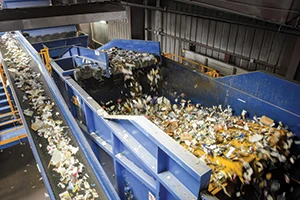
While sustainable technologies such as anaerobic digesters are capturing the limelight in the solid waste industry lately, another sustainable facility, called a mixed material recovery facility (MRF), is playing a workhorse role largely behind the scenes. At the heart of the mixed MRF is a sophisticated, semi-automated system that typically receives municipal mixed solid waste (meaning recyclable and non-recyclable materials, unseparated), which is sorted to separate recyclable material that is then sent offsite to become an ingredient in a new product.
In the US, the history of mixed waste processing began in the 1970s with the advent of refuse-derived fuel (RDF) facilities, and the need to prepare a fuel from solid waste that could be burned in specially designed boilers or with coal as supplemental fuel. Although some experiences were problematic, the variety of mixed waste, then heavy on steel and glass, was not ideally compatible with the machinery and led to excessive downtime. The lessons learned were key in evolving the technology and high reliability machines of today.
In the late ’80s and early ’90s another generation of mixed MRFs came online in response to accelerated municipal recycling goals. Since then, some of these facilities have been upgraded with newer technology to meet the ever increasing demand of higher capture rates of recyclable commodities and, more recently, the capturing of organics (i.e., food scraps). Although the highly automated systems in these facilities have proven over the last 15–20 years to do what they were designed to do—separate complex material mixtures accurately and efficiently—and have done it well, some facilities have had problems.
This article will provide a brief overview of the equipment in a mixed MRF, which communities have adopted these technologies, and commentary on key performance aspects.
Mixed MRF Processing Technologies
A mixed MRF is typically an aggregation of specific purpose machinery designed and situated to work in a sequential manner. The processes usually are integral with some manual labor, to segregate and sort mixtures of different materials as they flow through a facility into multiple, specific material streams, which include the desirable material streams and the undesirable (the residue or “contaminant”) streams(s). Contaminants could include, but not be limited to, common items such as drywall, rocks, dirt, rubber products, food waste (unless organics are being separated), and many other materials.
Although food waste are increasingly targeted for separation and reuse, they may be considered contaminants when, for example, they come in contact and soil what may otherwise be clean fiber materials, or even plastics. Mixed MRFs are not specifically equipped or designed to “clean” materials, in the sense that they do not, unlike a home washing machine, remove dirt or food residue from materials that were originally clean. Some of the more common pieces of machinery used in a mixed MRF are briefly discussed in the following paragraphs.
The demand for higher diversion rates from the landfill in many states, the need to maximize revenue from recyclable materials, and the increasing cost of labor has driven the development of highly specialized pieces of sorting equipment that are found in the newest mixed MRFs. Although the need for some manual labor is still there, these specialized pieces of equipment actually make the manual separation part of the process more efficient by performing one or more preseparation activities before the material flows gets to the manual picking stations.
For example, three dimensional plastic containers and fiber containers because of their bulk can obscure smaller plastic or fiber items so the smaller items are removed with an automated machine, which allows the downstream manual sorters to focus on the larger items. The result is that valuable materials that may have been covered over in the flow and either not seen or too difficult to retrieve are now visible to the sorter and can easily be removed from the flow. Some older MRFs that have been retrofitted with some of the specialized pieces of equipment have experienced dramatic increases in volume of captured recyclable materials, previously left as residue for landfilling.
No reasonable technology exists for a mixed MRF that the authors know of that can distinguish a clean plastic container from a soiled one, or clean paper from soiled paper. If these materials come in dirty or are inadvertently mixed with other dirty materials in the MRF, they will likely exit the facility in a similar condition. Because of the sorting action as a material moves through a highly mechanized MRF, some plastics for example, may emerge somewhat cleaner, but nevertheless still be soiled.
Some pieces of equipment, such as bag breakers, trommels, and eddy current sorters have evolved and continue to be utilized in mixed MRFs today. However, the advances in the application of air classification and optical sorting technologies have been especially useful considering the many types of plastics in the wastestream to be sorted, some of which, but not all, are currently recycled. These are discussed further below.
Disc Screens. A disc screen is essentially composed of multiple rows of
To continue reading the full article check out the May edition of MSW Management. Please click here. You may need to log-in or subscribe to our magazine.
Latest from Waste Today
- Vermeer announces plan to build new facility in Des Moines metro area
- Buffalo Biodiesel shares updates on Part 360 application to DEC, Tonawanda facility progress
- Capstar Disposal expands roll off dumpster rental services
- Supreme Court strikes down IEEPA tariffs
- Casella details facility closures, expansion efforts
- Zero harm: Building a SIF prevention program for waste and recycling operations
- Casella posts a loss in Q4 2025
- McNeilus names Haaker Equipment first Dealer Partner of the Year