Waste is inevitable in any construction or development project. Whether it’s clearing and grubbing, new construction and building, improvements to infrastructure, or demolition, waste is the deliberate or indirect result of these operations. Clearing and grubbing operations produce large quantities of a homogenous waste (a.k.a. green waste). Construction operations generate relatively small quantities of a heterogeneous waste as leftovers from the construction effort. Infrastructure improvement operations can result in a wide range of quantities and debris types. Demolition operations produce large quantities of heterogeneous waste.
Green waste from clearing and grubbing can be easily and almost exclusively handled by machinery. The residual materials left over from construction have to be handled almost completely by manual labor. Large infrastructure projects result in waste that can be handled by equipment, manually, or both, depending on the kind of project. Demolition debris should at least initially be processed manually. But, in all cases, the resultant waste debris needs to be mechanically processed to reduce the sizes of individual waste objects to something more manual, in order to be easily processed for recycling or simply disposed of in a landfill. This size reduction is performed by grinders and other material reduction and sorting machinery. As such, they are, in principal, no different than the grindstones used since the start of civilization to grind wheat into flour and separate the edible wheat from the useless chaff.
The main sources of construction and demolition debris (C&DD) materials are straightforward demolition jobs, and the site clearing and grubbing performed prior to actual construction. The first removes the works of man; the second clears away the handiwork of nature. Only certain types of machinery are suitable for processing these waste materials. The questions are: which ones are best suited, and how are they chosen for these tasks?
For something as apparently low tech as the grinding and shredding of solid objects, technological advances continue, improving productivity while reducing costs. As such, an operator needs to keep on top of these advances to squeeze out every possible cost advantage and time savings. The operator will also have to be aware of issues and potential problems involving grinder operations resulting from standard wear and tear or posed by unique materials, and how to overcome them. So, the operator should look for certain features that will provide that edge. And, lastly, grinding operations should be done with an eye towards either efficient recycling of the processed materials, or their easy disposal. So, an operation geared towards recycling will need certain specific tools and features.
What Is C&DD?
C&DD are those leftover materials that were ordered in excess of estimated construction material needs, natural woody and vegetative materials removed from a construction site as part of clearing and grubbing operations, or (more commonly) the bulk materials that were created by the act of tearing down and demolishing existing structures. From these various descriptions, it is easy to see why C&DD is such a highly variable material. All states regulate the management and disposal of it. Some states, such as Florida, have a definition that also incorporates a description of how heterogeneous this material can be.
‘Construction and demolition debris’ means discarded materials generally considered to be not water soluble and non-hazardous in nature, including but not limited to steel, glass, brick, concrete, asphalt material, pipe, gypsum wallboard, and lumber, from the construction or destruction of a structure as part of a construction or demolition project or from the renovation of a structure, including such debris from construction of structures at a site remote from the construction or demolition project site. The term includes rocks, soils, tree remains, trees, and other vegetative matter which normally results from land clearing or land development operations for a construction project; clean cardboard, paper, plastic, wood, and metal scraps from a construction project…
(Florida Department of Environmental Protection).
Demolition projects generate approximately 65 million tons of debris each year. This is nearly half (48%) of all of the C&DD produced in the US (135 million tons). Renovations and upgrades generate about 60 million tons of debris (44% of the total amount). Lastly, new construction produces about 11 million tons of debris annually (8%).
Even simple demolition projects produce a complicated variety of materials. Something as simple as tearing up a reinforced concrete pavement roadway in preparation for new pavement construction would produce piles of broken concrete, steel rebar, and aggregate. Residential and commercial buildings produce an even wider variety of material types when demolished (decorative facades and molding, glass window panes, aluminum and wooden wall studs, asphalt or tile roofing material, pre-cast concrete forms and cast in place concrete, copper electrical wire and plastic piping, aluminum ductwork, carpeting and floor tiles, etc.). While it is possible to organize these material types into a simpler set of categories, this would make the processing of C&DD no less complex. Metal, for example, can include items as different as plumbing fixtures, HVAC ductwork, wall studs, and cabinet hardware. Similarly, wood, plastics, stone, cement, etc., contain completely different types of debris.
This diversity complicates recycling and reuse efforts. Yet, given the vast amount of materials generated by demolitions and construction, most recycling efforts would still be justified. The potential for recycling any of these materials depends on both economic factors (strong market demand for the materials, transportation costs, and avoiding the costs of landfill disposal), and technical capabilities (the necessary equipment and proper facilities to separate and stockpile the materials). Chief among these technical requirements is the machinery that can grind down C&DD and reduce it to a more manageable size for easier processing and transport.
Processing Construction and Demolition Debris
There are basically two types of recycling methods: source separation and commingled. Source separation occurs onsite by the demolition personnel. After being separated onsite, the material can be further processed and shipped offsite as separate loads. Commingled recycling has the debris hauled offsite in bulk for later processing and separation. Once it arrives at an MRF, the C&DD can then be processed and separated. In all cases, size reduction is an essential part of the process. C&DD objects tend to be as large as girder, doorframes, staircases, or other large building features. Therefore, source separation and onsite processing tends to be less expensive and more efficient than commingled recycling of bulk demolition debris offsite, if only for the transportation costs. Each type of material has its own method of size reduction:
- Concrete demolition requires specialized equipment, such as pulverizers. These are attachments to long-armed equipment, such as excavators, that bite through concrete and the reinforcing steel within the concrete. Standard wrecking balls and vibratory drill attachments are also used in the demolition of reinforced concrete structures.
- The chunks of concrete created by initial demolition are further processed by portable crushers. The crushing process dislodges the rebar embedded in the concrete. Once freed from the encasing concrete, the steel rebar can be removed with overhead magnets working in conjunction with the crusher unit.
- The last stage in processing the broken up concrete generated by demolition involves passing the particles through a screener and sorter. These machines then separate the concrete into stockpiles of uniformly sized materials (ranging from boulders and cobbles, to aggregate or pebbles).
- The steel that is removed from the reinforced concrete (as well as any other structural steel in the building being demolished) is processed separately. Steel is reduced in size by steel cutters that chop up the steel. These cutters actually resemble large scissors. The force generated through their cutting edges is designed to shear through rebar, plate, and structural steel.
- Bricks are typically removed from a demolished structure with a “brick picker.” This is an attachment to long-armed equipment with a sharp point for puncturing through a brick wall and knocking off individual bricks, as well as hooks that can catch the edge of a wall and pull off bricks with a reverse movement of the equipment arm. Brick, tile, and other masonry are typically handled manually, with labor being used to sort and stack the bricks onto pallets for shipping offsite. Final cleaning of the bricks is also usually done by hand with residual mortar being chipped off prior to stacking, palletizing, and shipping.
- Manual labor is also used almost exclusively for the removal and recycling of expensive specialty items such as statuary and friezes, mosaics, and other artistic presentations, marble or stone fountains and facades, stained glass, etc. Having high market resale value, these items justify the use of expensive (even skilled) labor.
Processing Green Waste From Clearing and Grubbing Operations
Processing and recycling green waste is different than construction and demolition debris. While construction and demolition produces a wide variety of different kinds of waste, green waste tends to be relatively uniform mix of grassy and woody vegetation. Production rates also differ between the two. Construction and demolition can often be a relatively slow and methodical process, producing relatively small quantities of materials per unit of time. Clearing and grubbing, on the other hand, is usually completed and generating large amounts of bulk material in a short period of time. Construction and demolition usually occur within a confined space, such as the limited property tract of an urban building. Clearing and grubbing usually happens on open undeveloped areas with extensive elbowroom for the deploy equipment. As such, it is more practical to utilize large-scale machinery to process green waste than C&DD.
Given the large volume and relatively small density of loose piles of green waste, hauling it offsite for disposal without processing can be prohibitively expensive. To avoid these costs, green waste is processed onsite by tub grinders, wood chippers, and portable screening units. Using this equipment can result in a much denser material that is less expensive to transport offsite.
Alternatively, the resultant mulch can instead be reutilized onsite, avoiding the hauling and disposal costs altogether. The resultant mulch or wood chips can be used for environmental (promoting plant growth) and aesthetic (landscaping) purposes. The processed material can be stockpiled and later used onsite or shipped offsite. Once reduced to small particles, green waste has much overall density and is easier to handle. This makes it economical to load it into trucks for hauling offsite. So, it makes financial sense to haul onsite the green waste processing equipment to mulch the green waste into usable and easily transportable particle sizes.
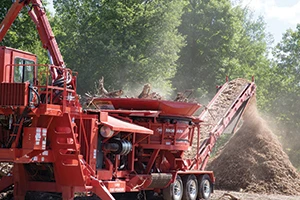
Green waste grinding equipment includes tub grinders, which are the preferred means of processing and reducing large sizes and bulk quantities of green waste, as well as wood waste from construction and demolition operations. Given the nature of their work, tub grinders are very large. In fact, they are the largest machines used to process green waste. They are large and powerful enough to process even extremely large tree trunks or other wooden material having dimensions as large as 8 feet. They can handle these large objects because of the high horsepower of their engines and the use of carbide-tipped flail hammers that pulverize wood rather than cut it, grinding wood and vegetation rather than slicing it.
Wood chippers are the next smaller size of green waste processing equipment. Together with tub grinders they process most of the green waste generated by clearing and grubbing operations. Though not as large and powerful as tub grinders, they provide operational flexibility and deal with smaller objects such as bushes, small trees, and large branches. An ideal work site configuration would see a ratio of one tub grinder for every three to four wood chippers. Higher overall productivity rates can be achieved with a tub grinder managing large trees, stumps, and logs with a wood chipper processing smaller objects.
Screeners process the material generated by tub grinders and wood chippers. The material they generate can vary in size depending on the operational settings and the type of material being processed. Screening can be performed both before and after material processing. Preprocessing screening is performed to remove small and abrasive objects such as dirt, sand, and rock that could damage or cause unnecessary wear and tear to the tub grinders and wood chippers. One of the most important steps in construction and demolition material grinding is having some type of sorting process prior to grinding. Having a sorted product go into the grinder will help maximize productivity and help reduce damage caused by metal contaminants entering the machine. Sorting the material could range from a hand-pick sorting line, to having disc or deck screens separating material.
Most screeners are designed to work as direct attachments to grinders and chippers and are as easily portable as the primary processing equipment. Screeners use both vibration and a variable-sized screen opening. To accomplish size separation, these screens are often stacked together to allow for separation of different sizes in sequence from the pass through materials flows. The vibration speeds the removal of small objects and breaks down large clumps of objects to make them more manageable. The biggest grinding problem an operator can have is the grinder being down due to the machine not able to handle the material being put through it; that is, the material is contaminated. Working with a manufacturer or dealer that sells more than just high-speed grinders or just high-torque shredders gives the operator more options. In addition to pre-screening, an operator should make sure the equipment that has been selected has built-in safety systems to reduce damage and downtime.
How Grinders and Chippers Work
But it is the grinder that is the primary piece of equipment needed to process green waste and C&DD. An operator needs to determine what their incoming material mix and material volume will be, as well as estimate what their daily volume needs will be. The material mix and the daily volume will assist in determining the style of grinder they may need, as well as the size of equipment needed to stay ahead of the incoming material flow.
Operationally different makes and models of grinders are distinguished by nine different characteristics:
Power (measured in horsepower) is the power at the point of grinding application not necessarily the power generated by the grinder’s motor. Available power determines the maximum allowable size of the objects that can be fed into the grinder without posing a safety or operational issue. The available horsepower is further divided into the amount of horsepower applied to each of a grinder’s flails, hammers, or blades.
Production Rate (measured in tons or cubic yards per hour) limits the allowable material feed rate into the grinder. However, production rates are not fixed. They can vary with the type of material being fed into the grinder. For example, a grinder processing hardwood tree stumps or logs will typically have approximately half of the production rate as when it is processing yard vegetation, bushes, and brush. It would also tend to have one-third of the production rate, compared to brush and vegetation when processing pallets or C&DD. An integrated control system to allow automatic feed rate speed control improves efficiency. The cost, quality, and longevity of the replacement and wear parts will have a great effect on long-term cost savings.
“Transportability” (measured by time to haul, plus time to set up) with all grinders and chippers is being transportable to some degree, depending on the difficulty and steepness of local terrain and the available transport vehicles. As would be expected, larger units are more difficult to transport than smaller ones, hence the operational flexibility provided by smaller chipper compared to larger tub grinders. Those less flexible than smaller units, large tub grinders can more than make up for in productivity what they lack in mobility.
A Vermeer TR620 in action
Weight (measured in tons) is the characteristic that best summarizes a grinders capabilities and classification since this weight includes the weight of its motor, size of blades, size of opening as determined by its overall size, etc. A small tub grinder is rated at 15 to 20 tons. Large grinders weigh in at 50 to 60 tons. These extremely large grinders tend to be fixed-processing units located offsite, with it being more practical to have debris being sent to them for processing rather than hauling them out to the work site.
Material Feed Opening Size (measured in feet of diameter or square inches of area) limits the maximum size of any object that can be fed into the grinder. Smaller units have openings between 2 and 3 feet in diameter, and larger units have openings ranging from 3 to 5 feet.
Discharge (measured in cubic yards or tons per hour) is the end result of input. Since there’s a lag time between the initial feeding and processing of waste materials, discharge rates tend to lag behind input rates as well. The ejection and collection of the processed materials is usually performed by augur feeds discharging onto conveyor belts, which move the materials either directly to adjacent stockpiles, or into screeners for additional sorting and separation. The conveyor belts are sized to manage anticipated discharge rates with belt widths ranging from 2 to 5 feet.
Tub Diameter (measured in feet) determines the volume of material that can be processed simultaneously by the blades, hammers, and flails spinning within the tub itself. Indirectly, the tub diameter can also allow for the addition of increased numbers of blades, compared to smaller-diameter tubs. For example, an 8.5-foot-diameter tub would feed a hammer mill of 4-foot diameter operating 20 hammers, whereas a 14-foot-diameter tub would feed a hammer mill of 5-foot diameter operating 26 hammers.
Drive Trains and Protections (indirectly determined by applied horsepower) describes the drive train connecting the engine with the spinning blades and hammers. The drive train also runs the augur feeds, and conveyor belts. It includes limiters, breakaway, and coolant system design to protect the drive train from sudden damage or extended wear and tear. Other protections are provided by extras such as lock packages, tool kits, air compressors, radial stacking conveyors, fuel transfer pumps, and auxiliary power units.
Morbark HT1042 Slow-Speed Shredder
Torque is an important issue for grinder performance. Highly contaminated material would require a slow-speed high-torque shredder to process. Material with lighter contamination or tramp metal contamination can be run through a high-speed horizontal or tub grinder. Torque also plays an important part in grinder acquisition decisions. For example, in onsite demolition or non-sorted demolition, an operator would want to consider a high-torque shredder. If material is mostly construction debris and/or picked/sorted wood debris, the operator can consider using a horizontal or tub grinder, especially if end product needs are for fuel or mulch.
The main difference between chippers and grinders (other than size and production rates) is that chippers use knives to cut material instead of using hammers to grind it. Made from heat-treated steel alloy, these knives are attached to rotors and set within the processing tub with finished dimensions within a 1/1,000-inch tolerance. Typically driven by v-belt drives, which provide optimum speed and eliminate the threat of damage due to misalignment and sudden stoppage, the rotors are set in ball-bearing housings that provide protection against dust and debris intrusion. Lubrication features are cooled with recirculating coolant systems, though some are air or water cooled. Water cooling is an effective means of minimizing temperature stress in the knives, with water recirculating through the hollow doors of the cutting chamber and internal passages in the sidewalls under the knife seats.
Discharge ports are also subject to wear and tear, and need protection as well. This protection is provided by granulator discharge grates (metal plates drilled with holes that have been appropriately
sized for the job), which receive the force of impact and are made from wear-resistant, heat-treated alloy (similar to the knives). Damage to the machine or wornout wear parts are two common causes of issues with grinding. Staying on top of maintenance is one of the most important steps to overcome this
Latest from Waste Today
- Vecoplan to present modular solutions at IFAT 2026
- Terex Ecotec appoints Bradley Equipment as Texas distributor
- My Green Michigan expands depackaging capacity
- Washington selects Circular Action Alliance as PRO
- Ten-8 Industrial opens new central Florida service center
- Triumvirate Environmental acquires Environmental Waste Minimization
- Official NYC Bin availability expands ahead of deadline
- US Food Waste Pact’s 2025 Impact Report shows decrease in food waste