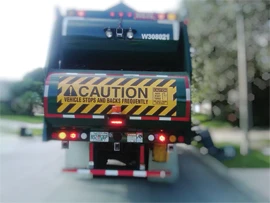
According to the USDOT Federal Highway Administration, the average driver-age 35-55-drives over 15,000 miles per year, forward…and less than 1 mile in reverse. But 1 out of 4 accidents occurs when backing. Do the math: Mile for mile, backing poses 5,000 times more risk of an accident.
Commercial Driving
Garbage truck drivers log even more miles per year-an estimated 25,000-although there is wide variability due to route layout and distance to landfill or transfer station, etc. And these drivers also do far more backing than the average individual (non-commercial) driver. So what does this mean in regard to safety? It means we’d better be looking for better ways to back safely.
Because of the increased risk associated with backing, the entire transportation industry-including the waste industry-has focused a lot of effort on minimizing the risk associated with backing. And while there are many details, the solution for backing really boils down to two steps.
Step 1-Don’t back up.
This is sounds simple…too simple, but if followed, most backing accidents would be avoided. Step 1 is based on the same story line of the patient who went to his doctor and said, “Hey Doc, it hurts when I do this,” to which the doctor replied, “Then…don’t do that.”
By a bit of preplanning in the way a driver approaches a stop, backing up can often be avoided-or minimized.
Step 2-Don’t back if you can’t see.
Step 2 is common sense, too seldom applied. It’s obvious: Drivers don’t back into things they can see…only into things they can’t see. So if you don’t back when you can’t see, there is slim chance of backing into anything. You do this by using a spotter, a rear-view camera, or sensors designed to warn of people or obstructions in the vehicle’s path.
One very innovative product of this type is manufactured by Global Sensor Systems Inc. Using infrared sensors, a system from Global can detect any object (person, car, etc.) in the path of the backing truck. If an object is detected, the driver is alerted by an audio alarm and a warning light.
But the technology doesn’t stop there-or rather it can stop there-because it can be integrated into the truck’s braking system. With the Global Sensor System Inc. automatic braking option, the brakes will be applied whenever the truck is in reverse and an object is detected within the protected area.
Creative solutions like these are meant to enhance the traditional safety procedures that drivers have used for decades.
The National Institute for Occupational Safety and Health (NIOSH) offers guidelines for safe backing. These guidelines for drivers were developed by the National Solid Wastes Management Association (NSWMA) in 1988.
Before backing, drivers should
- turn on the hazard lights,
- roll down the window,
- turn off all audio distractions…except for two-way radios,
- make sure no one is riding on the steps, and
- visually locate workers on foot to make sure they are clear.
When backing, drivers should
- stop immediately if visual contact with all workers on foot is lost,
- resume backing only when visual contact is regained,
- use a spotter, and
- use standard hand signals to communicate with the spotter.
In addition to these NSWMA guidelines, drivers should observe the following:
- Continuously scan all mirrors while backing.
- When backing can’t be avoided, try to back in upon arrival, rather than backing out later while departing.
- If you leave your vehicle, do a walk-around check before re-entering and backing out.
- Back slowly…and listen.
These guidelines for safe backing are obvious…and relatively easy to implement. So why do we continue to have backing accidents? Because we still allow some factors in the normal workday to trump these simple safety rules.
Work Pressure
There is an inherent pressure in the waste industry-as in all industries-to get more work done in less time. More stops in fewer hours…route optimization…just-in-time scheduling…it’s all part of the pressure on private and municipal haulers to offer the same great service with operating budgets that continue to shrink. This is not some evil conspiracy that seeks to displace safety with efficiency. It’s an on-the-job reality that must be integrated with safe work practices. The bottom line is: Do more for less…safely.
Distraction
For all of the hype about modern technology making our life easier, sometimes I wonder. More and more people have smart phones, but as our devices get smarter, it sometimes causes us to move in the other direction. With that little device-which isn’t much larger than a deck of cards-you can call, talk, chat, text, and e-mail. It will track the weather, local traffic, your calendar, and your expense account. With the right app, you can scan the news, the stock market, local restaurant reviews, or a bar code on a box of crackers.
When I was just learning to drive, my dad told me-more than once-“Every time your eyes leave the road, you’re looking for trouble.” This was good advice 40 years ago, but it’s even more applicable today.
According to information released by the US Department of Transportation, 18% of all injury crashes in 2010 were related to driver distraction. In that same year, over 3,000 people were killed-and more than 400,000 injured-in crashes involving a distracted driver.
Sending or receiving a text message takes a driver’s eyes off the road for more than four seconds, during which time his or her vehicle may travel hundreds of feet…blind. This is why texting while driving increases the risk of an accident by a factor of 23 times.
Whether driving or backing, a distracted driver is an unsafe driver.
But it’s not the technology itself that’s unsafe…it’s just how-and when-we use it.
There continue to be advancements in technology to minimize the risk of backing. For example, consider a new camera developed by Intec Video Systems Inc. Intec’s model CVC500AHXL has all of the features you’d expect from a top-of-the-line rear-view camera, including bright color display, waterproof camera housing, microphone (so the driver can also hear what’s behind the vehicle), wide field of view, and military spec connectors. This new model also has a built-in thermostatically controlled heater…to keep ice and snow from accumulating on the camera.
A savvy driver will stay focused on safety while working to maximize productivity, and to that end will also utilize technology wherever possible to make it happen. Technology, when applied wisely, can greatly reduce the risks associated with driving…and backing.
Latest from Waste Today
- Worn Again Technologies unveils Accelerator plant to advance polycotton recycling
- Nashville Waste Services launches new digital route system
- ACUA landfill expansion project unanimously approved
- Clean Energy announces multiple RNG deals with fleets nationwide
- Interchange 360 to operate alternative collection program under Washington’s RRA
- Waste Pro files brief supporting pause of FMCSA CDL eligibility rule
- New Way Trucks expands US network with Joe Johnson Equipment
- Tire Industry Project publishes end-of-life tire management guide