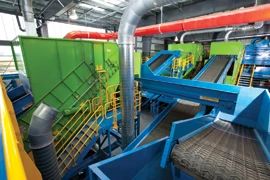
MRFs will most likely continue to change, grow, and take advantage of exciting new technology in addition to being quite tuned in to product and economic shifts as the tide of materials thrown away rises and falls. Some MRFs related that the tonnages of materials being processed at their facilities are steadily rising, for the most part.
Expansion Means Higher Volumes
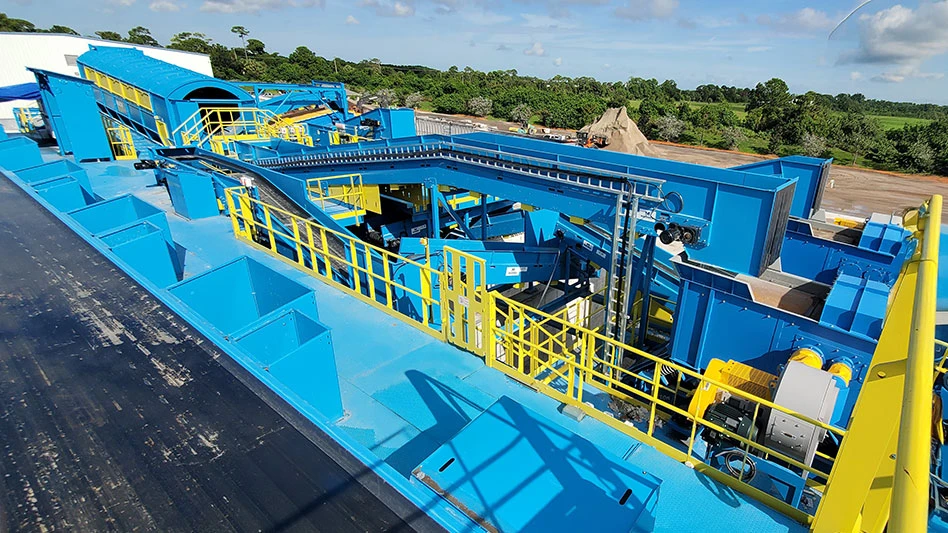
Lee County, FL’s MRF complex is just above the town of Naples, some two hours south of Tampa, FL. Recently, the facility did a conversion involving a building expansion and a conversion to single-stream. Its equipment is manufactured by CP Manufacturing Inc.
The complex has a metering drum on the infeed, a scalping screen, glass breakers, three CP newspaper screens, a three-deck old corrugated cardboard (OCC) screen, several three-deck ONP screens, and various glass breakers and air-drum separators. One of the HRB balers is dedicated to fibers, the other to bottles and cans. The MRF has one MSS Aladdin optical sorter used for polyethylene ester terephthalate (PETE) plastic.
The facility is happy with the new installation by CP, according Joe Lewandowski, plant manager for ReCommunity, the company the county contracts with to run its MRF operations. “At this point we are looking into enhancing our glass cleanup system. We’re not sure exactly what we’ll do there yet-perhaps add some type of screens for sizing and cleanup. Whenever you go through something like this, you go, “˜Oh, we should have done this or should have done that,’ but we’re quite happy with the CP equipment we have here. We do all the maintenance ourselves and CP has been very responsive to us. They’re out in California, and we’re here in Florida, but if we need to, we can get hold of someone 24 hours a day, and they can try to talk us through a problem if we have something we’re not too up on.” (Other than programming the variable frequency drive user, which they can do online, they’ve not had to have CP Manufacturing help them out, though they are always available.)
This MRF processes approximately 60,000 tons of material per year. “The amounts of processed materials, of course, are always up and down,” adds Lewandowski. “It was going up until the downturn in the economy hit. But with the single-stream recently implemented, it’s come back up.”
They are tracking about an 18% increase in volume over last year, which they are pretty happy about. The county put out 64-gallon carts so that people can throw out all their recyclables in one container now rather than having smaller 15-gallon toters. With bigger containers now, Lewandowski believes people are throwing more recyclables in there.
“We have a really good crew here working with us,” adds Lewandowski. “We also have an excellent relationship with the county. Lee County itself is very innovative in what they do and they are quite forward-thinking.” The county operates the scales at the solid waste compound. It has a waste energy plant, transfer station, and mulching operation, and it is also getting ready to start up a C&D operation that’s in place and built. Machinex equipment is being used for that operation. All of the different operations happen on a 500-600-acre piece of property.
The county added about 10,000 square feet to the existing recycling operation for trucks to back in and dump recyclables. As with many other MRF operations, it has a tip floor, with recycling trucks coming in to dump, newspaper handling, mixed paper, and old corrugated containers. “We work closely with the county to run the MRF,” says Lewandowski. “The county always has new plans to do more things. Right now they’re doing composting and have their own landfill offsite.”
“The main thing I’d like people to know about us is that recycling does pay,” adds Lewandowski. “It makes sense for us, the county, and the environment to try to save as many resources as we can rather than dumping them in a landfill or burning them in an incinerator.
ReCommunity has a central marketing group at their offices in Charlotte, NC, who are responsible for the marketing and movement of all their products. “What we do best here is to produce a quality product that our vendors want,” explains Lewandowski. “For example, here at Lee County we’re known for our clean No. 8 ONP, plastics and aluminum. Our folks take a great deal of pride in shipping out a clean product. We also pride ourselves on the cleanliness of our facility and on the whole Lee County operation. We have an excellent solid waste campus, where we try to take care of the county’s needs. I believe a system like we have here with most operations centrally located makes sense and works well.”
New Center Shows Tremendous Growth
Recycling Disposal Solutions, of Roanoke, VA, is a MRF specializing in marketing and brokerage of paper. It accepts all paper products, including corrugated cardboard, but also takes plastics, aluminum, tin, and glass. Mike Felker, general manager, explains that the quantity of the amount of materials they process has grown substantially since operations started in February of 2010. “We’ve grown by roughly 80% since then,” says Felker.
The company has been around for a decade, with main offices in Virginia Beach and a recycling facility in Norfolk, VA, but it is new to the Roanoke area. The facility has four employees, including a plant manager. The operation is looking to add a salesperson and another operator before the end of 2011.
Felker feels growth has come because the company is able to do some of the things the other recyclers in the area are unable to do. “We’re a one-stop location for most of the folks,” says Felker. “We’re a full recycling center, and I believe we do a pretty good job of servicing our customers with a lot of experience behind us.”
The facility does dual-stream separation. It is in the process of installing a reconditioned Bollegraaf Recycling Solutions sort line in combination with a new Daveco conveyor system. This will be able to be converted into single-stream. But when it’s set up, initially, it will be set up to do dual-stream.
When asked about challenges, Felker says, “Everybody wants to go to that zero-waste goal, but it takes a great effort to get there. Most things are recyclable, but you don’t always have the space or the ability to recycle everything.
“One example I can point to is that of the I-grade plastics: Generally, you are dealing with four or five different types of plastics, but as a whole there are hundreds of different types of plastics. A lot of times you can’t recycle a lot of the material in there, basically because there is not a market for it or it’s a product that’s very difficult to recycle or process at a recycling facility.”
Yogurt cups, termed a No. 5 plastic, are an example of one product that is not really marketable. It becomes a waste product for the Recycling Disposal Solutions MRF. “There are some plastics that are just very difficult to find homes for,” says Felker. “People want to take the easiest route and throw everything in the bin and just not have to deal with it.”
The company has a Van Dyk Baler for baling cardboard and a certified scale at the facility in Roanoke. Truckers utilizing the Avery Weigh-Tronics scale know that it’s calibrated correctly by a third party that comes in and checks the scales on a quarterly basis. “This is done to make sure everything’s in shape and that they are working properly,” says Felker. “There is also a place in our 50,000-square-foot facility where our customers drop material off with a tipping floor. Most of the trucks that dump here are not the big transfer trailer trucks but garbage and recycling trucks.”
Keeping Glass out of the Mix
Dale Gubbels works as chief executive officer for Firstar Fiber, Omaha, NE, which has two MRFs in Nebraska-in Lincoln and in Omaha-each of which started up in 1998. Now they service virtually the entire Omaha metropolitan area. In 2004, Firstar won the city of Omaha contract to process commingled materials. Omaha was the first city in the state to offer commingled collection of recyclables.
“Single-stream implies that it includes the paper as well as the containers,” says Gubbels. “I can’t say that we were the first; Nebraska was kind of late in coming to it. If Omaha did anything a bit out of the norm for the time, it was to not include glass in the mix when they put out the request for proposals. We were very pleased that they did that, because it made our bid a more valuable bid; we would have had to have gone in with a much lower bid had it included glass, because glass is such a problematic material for single-stream MRFs to deal with.”
It is part of the company’s contract that, since glass is not collected at the curb, it had to make arrangements to provide four drop-off facilities throughout the city that could accept glass. The glass is being used for road-building materials and at least being kept from contaminating both it and the other materials when it gets commingled with the other recyclables. “Because there isn’t glass in it, we pride ourselves with supplying the mills with quality materials,” says Gubbels.
With some 100 employees, the center runs 24 hours a day, five days a week. The entire building is about 350,000 square feet, but only two-thirds of that space is actually used.
“We view our operations as having customers on the supply side as well as on the demand side. This makes recycling in general a little different than at the typical company, because you have to treat your suppliers and your end markets with the same total respect as your customers. This keeps us on our toes, because their respective interests aren’t always the same.”
Generators or suppliers, according to Gubbels, just want the materials to go away. But the end markets want high-quality material, so if you are a supplier and the municipality or business treats the material as waste, which can create a problem.
“You can’t send it to a mill and expect them to be satisfied with the concept that they’ve thrown anything and everything into their container,” adds Gubbels. “We are the middleman, basically trying to keep everyone happy at the end of the day. The majority of MRF operators understand that concept; a lot has to do with where a MRF is located in the country, too.”
Firstar has to be more sensitive to these issues than perhaps a coastal area does, as coastal areas can rely on export markets more readily than Firstar’s MRFs can. If the mill is a customer overseas, other MRFs may not be as concerned about quality, because there will not be that face-to-face conversation with the customer at some point. “By necessity, we have to be very cognizant of pleasing the mills and their expectations,” says Gubbels.
Firstar uses a BHS screening system, an American Baler, and a two-ram Excel Baler. It outsources any live-floor needs to a local trucking firm to bring in material. The MRF also uses eddy currents and magnets to pull out the metals. The majority of the plastic sort is manually done. Though the economy has affected other industries in a variety of ways, Gubbels adds, “things have really rebounded for us since 2009 quite well.”
Catching the Wave of the Recycling Culture
Canada Fibers has its head offices in Toronto, ON, Canada’s largest city. The company is a 100% processor of recyclables, with a combination of residential and municipal materials from a broader range of sources, according to Jake Westerhof, vice president of operations. It runs six recycling centers in the province of Ontario. Four of the facilities are operated under contract to municipalities for the processing of blue-box materials, and the other two facilities are “merchant capacity” plants recovering recyclables from a broad range of sources.
Canada Fibers is a growing company, especially in the last 10 years. Tonnages have increased, and it is currently processing almost 500,000 tons of material per year. The merchant plants process over 100,000 tons each, and the business also runs a couple of 100,000-tons-per-year single-stream MRFs.
“The Toronto Ontario municipal contract is very large for a single-stream MRF. I think our operation is one of the largest in North America,” says Westerhof. They process all plastics, metals, glass, and paper products, including corrugated cardboard and paperboard, which all come in together in a single stream and then, through both mechanical and manual sorting, are made market ready.
Ontario has been recycling for a long time, according to Westerhof. “It’s a very mature program in the province, being well-participated in and ingrained in the population, so there’s been a real drive to divert these materials away from the landfill. There is a broad scope of materials in the recycling program in Ontario, broader than in most places; participation rates are very high, with a lot of material being diverted from disposal in residential programs. This carries on in people’s workplaces, schools, and other institutions, so it becomes a recycling ethic which isn’t just done at home, but people are encouraged to take that attitude with them wherever they go.”
Styrofoam recycling is a challenge because of its light weight and high volume. The company is getting what it can from that. Technology and markets are emerging and developing for that kind of plastic, as with a lot of other plastics, too, according to Westerhof.
In October 2010, Canada Fibers opened a state-of-the-art MRF in Toronto, using equipment
supplied by Bulk Handling Systems. Capable of 25 tons per hour of production, the facility processes single-stream recyclables from Industrial, Commercial & Institutional and residential sources, as well as residue from conventional MRFs and such difficult-to-recycle materials as mixed recyclables from high-density residential dwellings and public spaces.
Disc screens and optical separation technologies maximize the separation and recovery of fiber, plastics, metals, and other high-value commodities from the material stream with an extremely low final residue rate. “The facility is off to a good start, and we have exciting plans for additional processing capacity in 2012,” says Westerhof.
The SMaRT Station
The Sunnyvale Materials Recovery and Transfer (SMaRT) Station is a large-volume materials recovery facility and transfer station located in Sunnyvale, CA, serving the cities of Mountain View, Palo Alto, and Sunnyvale. Its operations include recovery of recyclable materials from the mixed municipal solid waste delivered by franchised collectors and self-haul customers; processing of source-separated recyclable materials collected through programs in the cities of Mountain View and Sunnyvale; processing of yard trimmings and woodwaste for use as compost feedstock and fuel for biomass cogeneration; a drop-off center for the public to bring recyclables and universal wastes banned from landfills (electronics, batteries, fluorescent bulbs, and other items); and transfer of nonrecyclable residue to a regional landfill.
The SMaRT Station is unique in that it processes mixed municipal solid waste and construction-and-demolition waste to divert materials from the landfill, so-called “dirty MRF” residue. They are also a regional facility serving three municipalities. This means the sharing of resources and costs reduces individual cities’ costs. This is a publicly owned facility operated by a private contractor. It also means there is just one facility involved in the processing of mixed waste, yardwaste, and source-separated recyclables.
What the SMarT Station does best is to recover resources (recyclable and compostable) that would otherwise go directly to a landfill. This is a diversion of 35% of incoming materials. A key component in this operation is that it works especially hard to ensure each of these cities exceeds the California mandate of 50% diversion from landfill; these operations are an integral element in the cities’ plans to achieve “zero waste.”
The facility uses a conveyor to move residue up into a compactor, rather than pit-loading, due to high groundwater levels, which make dewatering costly. This also reduces the risk of pulling up-gradient industrial groundwater pollution onto the property.
Their clean curbside processing is dual-stream. Materials are collected in a split-cart keeping paper and containers separated at the source. This, along with sorting by trained staff, ensures a higher quality of recovered materials and better value even in the worst of markets.
Designing a processing system to recover the maximum amount of recyclables from a heterogeneous wastestream while maximizing mechanical separation and reducing the need for manual separation has been challenging. Processing recyclable materials to meet market specifications, such as removal of broken glass from small organics, has also been a challenge.
To take on these hurdles, the SMaRT Station is designed to process a total of 100 tons per hour. The project is not yet closed. The facility uses two 70-foot-by-12-foot rotary classifiers (trommels) equipped with 84 knives to break open bags, as well as screens to separate material into two size fractions: 2 inches minus and 9 inches minus. Two disc screens are employed to further separate materials to 5 inches minus and 2 inches minus. Four electromagnets manufactured by Dings Magnetic Group and two eddy-current separators by Eriez Magnetics mechanically remove ferrous and nonferrous metals.
Their baler is a Harris Gorilla Model 200T, and it is used to bale all fiber, plastic, ferrous, and nonferrous cans. Sort line workers pull fibers (primarily OCC and mixed paper) and do final cleanup to prepare recovered materials for market. The equipment was purchased and installed by Monterey Mechanical Co., with much of the equipment supplied by Krause Manufacturing Inc., including rotary classifiers, conveyors, and disc screens.
The station promotes tours as a way to educate the public on where its garbage goes and how it is sorted and processed for recycling. It also has a virtual tour posted on YouTube: A Day in the Life of Your Garbage and Recyclables.
The closed landfill is open to the public for a variety of recreational activities, such as walking, jogging, bicycling, photographing wildlife, and on-leash dog walking. In collaboration with the local Audubon Society, the city offers free monthly bird-watching tours.
And in order to help keep gulls out of the open facility perimeter, the company installed monofilament wires strung in a grid 20 feet above open areas. Unlike the sorting done at a typical MRF, with all of its advancing technology, trying to keep Mother Nature where she belongs can be a bit more challenging.
Latest from Waste Today
- Vecoplan to present modular solutions at IFAT 2026
- Terex Ecotec appoints Bradley Equipment as Texas distributor
- My Green Michigan expands depackaging capacity
- Washington selects Circular Action Alliance as PRO
- Ten-8 Industrial opens new central Florida service center
- Triumvirate Environmental acquires Environmental Waste Minimization
- Official NYC Bin availability expands ahead of deadline
- US Food Waste Pact’s 2025 Impact Report shows decrease in food waste