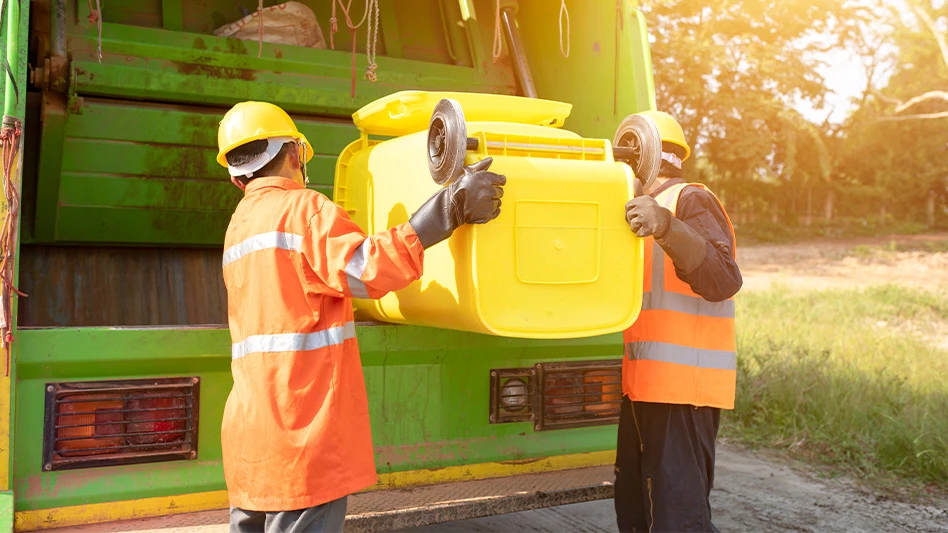
Fort Lauderdale, FL, has now completed its first year with its CNG refuse fleet. The vehicles have performed extremely well, according to Glen Miller, chief executive officer of Choice Environmental Services. The vehicles have required less maintenance than expected. “We’ve been very satisfied. Drivers were nervous when the vehicles were first introduced. These hesitations arose from the switch from diesel to NG, concerns on performance or safety issues, and also simply fear of the unknown.
“But once introduced, they’ve been pleased with their performance. They see no difference in operations except for the fact that diesel fuel odor no longer permeates their clothes, hands, and especially the cab of the truck. The vehicles are very comfortable, resulting in less driver fatigue. I don’t think you could take them away from our drivers if you wanted to.”
Aside from driver satisfaction, Fort Lauderdale is pleased to bring down emissions by dramatically bringing down carbon emissions and noise levels. “I can’t say enough good things about the Cummins Power Unit,” says Miller.
“I researched options for a year, driven mainly by high diesel fuel prices. Autocar suggested CNG to us, and I attended Cummins seminars before my final decision was made. Natural Gas is domestic fuel, is cleaner, and is less expensive. Choice Environmental is proud to be the industry leader for natural gas in the state of Florida. Choice has eight operation centers in central and southern Florida, and we’re looking to expand CNG to other areas of the state.”
Refuse Sector Is Growing Market
The refuse market is one of the fastest-growing segments of the natural-gas vehicle (NGV) business, according to Stephe Yborra, director of the nonprofit Clean Vehicle Education Foundation (CVEF). According to CVEF, there are about 4,000 refuse trucks now using compressed natural gas (CNG) or liquefied natural gas (LNG), a number that has nearly doubled in just the last three years. “All the major refuse truck suppliers now offer natural gas,” says Yborra. “Environment, energy security, and economics drive the trend. While the latest ‘clean diesel’ technologies have reduced soot and nitrogen oxides, natural-gas engines still have the emissions edge there, and they produce 20% to 23% lower greenhouse gases than diesel. Nearly all the natural gas used here comes from North America. Conservative estimates put domestic supply at over 100 years, so we can reduce reliance on foreign oil suppliers, many who don’t particularly like us.”
Repetitive routes, high fuel use and “return-to-base” operations make refuse trucks a great fit for natural gas, according to Yborra. While some use public access stations, most fuel at time-fill or fast-fill stations built onsite. Due to their spark ignition, the 300- to 325-horsepower natural-gas engines used in collection trucks have lower compression ratios.
“This fact results in about a 7% to 10% fuel efficiency differential,” adds Yborra. “However, that’s more than made up for by the fact that the price of NG is typically 30% to 50% lower than diesel. Recent advances in NG engine design have improved low-end torque to be on par with—if not better than—diesel engines. This is especially important for refuse trucks, with their constant stop-and-start duty-cycles.”
For big transfer trucks, which haul loads of 80,000 pounds or more, Kenworth and Peterbilt currently offer trucks powered by the Westport GX, an engine that runs mainly on NG with a small amount of diesel used as the pilot ignition. Based on the Cummins 15L ISX platform, the compression-ignition GX uses HPDI (high-pressure direct injection) technology to achieve 475 horsepower and nearly 1,800 foot-pounds of torque. “The GX is already in use in a number of transfer fleets,” says Yborra.
Simplifying Truck Integration
Of the approximately 4,000 NG collection vehicles, most of them have Cummins Westport engines, according to Jeff Campbell, Cummins Westport director of product marketing. Cummins has had NG engines since the mid-1990s. The Cummins Westport venture was struck in 2002. The company has placed over 25,000 engines into the market globally. The majority of those engines are in North America, running in transit and refuse vehicles.
“The market has changed quite a bit over the last few years,” says Campbell. “The 2010 technology for NG is pretty simple in terms of truck and vehicle integration. Now it has a three-way catalyst muffler so there are no diesel particulate filters [DPFs] or selective catalytic reduction [SCRs] on the system. Those two systems are on the diesel engine, but not on the NG engines. When you package equipment and everything else on the vehicle, not having those two systems helps because we also need to install the CNG tanks on the trucks.
“The body builders are getting into that in a big way, and the tanks seem to be less of an issue. McNeilus, Heil, and others all package fuel systems now, and I think that’s a benefit to the customer, helping to reduce costs.”
New CNG-Burning Engines and Repowers
Jim Cole, cofounder of Emission Solutions Inc., a natural-gas, heavy-duty OEM engine manufacturer in McKinney, TX, manufactures heavy-duty natural-gas (NG) engines from the diesel core of Navistar International Corp.’s MaxxForce DT. In the fourth quarter of 2010, Navistar announced its partnership with ESI to spec the ESI Phoenix NG 7 L (300 horsepower, 860 foot-pounds) at the Navistar facilities. Currently, ESI’s niche market space is in the short-haul distribution fleets (refuse, food/beverage, school buses, utilities, or delivery).
On the Navistar North American Sales website, Jim Hebe, senior vice president, points out that “the utility industry is very conscious about their public-facing environmental image. Recognizing the domestic raw material advantage the United States and Canada share with natural-gas resources, Navistar felt very compelled to invest in our products in such a way that enables our customers to expand their usage of very low emissions technologies through our engines. The use of natural gas certainly accomplishes this, and now ESI and Navistar are partners to install this advanced engine at the Navistar facilities.”
“Somehow many people think when you run a natural-gas engine you lose power,” adds Cole. “You don’t lose power; in fact, you can get better power and/or acceleration because of the 130 octane in NG. What you lose with CNG is energy efficiency, meaning one gas gallon equivalent is not exactly the same as a diesel gas gallon equivalent. However, you can easily make that up on the lower price of the NG.”
Three ways of measuring fuel efficiency, according to Cole, include looking at the number of hours on the meter, number of vehicle miles traveled or simply how much diesel fuel was used that day. “I spec my engines 110% to 120% more CNG than I normally do for a diesel. You just have to understand properties of NG. Over the last eight years or so, the new technology was not apparent to everybody, and subsequently education is one of my chief barriers to sales.”
Overcoming preconceived notions about NG is another challenge. It is not the fuel that was broke, it was the technology. During the big push to go with NG back in the late 1980s, many small firms arose with aftermarket kits that did not have EPA-CARB restrictions on them.
“With the technology available back then, people didn’t know the performance or durability of what they were selling,” says Cole. “It created all kinds of unscheduled downtime because reliability and the service methods were not in place, which cost the owner. With that, many AFV owners sued each other, and that left a bad taste in many people’s mouths and throughout the industry.
“You simply have to consider that fact when you knock on fleet manager’s door and they ask: ‘Why is it any different now than it was back then?’ What’s different now is when I have to certify our NG engine EPA and CARB. This means I’m committed to having a seven- to 10-year activity life on it; it’s got to meet current-year emission mandates for at least five years and performance that same period of time.
“If not, you’re going to pay the federal and/or state piper. It takes an AFV team to position natural gas in a diesel fleet. That is one reason I will never disparage anyone in this business. We’re all trying to do the right thing, and I don’t view others as my competitors but as companies validating my own market space. We need to be on the same wavelength. We all can help each other. You can’t afford to make a mistake in selling NG solutions, because the naysayers are going to be all over it.”
An application that truly separates ESI from most is that customers with older International diesel trucks can upgrade their diesel engine to a brand new model year 2010, EPA/CARB certified new clean burning CNG engine. “This process is called repowering the truck. When we repower International diesel engines with ESI Phoenix NG 7.6 L dedicated CNG engines it is seamless because the ESI Engine is built from the form-fitting functionality; nothing has to be changed out,” explains Cole. “Everything maps identically to the dashboard, the PTO, and transmission.
“The bottom line is ESI develops natural-gas engines to offer the fleet owner low-cost, safe, and predictable-cost fuel; a company recognized as a true environmental steward; engine simplicity and improved return on investment.”
Building Fuel Tanks for CNG
Luxfer Gas Cylinders is the world’s largest manufacturer of high-pressure aluminum and composite cylinders. For the waste industry specifically, its product is a type-three composite CNG cylinder or fuel tank. Luxfer made the decision to get into building fuel tanks for CNG vehicles because it believed this market was going to grow.
The waste industry has been a big and growing industry for the company. Most of the refuse companies, depending on whose body or chassis they get (whether it’s McNeilus, Heil, Bridgeport, or others), will be responsible for installing the fuel system. Where the fuel tank is placed depends on the body-chassis combination.
Luxfer’s tanks consist of an aluminum liner with carbon fiber overwrapping containing an epoxy-resin impregnation. “We test our cylinders extensively to ensure their robustness to meet multiple standards,” says Dave Myers, Luxfer sales manager. Some of the tests we conduct include drop-testing, bullet testing with the tank at full pressure, and bonfire testing to ensure the thermal relief valves work properly. They’re built to a federal motor vehicle safety standard as well as an industry standard that is more stringent than the federal one.”
“The savings from CNG as opposed to diesel add up fast,” says Myers. “It’s a nice linear curve. But the payback on the trucks is fairly short because they’re going to keep the truck some seven or eight years; the incremental cost is paid back in about two years. Things accelerate because they’ve amortized the incremental cost—and they’re still saving that dollar per gallon on fuel.
“When diesel gets back up around $4 to $5 a gallon, it will really make a difference. But I think the growth in the market is due to customers liking the quiet, the cleanliness, and the reduced expense for CNG.
“The infrastructure is growing, but slowly. Places in the US such as Missoula, Montana, would love to do CNG for their refuse trucks, but no fuel is found in the area. They’d willingly install their own stations, but cannot, as no NG pipelines run anywhere close.
“We need to get away from spending billions of dollars each week, importing oil for diesel fuel,” says Myers. “I cringe when I read articles mentioning the offering of incentives for green fuels because there is nothing said about using a domestic fuel here today and able to impact us immediately like CNG.
“What I see is more and more waste haulers planning on more trucks with CNG. They wouldn’t be doing it if it weren’t working for them; those trucks have to be reliable because they pay their own way. Tax credits help them save even more money by offsetting their tax liability. And that just ices the cake.”
How NGVs Are Different
Autocar LLC is going to build close to a thousand NG refuse trucks this year and has been building NG garbage trucks for the last 15 years, according to Tom Vatter, vice president sales and marketing with Autocar Trucks. “Autocar builds more NG refuse vehicles than all the other low-cab-forward OEMs combined,” says Vatter.
Autocar uses Cummins Westport engines that have spark plugs instead of fuel injectors. The ISL G right now is 320 horsepower with 1,000 foot-pounds of torque. This is a little below some of the 11-liter diesels; however, the 11.9-liter Cummins Westport ISXG is going to be coming out in 2012. According to Vatter, it will give the same performance as any 11-liter diesel out there.
The fuel system is different, with more tanks on the trucks needed for the CNG to have the diesel equivalence. A 75-gallon diesel equivalent requires four CNG tanks which can be in different configurations on the truck.
There are different materials that carry the fuel from the tanks to the engine. There is a separator, like a filter between the fuel tank and the engine. It can be likened to a fuel-water separator on a diesel truck. It removes the moisture building up in the line and must be emptied once a day.
Specifications of the engine oil used for CNG engine trucks are different than those for a diesel engine. It’s the same grade as that used in other trucks, but just a different composition, according to Trevor Bridges, Autocar’s vice president powertrain and strategy.
“Another difference is that gas engines require spark plugs. These must be replaced on a more frequent basis than an injector in a diesel powered truck,” says Bridges. “On the upside, there is no DPF cleaning to worry about.”
Packaging and Integration
E-Z Pack manufactures and assembles refuse trucks. When the chassis come in to EZ Pack, it has the Cummins Westport engines installed. EZ Pack buys the CNG system that has the fueling tanks and plumbing, and it installs that and integrates it into the truck bodies. The body is actually no different than a diesel body other than that the tanks must be integrated.
“The trick is packaging,” says Jim Rogers vice president sales and marketing. “You have fairly limited amount of space to package these fuel tanks, which are nearly 6 feet long and fairly big around in diameter. To have a 60-gallon diesel equivalent, you need to have four tanks.
“What we’ve done is to package these up inside the body front wall. A lot of people put them on the top of the body, but we try to keep them off because low-hanging tree limbs can take them off the top. Since the tanks are under 3,500 pounds of pressure, they’re not something you want falling off into the street.”
EZ Pack’s solution is to place two tanks inside the body front wall and two saddle-mounted on the driver’s side. If a customer wants 75 gallons of diesel equivalent CNG, they will integrate five tanks onto the truck body. For 90 gallons of diesel equivalent, they will install six tanks.
“If you make the body too long in an effort to incorporate more tanks, it can make things too difficult in handling turns with the turning radius of the vehicle. On an automated truck, you have about a 210 wheel base, measured from the center point of the front axle to the center point of the two tandems. You’ve got to place the body on it and integrate the fuel system into that space with those tanks. If the wheel base is stretched out too long you can’t turn the truck in cul de sacs. The trick is packaging it in a limited amount of space and not increasing the wheel base, so you can still have a good turning radius and good weight distribution.”
Finding the Right Configuration
In the 1970s, Crane Carrier was one of the first heavy truck companies that produced a Class 8 vehicle with a CNG engine, according to Glenn Pochocki, vice president of sales and marketing. Over the last half dozen years or so there has been a surge of interest in the new CNG vehicles and they’re among the first companies out on the market with the current Cummins ISL G engines. Crane Carrier’s LET2 chassis product, a low entry tilt-cab configuration, has a remotely mounted radiator that sits behind the cab and over the engine.
“It is sized quite generously because of the location, which also allows the cab to sit lower to the ground and provides more open interior space,” says Pochocki. “Because the radiator is behind the cab and not under the cab, there’s less heat that’s transmitted through the cab, giving the operator a more comfortable environment to operate in. We’ve been building that configuration since the mid-80s. The configuration works well for us in accommodating larger cooling systems for the higher heat rejections which the newer engine installations require.”
The lower cab height provides a lower step-in height and reduces the engine cover space claim inside the cab. This in turn provides more space for the driver and the occupant along with easy access and visibility from one side of the vehicle to the other.
“One thing that differentiates us is that we install the engine, the fuel control module [FCM] and the fuel storage tanks,” adds Pochocki. “That improves the integrity of the CNG fuel system, by providing the FCM to manage the pressure from the fuel storage system which is stored at a high pressure [3,000 to 3,600 psi] to a lower delivery pressure at the engine.”
Choices include the company’s behind-the-cab (BTC) system, offering from 30 to 75 gallons diesel gallon equivalent (DGE). The BTC system is basically a fuel cell in a tower formation “behind the cab.” The cabinet used is 96 inches wide, side to side, 24 inches deep from the front to the back, and the height depends on how many cylinders are in it. Enviromech Industries, of Long Beach, CA produces the cabinets for Crane. Each cylinder has a capacity of 15 DGE.
The company offers 15-, 30-, 45-, 60- or 75-gallon DGE systems. The other design Crane offers is a “saddle-mount” system, which is a series of cylinders mounted in one or two cabinets along side the chassis frame rails. This system creates a saddlebag appearance on the outside of the vehicle’s frame.
The saddle-mount is basically a couple of CNG tanks mounted parallel to the frame on the side of the chassis frame with an aluminum-shrouded cover, similar to what might appear on a touring type motorcycle. The capacity available is approximately 30 DGE per system on either side of the truck frame.
“There are various types of CNG cylinders,” adds Pochocki. “We use the Type-3, which has an aluminum liner and is carbon fiber-wrapped.” When a user does a fast fill, the gas is introduced to the system rather quickly under high pressure (3,000 psi or higher), which warms the gas. Typically, the warm gas provides a higher (or false) pressure reading, which shuts the fuel fill off early. The Crane Carrier aluminum liner absorbs the heat and dissipates it, so a more accurate fast fill can be accomplished.
The most accurate fill, according to Pochocki, is from a slow tank fill, when the vehicles are parked overnight, plugged in and filled at a slow pace, shutting off automatically when the proper pressure is reached; the vehicles are left unattended more or less and therefore the operator’s time is not taken to fill the vehicle. The slow-fill method cannot always be used, which is why Crane Carrier’s solution to the downsides of the fast fill is welcomed by the industry.
“Our supplier provides a prepackaged BTC fuel cell system in a saddle system configuration. Similarly, body companies utilize a prepackaged, roof-mounted system, often used on transit buses,” explains Pochocki. “Many times space isn’t available on the frame, and it might not be desirable to locate a system behind the cab for various reasons, including lengthening the wheelbase. When you add a BTC system, you are adding about 24 inches to the length of the wheelbase. For example, if your body installation requires a 200-inch wheelbase, you would have to go to 224 inches to accommodate a BTC system. This is typically acceptable for rearloaders, recycling, and other applications, but not acceptable for frontloading applications.
In a frontloader application the fuel storage is either on the frame or “saddle-mounted.” Overall, the roof-mounted system is more popular. With a roof-mounted system, an operator can actually get more capacity, and it’s less likely there will be any interference of the system with the body installation, the geometry of the arms, or the forks that raise the containers at the front of the cab.
CNG Is Making the Grade
Republic Services has been involved with LNG fuels for several years, and today the company runs about 100 vehicles in California powered by LNG. Republic’s move to CNG is driven primarily by cost and functionality considerations—and a belief that CNG will provide a favorable fuel cost comparison to diesel into the future.
The company uses its CNG-powered collection vehicles in the same applications and in the same manner it would use a diesel-powered collection vehicle. Republic has commercial frontloaders, residential automated sideloaders, residential rearloaders, and early in 2011, will add its first rolloff trucks powered by CNG.
“Our drivers love the trucks,” says Peg Mulloy, APR manager of media relations. “Obviously, they are new, so that’s a big plus to any driver. But more importantly, they perform as well or even better than comparable diesel trucks using the new 2010 emission technology. Driver and customer feedback has been overwhelmingly positive.
“CNG is a viable fuel alternative to diesel. We will continue to purchase CNG-powered trucks in the future because it is a financially smart, sound decision for our customers, our employees, our stockholders, and our country, from both an economic and an environmental perspective.”
Safety System for Quieter Trucks
Because the CNG trucks are so quiet, a pedestrian who is used to the noise of a diesel engine might not notice the truck backing up, giving the driver more of a challenge. Global Sensor
Latest from Waste Today
- Vermeer announces plan to build new facility in Des Moines metro area
- Buffalo Biodiesel shares updates on Part 360 application to DEC, Tonawanda facility progress
- Capstar Disposal expands roll off dumpster rental services
- Supreme Court strikes down IEEPA tariffs
- Casella details facility closures, expansion efforts
- Zero harm: Building a SIF prevention program for waste and recycling operations
- Casella posts a loss in Q4 2025
- McNeilus names Haaker Equipment first Dealer Partner of the Year