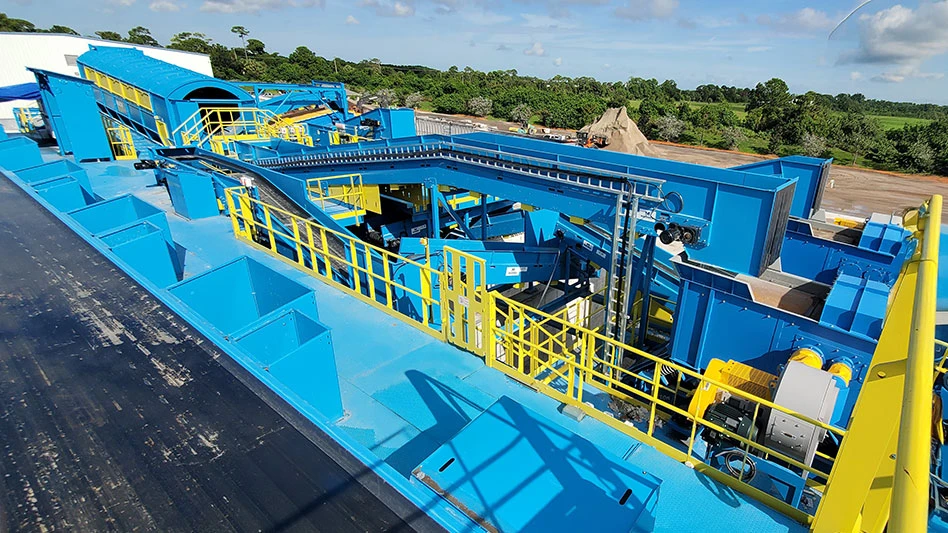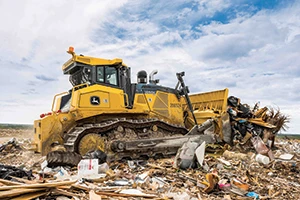
Although landfill operations are seen as distinctly different from general construction, it should still be thought of as a construction application. The machines working on an active landfill are constructing cells—the volume of waste plus a top layer—and liners, which are the containers in which the cells are constructed. Each day, several machines are used in constructing a new cell and this process is continued throughout the working life of the landfill.
Most construction projects take between a few weeks and a few years to complete, but the construction of all the cells in a landfill takes decades to complete. Also, instead of needing to purchase the building materials (concrete, asphalt, steel, wood, etc.), the building materials are supplied to the landfill for free.
Landfills are also high-tech work sites and employ some of the same technologies, such as drones, GPS, 3D mapping, and fleet management.
“Technologies such as GPS, telematics, 3D mapping, and fleet management software are very useful for both the management and the equipment operators,” says Austin Phares, regional sales manager, Humdinger Equipment, the manufacturer of TANA landfill compactors. “They allow the equipment operator to compact the waste in the most cost-effective and efficient way possible by removing the guesswork.”
“These technologies can be very useful to a landfill if utilized correctly,” says Tom Griffith, market professional, waste and application products, Caterpillar.
More Than Just Landfill Compactors
Although landfill compactors are the iconic machines of landfills, various equipment is used on an active landfill, and work site conditions can be tough and variable.
“Most landfills operate year-round, so conditions are constantly changing. The weather can have a big impact on the work site. This can range from rain and mud to wind and dust. In northern areas snow and frost can also create challenges,” says Cory Brant, Crawler Product Consultant, John Deere Construction & Forestry. During the pre-waste acceptance period, a lot of earth needs to be moved. Landfill operators dig as deep as they are permitted as one means of maximizing the amount of waste they can accept, and thereby increasing the longevity of the landfill. Scrapers and/or excavators are the most popular excavation equipment.
For example, K-Tec scrapers were essential in performing the site preparation work for the nation’s largest landfill. Bloomsdale Excavating Company Inc. used the K-Tec scrapers to move more than 1.2 million square yards of dirt and meet an aggressive production schedule.
Then dozers and sometimes motor graders are used to contour the liners, the working face (which is where the compactor compacts the waste), and the roads.
“There are several standard features built into all John Deere dozers that make them exceptional performers in landfill applications,” says Brant. “Dual path hydrostatic transmissions make all John Deere dozers very user-friendly and easy to operate. The John Deere engine provides reliable performance with added fuel-saving features like Eco-mode and Auto-idle. A standard cool on demand, hydraulic reversing fan drive system helps keep coolers from plugging by automatically reversing the flow of the cooling air to blast debris out of the system.”
“Caterpillar has a wide range of dozers for the waste industry, whether utilized in landfill applications or transfer station applications. Dozers that are popular in landfill applications are the D6T, D7E, D8T, and D9T,” says Griffith.
“The two most important things for the contractor, as it relates to the scrapers, are speed (cycle time) and consistent, high-volume loads,” says Ben Pias, Area Sales Manager, Titan Machinery Inc. “Due to the fact that they are operating in a bowl type site, the area of operations is susceptible to water/heavy moisture which makes for very sticky clay. Scrapers that present a lighter footprint and can keep cutting through the wet, sticky material work the best.”
Wheel loaders are more commonly thought of being employed at material transfer stations, but they do get employed at the working face.
“The Doosan DL280-5, DL300-5, and DL350-5 wheel loaders are ideally suited for sanitary landfill applications and can perform a variety of tasks at sanitary landfills,” says Aaron Kleingartner, Doosan Infracore North America, LLC. “If a waste management company or authority is building a new facility or expanding an existing landfill, wheel loaders can be used to excavate, carry dirt, and load trucks. For landfills that accept organic debris, such as timber or landscape debris, wheel loaders can lift and carry the items, as well as load debris into grinders or chippers that shred the material.”
Suiting Up For Action
Of all the construction equipment used in landfill applications, only the landfill compactor is designed specifically for the tough working conditions of a landfill.
“Imagine working in trash. You don’t know what you’re going to get. It’s pretty taxing to the machines,” says Bert Erdmann, product manager, heavy compaction, Bomag Americas Inc. “Whatever waste is going to be brought in, these machines have to distribute it and compact it.”
Griffith continues: “We start with waste guarding packages from the factory on our D6N to D9T. These guarded machines work in a variety of different landfills globally.”
John Deere offers three dozers that can be equipped with a John Deere Waste Handler package—the 850K, 950K, and 1050K. These three dozer sizes are the most commonly used in waste applications. The Waste Handler package is what sets these machines apart from a traditional dozer, providing robust guarding and protection that is needed in this demanding environment. When these dozers are equipped with the John Deere Waste Handler package, guarding is placed where it needs to be. This can include final drive seal guards, blade trash racks, hydraulic cylinder guards, tank guards, cab screens, and track strikers.”
Purpose-Built For Landfill Applications
Landfill compactors are engineered to work in harsh environments. “Work site conditions for landfill compactors are probably some of the worst environmental conditions for a piece of mechanical equipment,” says David Little, Regional Sales Manager, C&C Manufacturing, the creators of Aljon landfill compactors. “The conditions and materials that machine manuals state should be avoided—landfill compactors have to work in them every day.”
“In order to work effectively in the garbage, landfill compactors protect themselves not only from garbage damaging the exterior but also from entering the machine,” says Erdmann. Bomag landfill compactors feature completely sealed rear frames for the engine so no debris can enter and potentially cause a fire, as well as secondary filtration screens, keep particles away from the engine; it keeps the air and fans cleaner. Extremely high-positioned air intakes—higher above ground where the air is cleaner—means the air going into the machine is cleaner.
“Bomag landfill compactors can be used at full capacity all day long and have longer service intervals,” says Erdmann.
“The TANA landfill compactors were the first landfill compactor ever designed, and the design has been improved repeatedly over the years. TANA landfill compactors are the only machines in the world that are designed with two full-width drums and a rigid frame to compact the trash more effectively,” says Phares.
In order to choose the right landfill compactor, a landfill owner should consider a machine’s weight, pound per linear inch (PLI), its guarding and other protection, and its wheels.
A machine’s PLI is more important than its weight. Although a dozer is heavier than a similar horsepower landfill compactor, its weight is more evenly distributed. What makes it great at pushing—its flotation—is also what makes it not great at compacting.
On Aljon landfill compactors, the wheel size and wheel cleat configurations are variable. “Depending on tonnage, the number of hours, and type of waste, the machine can be configured with different cleat patterns,” says Little. “The Aljon compactors can be adapted to maximize performance in high-percentage construction and demolition waste or high-percentage municipal solid waste and organic municipal solid waste; Aljon can make adjustments to the type of cleat and cleat patterns to optimize machine performance in these applications.”
“Caron’s self-cleaning wheels with patented pin-on teeth minimize wheel plugging. Instead of blades or tampers, Caron compactor wheels are equipped with two types of specifically designed teeth that clean themselves automatically as they compact. This results in better compaction in fewer passes,” says David Williams, Technical Sales Support Manager, Caron Compactor Company. “Teeth and wheels remain free to chop, grind, and compact a wider range of refuse without fluffing lightweight materials. Full penetration permits greater compaction density in less time. And firmly packed surfaces can reduce cover materials by as much as 30%.”
Latest Technologies
The use of technologies such as 3D mapping, GPS, and fleet management on landfills continues to grow.
“Landfills are relying on John Deere technology solutions to improve the bottom line. For example, many Waste Handler customers are using the John Deere JDLink system to monitor fault codes, engine hours, and fuel level,” says Brant. “This system provides customers with information about how their machine is being utilized, as well as valuable insights for maintenance planning. John Deere offers an advanced support system called Service ADVISOR Remote, which provides remote diagnostics and prognostics services. This system allows dealers to log in remotely to the machine to troubleshoot or even update software without making a trip to the machine.”
Landfills are also using GPS for counting passes, measuring density, shaping the work-face, and building new roads.
3D mapping is often achieved through the use of a drone. The Kespry drone creates a 3D map by taking several overlapping images at a safe flight height above the operation. “These images are accurately tagged with positional information using GPS technology in the drone. The images are automatically ‘stitched’ together by Kespry using a process called photogrammetry,” says Jason Nichols, senior product marketing manager, Kespry. “With enough overlap of images and a highly accurate method of collecting GPS data, a single image of the entire site is generated with 3D data along with the high-resolution picture.”
By using 3D mapping, landfill operators can improve the accuracy of volumetric calculations for compacted piles, windrows, and biomass cells. They can evaluate void spaces in compacted material and monitor airspace utilization to determine capacity rates, prevent overfilling, and prepare for closure. They can also use the survey-grade data for expansion planning, permitting, and generating cut and fill plans.
Latest from Waste Today
- Vecoplan to present modular solutions at IFAT 2026
- Terex Ecotec appoints Bradley Equipment as Texas distributor
- My Green Michigan expands depackaging capacity
- Washington selects Circular Action Alliance as PRO
- Ten-8 Industrial opens new central Florida service center
- Triumvirate Environmental acquires Environmental Waste Minimization
- Official NYC Bin availability expands ahead of deadline
- US Food Waste Pact’s 2025 Impact Report shows decrease in food waste