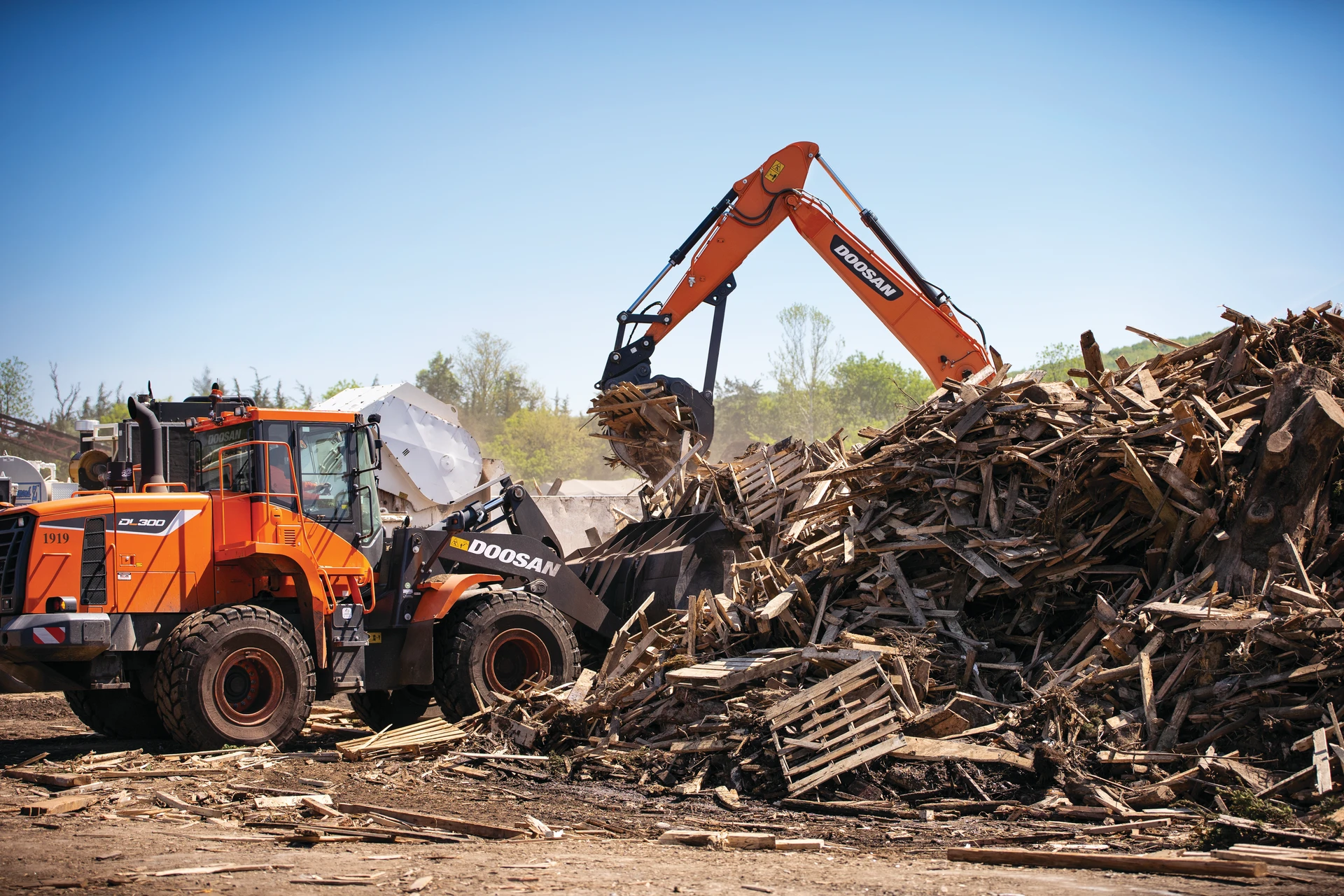
A steady line of trucks pulls into the Nature’s Choice Corporation facility in Sparta, NJ. Pallets of wrapped and bagged hardwood mulch await pickup and delivery to big-box stores throughout the Northeast. At the heart of the recycling operation are more than a half-dozen machines lifting, pushing, loading and transporting the material.
Charles Ehrmann is the company’s vice president of operations. He works out of the corporation's headquarters in Hillsborough, New Jersey. He regularly visits the company’s facilities where employees convert wood waste to mulch and make topsoil.
The company was founded in 1992 and went through several ownership changes before the current ownership took over in 2014. Today, Nature’s Choice operates seven locations, including its Sparta facility. It handles approximately 1,000,000 cubic yards of material annually.
Material In
At its facilities, municipalities, contractors, and land-clearing companies deliver wood and yard waste. When companies arrive at a Nature’s Choice facility, raw materials get separated into wood, leaves and grass.
“All the wood materials are ground twice into finished mulch, and then further processed into colored mulch,” Charles says. “In fall, when leaves come in, we grind those and we windrow them in our Class C composting box. Then, we’ll process that until we have finished compost ready to screen for topsoil.”
Reliable construction equipment is a must at the Nature’s Choice facilities. Once the wood waste is delivered, trucks unload it on the ground. A Doosan DL300-5 wheel loader—purchased from Best Line Equipment—pushes the material into a pile. Meanwhile, a Doosan DX225LC-5 excavator paired with a grapple loads the organic material into a horizontal grinder for the first pass.
“Our operators like our excavators because of quick cycle times which leads to more efficient processing,” Charles says. “The excavators are stable, which is important for the type of work that we do.
“The excavators’ rearview cameras help us in our busy retail locations. There can be times when a truck pulls up behind the excavator or loader without the operator expecting it. It's nice to be able to check the display monitor, see the rearview and make sure it's clear."
From there, another Doosan wheel loader takes the material to a curing pile where it ages. It stays there until it properly cures, and then operators grind it a second time. After the second grinding, operators use a wheel loader to put the material into the colorizing system.
Adding Colors
Nature’s Choice offers several different types of hardwood mulch, including colored varieties. According to Charles, their facilities can produce triple-shred, black, brown and red hardwood mulch. The firm started coloring mulch in 2001. Charles says colored mulch has become increasingly popular with homeowners and at multifamily residences, such as condominiums and apartment buildings.
“The colored mulches, because of how long they last and how they enhance the landscape of a home or complex, are popular,” he says. “It makes a difference in the longevity of the material and how you only need to add mulch every other year instead of every year.”
The colorizing system sprays a mix of water and liquid color on the mulch. Then, the mulch enters a rotating drum and comes out on a conveyor belt. From there, Nature’s Choice builds stockpiles of colored mulch.
Automatic Bagging
At the 62-acre Sparta facility, a wheel loader with a high-capacity, high-tip bucket fills a hopper with low-density colored mulch. From there, it enters an automatic bagging line. Inside the building, a machine fills mulch in branded plastic bags and seals them. Two robots lift the bagged mulch and efficiently place it onto pallets. Each pallet has about 60 finished bags. In a matter of minutes, a stacked pallet of mulch travels down a line where it’s shrink-wrapped in plastic and eventually picked up by a forklift.
“We have a fully automatic bagging facility,” Charles says. “We bag mulch for some of the largest big-box stores in the Northeast. In the mulch business, not many people have the facilities to supply such large demands. In Sparta, we not only have all the inbound products to make mulch and topsoil but having the storage space to be able to house the outgoing big-box store materials is very important.”
Although the facilities operate year-round, spring is the busiest time of the year for the company. As fast as an automatic bagging process can build pallets of finished products, forklifts place the pallets on flatbed trailers headed for retail locations where customers are eager to buy the mulch for their landscaping projects.
Nature’s Choice also offers cedar mulch, which is produced from cedar chips, and sold to their customers. At locations where the material isn’t bagged, the finished mulches are loaded into trucks for bulk distribution.
“We like the high reach of our wheel loaders so we’re able to load high-sided trucks and trailers,” Charles says. “We have quick couplers on the wheel loaders which make it easier for our operators to switch buckets.”
Nature’s Choice isn’t just another wood waste recycling facility. The company is taking steps to position itself as a leader with its coloring system and automatic bagging process. It works closely with the State of New Jersey to ensure proper steps are taken to intake and process the material, as well as follow stormwater management procedures.
Fuel is one of the biggest expenses for Nature’s Choice. Charles Ehrmann says his equipment dealer introduced him to telematics to help the company monitor its Doosan heavy equipment, including fuel consumption. Charles says he can see which excavator or wheel loader operators are letting the machines idle, which burns fuel and can waste warranty hours.
“We spend a lot of money on fuel between our loaders, grinders and excavators,” Charles says. “Being able to have insight into how much fuel we’re consuming and when operators are letting machines idle helps us manage our operators and expenses. It’s nice to have the insight and to be able to tell from an iPad or iPhone how much fuel we’re using.
“We let our operators know if they’re not using the machine for 10 minutes or more to shut it down. We want the operators to shut off the machine and conserve fuel.”
Another benefit of telematics is the dealer’s ability to remotely monitor the equipment. Employees at Best Line Equipment can see when a critical service interval is approaching. Technicians are dispatched to the Nature’s Choice facility and the machine is taken offline temporarily for service.
[end sidebar]