The number of single-stream material recovery facilities (MRFs) operating in the US has almost doubled in the five years starting in 2003 when 90 MRFs operated across the country, and expanding to over 160 by 2008. A significant number of these MRFs utilize optical sorting technology to sort commingled materials during the last stage of the recycling process. Recycling is a multi stage process that involves the picking of the “lowest-hanging fruit” first, and removing successively more difficult “fruit” in subsequent stages:
- Large heavy objects like appliances, furniture, and car parts are typically removed manually prior to the start of the main recycling process.
- Then, easily extracted ferrous metal gets removed out of the wastestream first via electromagnetic separation.
- Next comes non-ferrous metals (like aluminum) similarly extracted by eddy current separators that rapidly rotating magnets that use induce an electric current and generate an electric field into the metal causing repelling forces to expel it from the wastestream into awaiting collection bins.
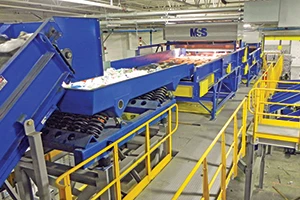
- The next stage usually involves removal of waste according to size and weight via disc screeners. These are enclosed floors lined with rows of rotating discs of differing shapes and sizes designed to create a wave action in the waste flow.
- Large, light objects like cardboard sheets and boxes are sent to the top of the waste where they are easily removed.
- Small, light objects like office paper and newsprint are separated by means of air pressure from air knives, clarifiers, and cyclones.
- The residue then passes through a rotating trommel deigned to remove dirt, small particles, and other unrecyclable materials.
- The remaining material consists of colored glass, cullet, ceramics, and plastics. Traditionally, these are the materials that are removed and sorted (according to material type and color) by means of light spectrophotometry and optical sensors.
- Large heavy objects like appliances, furniture, and car parts are typically removed manually prior to the start of the main recycling process.
- Then, easily extracted ferrous metal gets removed out of the wastestream first via electromagnetic separation.
- Next comes non-ferrous metals (like aluminum) similarly extracted by eddy current separators that rapidly rotating magnets that use induce an electric current and generate an electric field into the metal causing repelling forces to expel it from the wastestream into awaiting collection bins.
- The next stage usually involves removal of waste according to size and weight via disc screeners. These are enclosed floors lined with rows of rotating discs of differing shapes and sizes designed to create a wave action in the waste flow.
- Large, light objects like cardboard sheets and boxes are sent to the top of the waste where they are easily removed.
- Small, light objects like office paper and newsprint are separated by means of air pressure from air knives, clarifiers, and cyclones.
- The residue then passes through a rotating trommel deigned to remove dirt, small particles, and other unrecyclable materials.
- The remaining material consists of colored glass, cullet, ceramics, and plastics. Traditionally, these are the materials that are removed and sorted (according to material type and color) by means of light spectrophotometry and optical sensors.
The technique of light spectrophotometry (LSP) was developed by the chemical industry to allow for the automated sorting of chemicals by color. It was soon discovered that this same technology could be applied to the recycling process. Using its ability to differentiate between colors LSP can be used to sort and separate different colors of glass (clear, amber, brown, or green) from ceramic cullet. Each color reflected from the surface of these materials has a different wavelength. The unit’s optical sensors read these wavelengths to determine the color of the glass. This is not an easy process, and simple direct reading of glass colors can result in a lower removal efficiency.
The next improvement of this differentiation process was the development of the near infrared (NIR) sensor. In addition to color, the NIR senor can differentiate between material densities, allowing for the processing of different types of plastic as well as different colors of glass. Whether LSP or NIR, the sensors are mated to air blowers. These blowers are programmed to deliver a timed blast of air that propels the glass, cullet, or plastic off of the conveyor belt and into the appropriate collection bin.
The above is just the simplified version of how optical sorters operate and how they are originally utilized by MRFs. The recent development of this equipment is far more complex and varied. At first, MRFs utilized optical sorters just to differentiate between HDPE and PET plastics, as well as differently colored glass. The technology has advanced and expanded with multiple types of optical sorters—NIR; Mid Infrared (MIR); Visual Imaging Sensor (VIS); Cyan, Magenta, Yellow, and Black sensors (CMYK); Red, Green and Blue sensors (RGB); extended spectrum color sensors; and high-resolution color cameras—designed to separate a wide variety of materials and fibers. Combining several different types of optical sorters allows for both increased productivity, speed, efficiency, and flexibility.
These combined systems can work rapidly, separating material from conveyor blest moving as fast as 800 to 1,200 feet per minute. And they are no longer strictly relegated to the final stage of the recalling process. These units can be used at different stage and locations in the MRF material transfer system depending on the material being removed and the overall design of the system. Efficiency improvements have kept pace with increases in speed with 90% removal rates being common. Optical sorters can be used to remove not just glass and plastic, but also different types of fibers (OCC, ONP, OBB, and office paper). Their flexible programming allows one sorter to be used for removing different materials types during different batch runs.
Latest from Waste Today
- Vermeer announces plan to build new facility in Des Moines metro area
- Buffalo Biodiesel shares updates on Part 360 application to DEC, Tonawanda facility progress
- Capstar Disposal expands roll off dumpster rental services
- Supreme Court strikes down IEEPA tariffs
- Casella details facility closures, expansion efforts
- Zero harm: Building a SIF prevention program for waste and recycling operations
- Casella posts a loss in Q4 2025
- McNeilus names Haaker Equipment first Dealer Partner of the Year