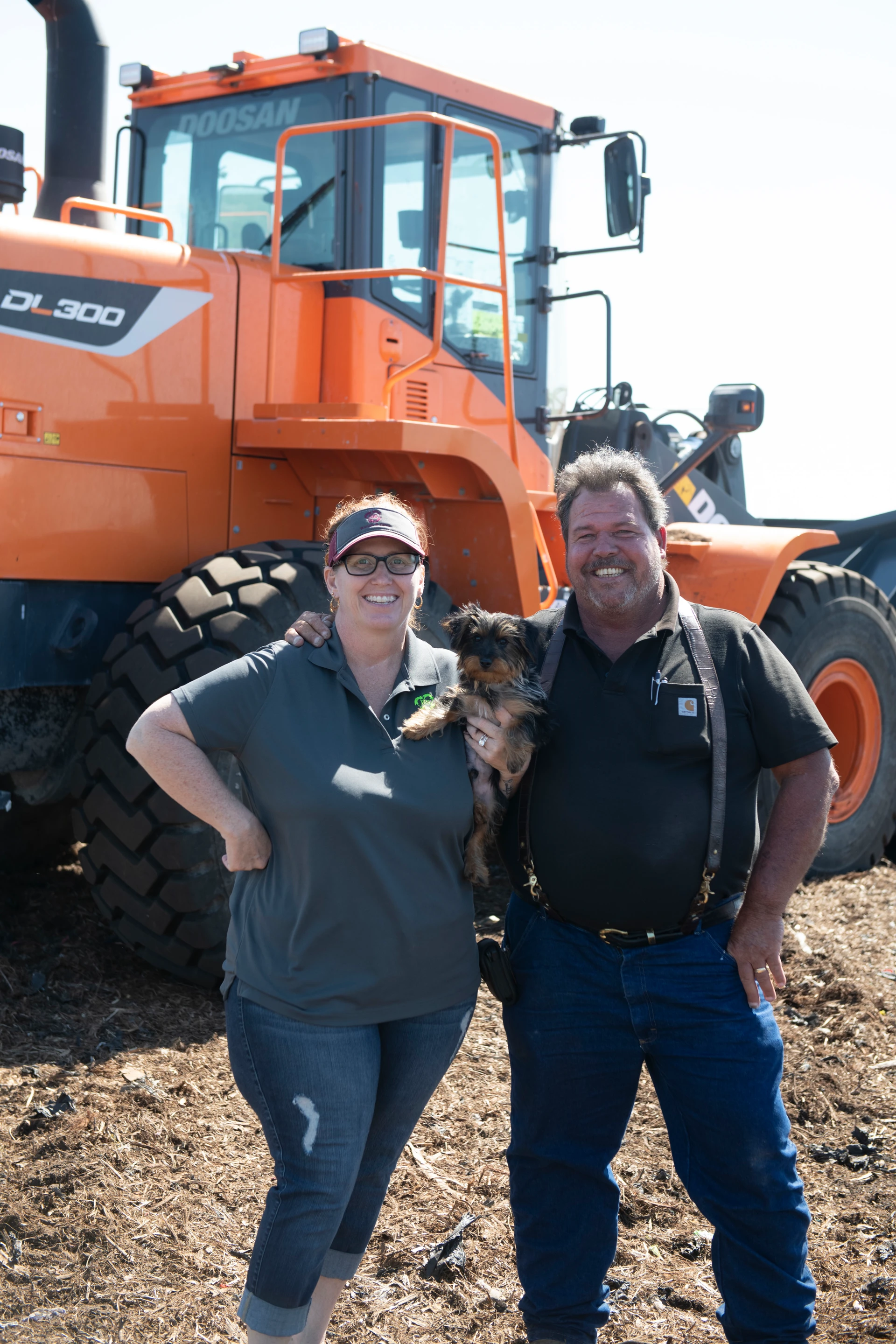
Bill Stanton is a Florida native. He grew up on a farm and watched as the state’s urban areas population exploded during the past 40 years. Florida’s population has more than tripled in Bill’s lifetime. Today, Bill operates a unique industrial facility aimed at diverting organic waste from Florida’s landfills.
Bill, age 54, and his wife, Brandy, started BS Ranch and Farm 12 years ago in Lakeland, Florida. Bill’s diverse background in related fields, including wastewater treatment and power plants, helped build a foundation for the new business—an organic management company that manufactures topsoil.
Encompassing approximately 340 acres, BS Ranch and Farm accepts organic waste from a 100-mile radius. The three main product types accepted are wood waste, food residuals and wastes, and biosolids. According to Bill, these are organics that are discarded from the urban and city environments and would otherwise end up in a sanitary landfill. Where others see waste, Bill sees an opportunity to narrow the gap between the rural and urban environments.
“I grew up in a rural environment with animals and wildlife,” Bill says. “I understood the balance of what it’s like in the rural environment, and that’s why I noticed that there was a gap between the urban and rural areas. I noticed that there was a big variation in how the different cultures and the rural and urban communities treat the environment. One of the largest things to be noticed is that the consumables come from the rural areas, get trucked into the cities, and then discarded. So, to try and make a relationship there is to have the material come back, go through a treatment process of one nature or another and, once it’s healthy, be used again in the rural environment.”
A steady flow of trucks brings the organic waste to BS Ranch and Farm. Once it arrives at the facility, approximately 30 of Bill’s co-workers begin handling the material using a variety of heavy construction equipment.
“As on any kind of construction site or agricultural activity, our machines are pushing, pulling, loading, and transporting the different materials at different times in the process,” Bill says.
Wood Waste
One of the most plentiful types of incoming organic waste is wood. Tree care professionals, landscapers and land-clearing companies deliver the material in trucks and trailers. Some companies deliver mulched material from area transfer stations that are further processed. Once on-site, the wood waste begins a slow decay process.
"Our decomposition process takes between three and five years," Bill says. "We leave some of it in a whole state and let it decompose for up to three years before either grinding or blending it with other materials. We create large piles that help to generate some heat. We blend the material so the wood absorbs all the nutrients and the proteins and amino acids from the decaying, more concentrated organic materials, such as septic, biosolids and food residuals."
An operator in a Doosan DL300-5 wheel loader uses a grapple attachment to handle the wood waste once it’s delivered. He picks up material and loads it into a DA40 articulated dump truck (ADT). Working alongside the wheel loader is a DX300MH-5 material handler. It’s paired with a grapple, loading the ADT with the wood waste. The machine has a hydraulic rising cab that allows the operator to get a better view of the truck bed when he’s loading the material. Once the truck bed is full, the ADT transports the material to another area for processing.
The raw material is processed with a tub grinder to reduce its size. As it’s stockpiled on the property, the mulch piles heat up and steam emanates from them. From there the material is loaded into the ADT using another DL300-5 wheel loader with a high-profile bucket. Bill says the high-profile bucket enables the operator to easily move a large volume of material.
“The DL300-5 wheel loaders are very mobile,” Bill says. “They’re not overly big for the work that they’re doing. They’ll run up to about 2,400 hours a year.”
The ADT transports the processed mulch to an area where a new decomposition pile is being constructed.
“We pad all this operation with 5 to 10 feet of mulch on the bottom of the beds before we take and load the other material on top of it,” Bill says.
Bill purchased the Doosan equipment from Synergy Equipment in Tampa, approximately 30 miles from BS Ranch and Farm. He started working with the dealership approximately two years ago. Since then, the dealership has helped supply Bill not only with reliable equipment but the attachments he needs for the volume of material that’s processed.
Food Residuals and Wastes
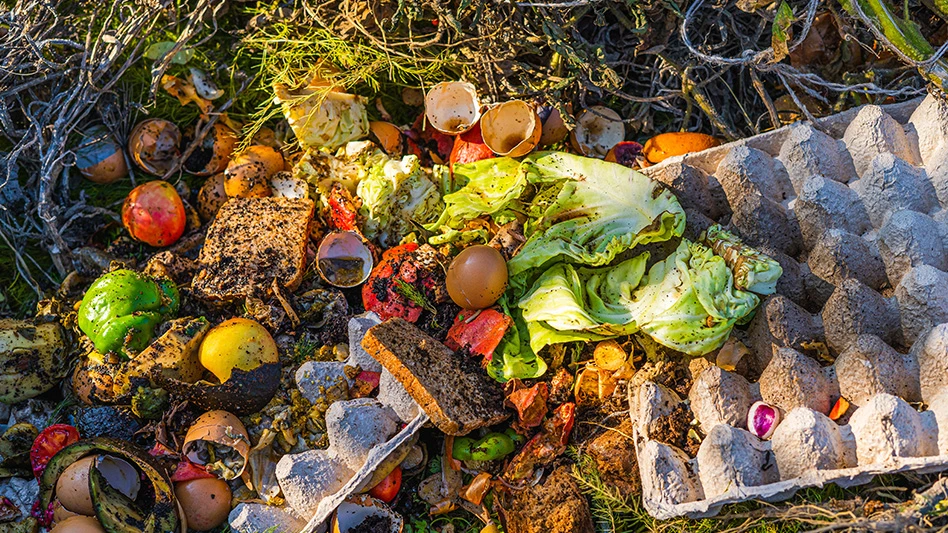
The second type of material collected at BS Ranch and Farm includes food residuals and wastes. These come from food processing plants, restaurants, hotels and grocery stores in the Lakeland area. According to Bill, these facilities put the food waste in carts that are picked up by specialty trucks. Those trucks deliver the material to Bill’s facility. From there, it goes through a de-packaging process.
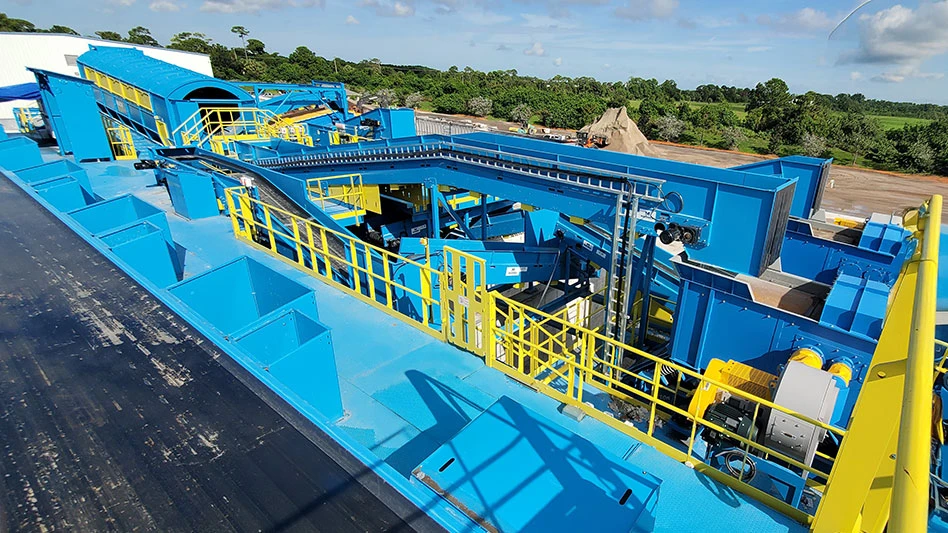
“We call our de-packaging process product destruction,” Bill says. “We run the food material and packaging through machinery to separate it. We remove all the plastics and what can be considered contaminants upfront. We even disassemble some of it by hand. What we don’t get through that part of the process, we take out as much as we possibly can in the final screening process.”
The material becomes food for the decomposition process. “It decomposes and contains bacteria that help it to function in the rotting process,” Bill says.
Biosolids
A third and important part of the decomposition process is biosolids, including septage. Bill says BS Ranch and Farm sources their material from wastewater treatment facilities and septic service companies.
“That’s an organic waste as well,” he says. “It finishes off the entire circle of organic material that is excreted from the urban environment. It’s not complete when it arrives. It’s not finished in its decay process, and that’s something that we provide.”
Upon arrival, the biosolids are processed through filters to remove many inert contaminants. Then, according to Bill, it’s emulsified into a liquid state. The secret sauce, so to speak, is added to the wood waste and food residuals to complete the company’s recipe for decomposition.
“It goes through lagoons for up to six to eight months before it’s added to the carbon material, being wood and yard debris. In that process, it’s had a chance to go through both an anaerobic and aerobic state of decay with all the microbes that function inside of that decay process. It’s no longer human waste at that point. We harvest the algae and put the algae on the decomposing piles.”
Let’s Get Cooking
As Bill and his co-workers combine the organic ingredients, they build their piles on clay berms. The clay berms help the piles retain moisture. Stormwater is collected onsite too, and his equipment operators adjust the water levels around the pile.
The hot, humid weather in Florida creates the ideal conditions for the decomposition of the organic material. A Doosan DX300LC-5 super-long-reach excavator sits atop one of the piles of decomposing material. It’s equipped with a grapple attachment.
“It’s used to work the toe of the slopes on the different tiers of the pile to move the logs back into the center of the pile,” Bill says. “The excavator pulls out some of the larger wood debris and moves it back toward the interior of the pile in the center. We fill the interior side of the pile with fluids … and the material will decay down. The long-reach configuration works well for the size of the piles in the area and the reach.”
Mature Point
In this big outdoor laboratory, so to speak, material and equipment are moving constantly. Even in the chaos of the day-to-day operations, there’s a slow decomposing process taking place.
"We take our time in letting everything decay as naturally as possible," Bill says. "In the last year of decay, we have a propagation of microbial activity occurring. We run tests on it regularly and check the maturity of the material on a percentage rate."
Eventually, the product reaches its mature point. Bill refers to this as the point at which the material won’t decay anymore and it’s stable.
"Once the product is mature, we run it through screening plants and separate it down from a 1-inch minus," Bill says. "The oversize material returns to the piles. It stays in operation until it's decayed."
Most customers purchase the final product in bulk, whereas some material is sold to customers who bag it and resell it. BS Ranch and Farm advertises its product as a topsoil blend that is perfect for farms, gardens and lawns.
Bill says he hopes to expand to other areas of Florida and use his Lakeland facility as a large-scale prototype for future growth, starting in the Fort Myers and Naples area.
* (SIDEBAR) *
No-Fuss Maintenance
Bill Stanton’s Doosan wheel loaders include a reversible fan cooling system. In his line of work, it’s critical to keep his wheel loader’s cooling system as clean as possible. His operators set the reversible fan to automatic mode and the fan reverses direction on preset intervals.
“It’s nice that the fans stop and reverse during operation,” Bill says. “The Doosan machines never have to slow down. With some of our machines, we have to stop them, turn them off, and start the fans in the opposite direction.”
Latest from Waste Today
- Interchange 360 to operate alternative collection program under Washington’s RRA
- Waste Pro files brief supporting pause of FMCSA CDL eligibility rule
- New Way Trucks expands US network with Joe Johnson Equipment
- Tire Industry Project publishes end-of-life tire management guide
- Vecoplan to present modular solutions at IFAT 2026
- Terex Ecotec appoints Bradley Equipment as Texas distributor
- My Green Michigan expands depackaging capacity
- Washington selects Circular Action Alliance as PRO