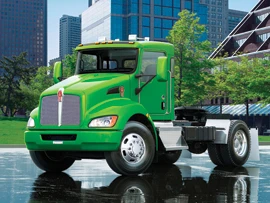
As time goes by, the impetus and synergy for the development of viable natural-gas and hybrid collection vehicles-and even electric transport equipment-has come into its own. Whether fuel prices (gasoline or diesel) are up or down at the moment is irrelevant. In the long term, as municipalities look for investments that are both cost-effective and environmentally friendly, hybrid systems and natural-gas-powered vehicles (NGVs) clearly are a move in the right direction.
NGVs in the Driver’s Seat
The markets for the use of NGVs aren’t showing any indication of slowing down for the most part, according to Scott Edelbach, general manager of sales at Vocational Energy in Tampa, FL. “As far as CNG [compressed natural gas] goes, the big trucks, the 9-liter guys, all the vocational truck lines including concrete and garbage trucks have had an engine this size for five or six years, and it’s worked really, really well. Now the 12-liter engine is coming out from Cummins Westport, available at the beginning of 2013 and will open up those really big over-the-road heavy hauler applications.
“CNG and LNG [liquefied natural gas] both are going to be great, making big transitions over the next several years. Natural gas is currently selling for $2.65 to $2.70 per 1,000 cubic feet.”
In terms of fuel, that works out to about 7.2 gallons, a relatively high amount. This means the natural gas (from which CNG is created) sells for roughly 40 to 45 cents per gallon right now. Add in the state and federal road taxes, equipment maintenance, and operational costs, and this is still substantially less than diesel fuel, putting total production costs at between $1.30 and $1.60 per DGE. Even if the price for raw natural gas went up to $20 for 1,000 cubic feet, it would be comparably priced to diesel fuel, according to Edelbach.
“This is has been true whether there has been fracking or not. Fracking has helped somewhat to bring the price of natural gas down. But over the last 10 years, natural gas has averaged about $4 to $4.50 per cubic foot, still far below the amount it would have to reach to be close to the price of diesel fuel. We’re pretty optimistic that the price of the fuel itself is going to be modest for a long time. The truck engines are performing really quite well. People like them, they’re quieter, they give them the power that they need, and there’s lots of benefits there.”
Regarding emissions, users don’t have all the after-treatment that you have in all the diesel-built trucks. Though this isn’t a particularly good fit for light cars, it’s definitely a good one for the truck industry and will be for quite awhile.
“Safety-wise, natural gas is better than gasoline or diesel,” adds Edelbach. “I think the industry is pretty comfortable with the safety of the technology and the reliability.
“We’ve been in this for four years now. Last year, we built 17 projects in 12 states across the country. Natural gas is just one of many alternative transportation fuel options going forward. There’s one solution that fits every vehicle fuel type, but CNG is certainly a great solution for many sectors of the trucking industry.”
Hybrid Comes of Age
Crane Carrier is a heavy-duty custom truck manufacturer that builds trucks for a variety of vocational industries. “We are a systems integrator, buying a [hybrid or CNG] system from a manufacturer and integrating that system into our chassis,” explains Glenn Pochocki, national account executive. “As a chassis supplier we’ve been somewhat of an important link in working with these other manufacturers or system integrators of the hybrid system so that they understand what the expectations are to the system, how the controls work, and how they integrate or work with an application such as a refuse truck.”
| |
| Photo: Parker Hannifin Corp. Parker Hannifin’s RunWise system |
Between the years 2008 and 2009, before the credit crunches and the stock market crash, fuel prices were rising and there was considerable interest in hybrid technology, and growing. There were also a number of emerging technologies in development. However, the cost at the time was extremely high. “It was in the neighborhood of anywhere from a couple hundred thousand dollars to a million dollars for preproduction and prototype configurations,” adds Pochocki.
Since then, a number of the technologies and the suppliers have been weeded out. There aren’t as many companies out there. Some companies failed, and some were acquired or merged. What is left are a number of solid hybrid technologies, predominantly parallel electric or hydraulic, available now at a much lower cost than what was rumored or available just a couple of years ago.
With fuel prices creeping up again and the emergence of solid alternative fuel technologies, we are no longer limited to just diesel. There are now affordable alternatives to consider. These include moving away from diesel to CNG or LNG fuels. Natural-gas-based fleets will cut fuel costs in half. An additional alternative would be to use hybrid technology. There are three main hybrid systems: parallel, series, and PHEV.
The parallel hybrid system is used in “parallel to the existing drive train.”
The existing drive train has an engine and a transmission. The transmission is conducted to the rear axle through a drive shaft. A parallel system will either be integrated into the transmission or be a separate unit located between the transmission output and the rear axle input. Parallel systems typically are lower in cost. If the system isn’t operating properly, it can be turned off and the vehicle can be operated in a normal mode without the hybrid system running.
A series hybrid system basically replaces the automatic or manual transmission that is located in the vehicle with a complex list of components. The components are either hydraulic or electric and provide the movement of the vehicle. Series hybrid systems are generally more expensive installations in comparison with parallel hybrid systems.
A plug-in hybrid electric vehicle, or PHEV, is another fuel alternative. In some cases it may not have an onboard engine, but it will have an electric storage device such as a battery or a generator and a motor. The PHEV takes the electric energy that’s stored and drives the motor, which is also the generator and which moves the vehicle. When the vehicle is coming to a stop, the motor works to recover the energy of the moving vehicle in the braking mode and returns that electric power to the battery for reapplication when the vehicle accelerates.
That operation is typical, whether it’s a parallel or a series hybrid system. “That’s the key with a hybrid system,” explains Pochocki. “In a hybrid system, you are basically trying to capture the kinetic energy of the vehicle when it’s coming to a stop and turning that energy-by driving either a hydraulic pump or an electric motor-to a source device that is used to propel the vehicle when you step on the accelerator pedal.”
“Series and parallel hybrid systems are available both in electric and hydraulic formats right now, in addition to PHEVs. The technology is there to reduce fuel consumption and to potentially reduce the brake wear on your vehicle, because the system itself is used to slow or retard the vehicle’s motion to a stop. When it is in this regeneration mode, the generator drags the vehicle down to a stop while the vehicle’s motion is turning that generator and creating electric or hydraulic pressure as well as returning that pressure or power to a storage place.” Pochocki says.
Then, when the accelerator is reapplied, the stored energy, whether it is hydraulic or electric, is used to propel the vehicle. The propulsion allows the vehicle to move without burdening the engine and using fuel. Typically, the systems will have what is known as an economy mode or a performance mode. In economy mode, the system would tend to use more of the stored energy to move the vehicle, and operators would have to apply the gas further to assist the vehicle in moving.
In a performance mode, as soon as the accelerator pedal is applied, the vehicle receives power from both the hybrid system as well as the engine. This will move the vehicle at a relatively faster rate of speed than it would without a hybrid system on it.
Systems currently available, primarily from Eaton Corp., are the Hydraulic Launch Assist™ (HLA®) systems. An HLA system is a parallel hybrid hydraulic system. Crane Carrier has worked with Eaton to install its system on the Crane Carrier chassis. Crane must then tune that chassis configuration and the drive train to the vocation and the customer’s expectation regarding performance and such other factors as engine sizes, horsepower, axle ratios, or acceleration.
“All those things come into question when you are developing a specification for a vehicle,” says Pochocki. “With that, we basically take a look to see if there is an opportunity for a hybrid system. These opportunities are identified when a vehicle has a number of stops and starts throughout the day. Vehicles such as transit buses, shuttle buses, parcel delivery trucks, or anything that makes lots of stops during the day are great candidates for hybrid system.”
The key to the hybrid system is the number of stops in a day and the distances between those stops in the formula in recovering energy and being able to reuse that energy to reduce fuel consumption. The higher number of stops a vehicle has in a day will assist in improving the payback and performance of a system. But the distance between those stops is just as critical because if there is not adequate distance between the stops, the system will typically not recover the amount of energy necessary to propel the vehicle between the stops. The optimal distance between stops is 75 to 100 feet. If the stops are fewer than 50 feet apart from one another, then there is not going to be enough charge between the stops to propel the vehicle. Every time acceleration occurs, the driver actually is depleting the system more than it is capable of recovering between the stops.
The number of stops and distance between the stops is key input on any formulae for calculating the vehicle’s payback, performance, or potential fuel savings. Typically, a system will extend a vehicle’s brake life two, three, and maybe four times. So if a collection fleet is replacing brakes on a vehicle every six months, it could potentially go 12, 18, or maybe as many as 24 months before brake work.
“This is a savings that can add up fairly quickly and can help pay for the system,” says Pochocki. “The reason it saves on the brakes is because the system is actually slowing the vehicle down to a stop. However, the drivers have to change their driving habits to accept or allow the system to bring the vehicle to a stop rather than drive more traditionally with “˜screeching halts’-foot all the way to the floor on the accelerator and then on the brake.
“This is something of a philosophical change for the operators: They have to take their foot off the gas and allow the system to slow the vehicle down before placing their foot on the brake. We have to let the systems coast, allowing the vehicles to come to a stop, in order to collect that energy,” explains Pochocki.
Understanding Your Needs
“We have some people using their hybrid the way it was intended to be used,” according to Eaton Corp.’s Ben Hoxie, chief engineer for hydraulic hybrids. “They are saving a lot of fuel, improving brake life, gaining productivity, and getting a lot of value out of the hybrid.
“Other customers deployed hybrid equipment without complete understanding of route dynamics and system utilization. In these cases, hybrid does not do a lot for them. There are a large variety of factors involved; things will always be systems-specific and truck-specific. If too much highway driving is involved, it may not be the best fit for an operation.”
Increasing Fuel Efficiency 100%
Parker-Hannifin is the only manufacturer to have an advanced series hybrid drive system in production. The fundamental difference between other systems serving the Class 8 vehicle market and Parker’s RunWise system is the hydrostatic drive combined with brake energy recovery capabilities.
The technology integrates mechanical and hydraulic drive elements into a three-speed transmission to optimize efficiency at all speed ranges. All shifting occurs smoothly and automatically, and all speeds accommodate brake energy recovery, allowing stored brake energy to be used to power the vehicle in all modes of transportation. The results are reduced fuel consumption, less brake wear, lower operating costs, and improved productivity for the operator.
“After some training to understand the technology, drivers are able to cover their routes in a smoother manner and in less time,” explains Tom DeCoster, business development manager for Parker-Hannifin Hybrid Drive Systems. “As long they’re on the routes collecting, the system does its thing, which is saving more than 40% on fuel compared to traditional trucks, reducing emissions and improving productivity, including less brake wear over the life of the truck.”
Upon braking, RunWise works seamlessly with the refuse vehicle’s standard friction braking system using pressurized hydraulic fluid to decelerate the vehicle, while simultaneously transforming and storing the vehicle’s kinetic energy in lightweight composite accumulators for use when the vehicle starts moving again. The more stops a vehicle makes during the day, the more efficient the system becomes relative to a conventional drive train, all while wearing the brakes down less and reducing the amount of brake dust being expelled into the atmosphere.
Most municipalities and haulers are changing brakes three to five times per year, according to DeCoster. With the RunWise technology reducing brake wear, users will now change out the brakes once every five to six years.
“That’s a game-changer,” says DeCoster. “For the users out there this is a major breakthrough. Brakes have constantly needed to be watched to ensure safety and unnecessary wear. Now, with the brake replacement cycle being extended and fuel savings that can reach between 40% and 50%, that is absolutely huge.”
Municipalities or private haulers looking to reduce day-to-day expenses now have another option. “Collection trucks are going to be running; they might as well be running as clean and lean as possible,” adds DeCoster. “This Advanced Series Hybrid is a win-win for everyone; I don’t see any downside to it. In the end it all comes down to taxpayer dollars, or with the private hauler the cost of picking up your refuse. It’s got to get done. Why not save money in the process?”
Surpassing Expectations
The city of Miami, FL, obtained its first collection truck equipped with the Parker RunWise drive in November 2010. Because of cost savings witnessed by Jose Davila, fleet superintendent with the City of Miami, by the end of August 2012 the city had invested in a total of six hybrid trucks.
“Our fuel savings for the first month on the truck was 47%, which was higher than our demo truck, which was 43%. After some updates from Parker and more efficient utilization from the operator, those savings increased to at least 50% the following month,” says Davila. “Typically, our trucks consume 785 gallons of diesel per month. The new system now saves 400 gallons per truck per month.”
“Initially, this was a tough sell for me. With budget constraints, it’s not an easy thing to do. I was very lucky that city leaders listened to me, and now everyone is happy with the decision, especially since in addition to reducing our operational costs, this has also been an excellent product to tie in with our mayor’s green initiative.
In spring, 2012 the city conducted its first brake analysis, and the outcome more than surpassed expectations. The initial assessment was that the brakes would need maintenance every three years. When they checked the brake wear on the first hybrid truck, which had run almost 18 months and 2,200 hours, the most wear on any one shoe was 4/32.
Brake replacement costs can reach nearly $1,000 per truck axle due to the labor involved as well as changing out the hardware and the relining of brake shoes. The three-year brake replacement the city figured now became a six-year replacement cycle. “We will save $81,000 based on a six-year replacement cycle,” says Davila. Paired with fuel savings, the city’s return on investment for these trucks is a little less than three years, according to Davila.
“The hard work was already done by Parker-Hannifin in regard to their research on this technology and to get this product to market,” said Davila. “Our work was to help validate it with real-world operation. If we were the test case, we were happy guinea pigs.”
Program to Evaluate Real-Time Performance
BAE Systems’ HybriDrive Solutions organization is now based in Endicott, NY, with a large application center in Rochester, UK. Working with Crane Carrier, the company has kicked off the “Lap of America,” which involves using a the Crane Carrier refuse collection vehicle with the BAE Systems’ HybriDrive Parallel system installed on it. The company is putting the vehicle into a sort of service with various refuse collection agencies, starting in the Huntington Beach area. Between now and the end of 2012, it will make its way around the country.
The vehicle will gather data, customer feedback, and results on performance, how well it drove, fuel economy, and the seamlessness of the vehicle. “If you think of where our program is, we’re in the phase where our hardware is in last stage prior to production,” explains Tim Wells, program manager for BAE Systems hybrid product. Wells is working with Filippo Muggeo, lead engineer on the parallel hybrid program. “This involves engaging in various field trials while kicking off the environmental component testing with planned early production dates near the end of next year,” Wells says.
BAE Systems has been working on heavy-duty hybrid systems for more than 15 years. The company is one of the founders of heavy-duty hybrid technology, according to Wells. It has been in the transit bus marketplace with its HybriDrive series hybrid system, which has been fielded now for nearly eight years, starting in places such as New York City. New York City and Toronto have more than 2,300 series hybrid transit buses in use.
Currently there are close to 3,800 systems globally that are picking up passengers daily. The hybrid technology is used on the BAE Systems’ HybriDrive Series product line that is currently in production, and the parallel hybrid technology is the technology that the company is taking to the vocational truck marketplace.
“I would say the appetite for the hybrid electric technology is very, very strong in the marketplace, and there are numerous vocations and numerous customers who all want hybrid electric technology, but they all want to utilize different aspects within it,” adds Wells.
“One of the biggest challenges for us is being able to address all the vocations and giving them all what they want. Even within the series hybrid technology for transit buses, you are going to have customers in some areas of the world who are going to want a lot of engine-off operation, while others will be more focused on noise and clean emissions.”
In some areas it is going to be all about maximizing fuel economy, while others are looking at entry costs, and the cost of the vehicle. Every customer has a number-one priority, according to Wells. “Our challenges are trying to satisfy as many of those customers as we can. It’s kind of a nice problem to have, when you think about it. The challenge is driven by the fact that the market’s appetite is very strong for the technology, and our job is to service the customer’s needs.
Hybrid technology is not just an alternative to alternate fuels, it coexists with alternate fuels. The technology is flexible. The series hybrid architecture is the first building block that’s essential to moving to an all-electric heavy-duty vehicle.
“From that standpoint, it’s not trendy for us, but actually a roadmap for the future,” says Wells. “It makes economic sense through the reduction in the cost of operation, and it makes environmental sense by reducing emissions and noise.”
Hybrid technology has crossed the line to become an investment decision and is not just about the sticker price.
Recurring cost is also a big issue. The one aspect%2
Latest from Waste Today
- My Green Michigan expands depackaging capacity
- Washington selects Circular Action Alliance as PRO
- Ten-8 Industrial opens new central Florida service center
- Triumvirate Environmental acquires Environmental Waste Minimization
- Official NYC Bin availability expands ahead of deadline
- US Food Waste Pact’s 2025 Impact Report shows decrease in food waste
- Coastal Waste & Recycling expands recycling operations with Machinex
- Reconomy acquires German-based GfAW