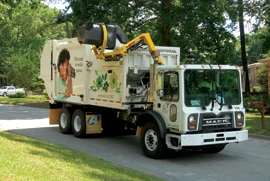
“We’ll pick up garbage however the customer wants,” says Brian Jongetjes, president of Johns Disposal Service Inc. in Whitewater, WI. Fulfilling municipal contracts means he has to “deal with everyone,” he explains, so he willingly adapts to his customers’ preferences. “We’re not proud.”
But they are practical. Johns Disposal began automated collection in 2001 with 5,000 households, largely because of single-stream recycling. Although dual-stream is the norm in his area, Jongetjes says single-stream is taking over because separating paper from other recyclables at the truck takes too long.
However, the traditional blue bins aren’t adequate for single-stream recycling. “The customer needed more capacity,” he explains.
Not only does a 96-gallon cart with a lid and wheels from Toter have enough capacity to handle single-stream recycling, but it is big enough that it is only emptied every other week. That helped reduce costs and fuel. “If you recycle to conserve resources, why send a Class 7 truck every week?” Jongetjes ponders.
Another question he asked was how to empty these large, heavy carts. “They’re too big to lift and too slow to wheel up to the truck.” Moving to a fully automated truck with a hydraulic arm proved to be safer, quicker, and more efficient.
The end results are improved recycling and better aesthetics, thanks to reduced litter in the street. “We sell it as better for the customer,” Jongetjes notes. “The savings pays for the can.”
The company that was started by his dad in 1969 with one truck now serves 100,000 households in an eight-county area and has two recycling facilities. They serve those customers with Heil fully automated side-loaders, exclusively, and about 100,000 Toter carts.
“Heil was our choice because we had issues with litter on the front loaders,” Jongetjes explains. “We also believe there’s an advantage with the side-loader; you can see in front better.”
He chose Toter because he believes the rotationally molded carts perform better in cold weather than their injection-molded counterparts. Another benefit is that the carts tip back on their wheels more easily and can nest inside each other with the wheels on.
Johns Disposal offers the carts in three flat colors: brownstone is most commonly used for garbage, and greenstone for recycling. “A garbage container should not be the focal point of a property,” Jongetjes states. “It shouldn’t stand out; it should blend in.”
And it should last. “It costs money to replace, so we don’t want to. Fortunately, every one has a 10-year warranty.”
Budget Impacts
All manufacturers offer a 10-year warranty because customers are looking for durability, says Steve Schiefer, vice president of sales and marketing, environmental division, with Compass Molded Products LLC. “Durability and warranty are important.”
They’re important because in a tight economy, everyone’s watching costs. “The investment in carts is substantial,” Schiefer explains. “Bells and whistles get cut when a budget gets tightened.”
One of those bells and whistles is RFID. Jongetjes doesn’t use it in Wisconsin, and neither does Schiefer, who says, “People want it because it increases efficiency, but they don’t want to pay for it.”
RFID participation costs money, confirms Don Groseclose, vice president of product sales at Otto Environmental Systems North America, Inc. Some of his municipal customers request tracking inside the cart to gauge end-user participation and trace service, but he says haulers are also concerned with day-to-day reliability. “They need the wheels and lids to stay on,” he elaborates. “They want no rodents, no issues.”
Dian Sommers, account manager, refuse and Tool-Tainer products, says Snyder Industries doesn’t even offer RFID. Instead, their containers have serial numbers that can be seen from the truck for tracking purposes. Because the first container is free, but customers have to pay to repair or replace broken or lost carts, it’s necessary to track them. Some end users have been known to switch broken carts with their neighbors.
Customers want to save money, Sommers continues. The right cart can help them save man-hours, time and fuel-all of which cut costs. Made of HDPE plastic resin, rotationally molded Snyder carts are durable. Sommers says that the city of Roswell, NM, has used them for 15 years. “The ROI is very good!”
Plastic carts have several benefits; they don’t rust, there’s no paint to chip and they’re easy to power-wash. They’re also recyclable. “Metal bins have to be repainted every other year,” Sommers notes, “and the bottoms rust. Workers hate metal bins: bottoms rust out, so they have to fix them. That’s a lot of maintenance.”
As the only manufacturer that makes plastic side-load bins, Snyder attracts customers concerned with saving weight, which creates wear on the truck arm. “Our plastic 2- and 3-yard side-load bins weigh 60% less than steel,” Sommers says.
An unexpected benefit of the lightweight, robust plastic carts is their resilience. Sommers tells a story about a customer in Big Lake, TX, that used a truck to push the carts back into place without damage after strong winds blew them across a parking lot.
Teamwork
There are two types of carts, Schiefer explains: rotationally molded and injection-molded, which, due in part to cost, comprises 80% of the market. Compass Molded Products produces injection-molded carts for residential users in sizes of 35, 65, and 95 gallons.
“The features are similar; there’s not much difference between manufacturers,” he confesses. “It’s all about customer service. Service is important in today’s world.” As part of CMP’s service, Schiefer says the company works with haulers to ensure they’re compatible with the trucks used and that the grabber arms are not abusive. “Carts don’t break by themselves. You must maintain the arms on the trucks; they work together.”
It’s equally important that the end user is able to work with the cart, which is why Snyder offers two styles of innovative lids for its 200-, 300- and 450-gallon carts, both of which are interchangeable. The 50/50 split lids have a smaller opening and are typically used for recycling, Sommers says. Because the durable double-wall construction produces a heavier lid, the split lid is lighter for customers to lift.
The two-thirds lid design, what Sommers refers to as a 70/30, features a bigger opening. Because the single-wall construction is lighter, it’s easy to lift and allows for use of larger refuse bags.
Lids are available in a variety of colors to designate refuse, recycling, or yardwaste collection. “Blue is popular for recycling, and green for trash,” Sommers indicates, adding that some customers request school colors or prefer tan so the carts blend in.
The lids rotate 110 degrees for easier loading, dumping, and independent closing. Attached with four “molded-in” hinge holes and large hinge pins to add strength, the lids feature an angled bracket that keeps the lid from “going too far over” due to wind or excessive use.
Snyder’s 300-gallon round cart is its most popular for side-loaders by 10 to one, Sommers says, but a new product is attracting attention. Fully automated Eco-Tainer Litter Receptacles and Eco-Tainer Recycle Receptacles replace the outdated concrete and metal receptacles commonly used in downtown city locations, at retail businesses, parks, stadiums, hotels, restaurants, and on campuses. Available in 40- and 58-gallon capacity, they feature double-wall construction for strength and leak protection. Optional features include an ashtray and bottle/can opener.
Leftovers
Innovative responses to changing trends in collection are becoming more prevalent and, as always, are driven by costs. The desired result is generally increased efficiency, productivity and/or safety.
Otto makes low-maintenance carts that end users can move easily for its municipal customers, as well as carts for large families, apartment complexes and recycling, but Groseclose explains that different types of collection require different types of carts. Manual collection necessitates carts that can be easily handled. With fully automated collection, where speed is an issue, carts must withstand the pressure of years of service.
Currently, single-stream recycling is successful because it’s easy for the customer to understand.
Because it’s easy, it encourages more participation, which lowers the cost.
Recycling must make financial sense, Groseclose says. But costs are pushing back from another angle, and that’s changing ideas about collection.
In the future, Groseclose envisions a focus on foodwaste and greenwaste that will create a demand for a smaller container. “Weight is the issue,” he says. “The new push is to take the weight out by separating kitchen and greenwaste.” Landfill fees are driving it, he says. Disposal fees for food are high because it is some of the heaviest waste.
The goal is a smaller, easy-to-maneuver cart that’s separate from nonrecycling and other recycling carts. “Food and greenwaste can be recycled, but must not contaminate other recyclables,” explains Groseclose.
Otto’s injection-molded plastic carts are available in many sizes, ranging from 20 to 95 gallons. “Many communities are using the 95-gallon cart for recyclables,” Groseclose says. “Our goal is for everyone to use the biggest cart for recyclables.”
To encourage more recycling, he says it’s important to continue to make it easy on the end user and that they need to generate “buzz” and incentives-possibly by obtaining grants to offer incentives to recycle. Education of school children will help create lifelong habits that lead to successful programs and an enriched knowledge base for future generations.
Roughed Up by Recycling
Anticipating future impact on truck specifications from the increased popularity of source-separated organic waste (both commercially and residentially), Ken Beaver, director of mobile products, Environmental Solutions Group, for Heil Environmental in Monroeville, PA, says the unique characteristics of organic waste-primarily foodwaste (putrescible, high-liquid content, corrosive, high uncompacted density) create distinctive challenges for both haulers and RCV body manufacturers.
Fontaine Modification outfits trucks in a variety of configurations, including dual-drive.
As Jongetjes learned, dual-stream recycling (paper, cardboard, magazines in one container; glass, cans, etc., in another) is being largely replaced by single-stream recycling as more single-stream MRFs are being put into service, Beaver says.
Single stream, also referred to as commingled, is used typically to refer to collecting all recyclables in one container. The convenience of single-stream recycling for the homeowner predictably results in higher participation rates.
Convenience for the customer sometimes goes even further. “So-called “˜dirty MRFs’ are now gaining in popularity as the technology has advanced to the point where recovery rates are acceptable when garbage and recyclables are mixed together,” Beaver says.
Whether haulers are picking up garbage and recyclables in the same container, or just recyclables, it has an impact on truck specifications: the level of compaction cannot be too high, as it could render some of the recyclables unrecoverable at the MRF. For example, a plastic milk carton must somewhat resemble an uncrushed carton in order for the MRF to properly sort it.
For smooth, productive collection of recyclables, Heil offers both Rapid Rail and Liberty automated side-loaders with continuous pack functionality. According to Beaver, their installed base of Python and Rapid Rail ASLs is by far the largest fleet of ASLs in operation today.
In the two decades since the original units went into service, the company has collected extensive real-world performance data and used that information to fine-tune its designs and establish preventative maintenance procedures to ensure maximum uptime and performance in the field, all of which contributes to reliability and durability-key components in calculating the total cost of ownership.
Snyder’s plastic 2- and 3-yard bins weigh 60% less than steel.
“It takes an inherently good design combined with proper preventative maintenance to ensure consistently high performance and productivity with an ASL,” Beaver continues. “In addition to the mechanical design itself, the hydraulic system and controls are critical to durability, smoothness of operation, and ergonomics. Hydraulic hose routings, in particular, are an area we pay close attention to.” The company’s ASLs routinely collect from more than 1,000 homes a day; routed hoses ensure longevity.
By studying the G-forces associated with the cycling of the automated arm, they have fine-tuned the controls to minimize rocking in the vehicle, which reduces fatigue on the operator and equipment. Reducing fatigue can affect durability, which, in turn, affects costs.
Life cycle cost, or total cost of ownership, is keenly affected by reliability, as Wayne Industrial Holdings LLC has already discovered, says Mark Watje, business development manager. “Recycling debris wears away steel in close to half the time one would expect with standard residential trash. This means that the metal in hopper floors and body floors has to be patched or replaced more often.” It also means that the refuse trucks have added weight due to thicker steel packages and steel overlays required for recycling.
Dedicating a truck to a recycling-only route is one of the most abusive things a user could do, Watje warns. The same truck operating on both recycling and residential trash routes will last longer because of the lubrication provided by residential trash.
“The reason recycling is so abrasive is because it is dry and has spring-back,” Watje explains. “Plastic products push back after being compacted. The spring-back action causes abrasion during compaction and post-compaction.” In response to the changes, most of their Curbtender ASLs are now equipped with a Hardox 450 hopper floor overlay.
Environmental Impact
In order to lessen their effect on the environment, some municipalities are moving to an every-other-weekend collection by using larger carts. Heil is offering an option to run CNG rather than diesel in its vehicles. Both plans can reduce the environmental impact of collection vehicles.
“If the CNG originates from a natural-gas pipeline, the carbon footprint of that vehicle is reduced by 25%-a significant number, considering a diesel-powered RCV will release over 800 tons of CO2 into the atmosphere over its lifetime,” Beaver says. CNG trucks are also significantly quieter than diesel.
Heil manufactures and installs CNG systems in its facility in Fort Payne, AL, and has an onsite fueling station as part of its commitment to this clean, domestic fuel. “We expect that by 2014 or 2015, CNG will actually be the majority fuel.”
If the CNG originates from the organic waste being collected by the truck, through use of a SmartFerm anaerobic digestion system that converts waste into methane (the primary component of natural gas), there is even greater benefit for the environment. “This is even better than landfill gas, because 100% of the methane is collected, as opposed to 75% of landfill gas typically being collected, in a controlled environment, with only a 21-day cycle time,” Beavor elaborates.
The remaining mass is marketable compost material. “This is a beautiful closed-loop system, using the very waste being collected by a truck to fuel that truck!”
Sometimes it’s the seemingly obvious things that can make a difference. Reducing the weight of the vehicle has a significant impact on both the cost of operation and the environment. “By using sophisticated finite element analysis tools, combined with extensive in-the-field results, we know where weight can be reduced without compromising structural integrity,” Beaver indicates. “This is akin to the housing industry. In the old days, houses were often greatly overbuilt, due to a combination of cheap raw materials and a lack of structural analysis tools. Nowadays, designs such as truss systems and new lightweight materials can both reduce the weight/volume of the materials being used and increase structural integrity. Our Liberty and Rapid Rail ASLs and Freedom AFL are great examples of lightweight RCV designs at work.”
Safety Is Job One
The more sophisticated haulers pay close attention to their total cost per home. “The key elements of TCO are productivity, operator, fuel, maintenance, and capital,” Beaver says. The operating costs over the life of a vehicle, which he estimates can run well in excess of $1 million, can be significantly reduced by investing in the right equipment.
Investing in a skilled work force can also benefit the bottom line. Beaver says end users are dealing with an aging work force and that they face increasing difficulty in finding and keeping employees-particularly trained mechanics. He believes that standardized equipment and comprehensive technical training can help retain employees.
Ergonomics may be another way and, as Beaver acknowledges, although cost of operation and environmental impact are important considerations, safety is the number-one priority for almost everyone. “Safety and ergonomics continue to be huge issues for our customers.”
He says that transitioning from rear loaders to Heil automated equipment made a significant improvement in safety-as well as productivity-and that it’s not unusual to see workers compensation claims drop by 80% or more as a result.
Even with ASLs, however, there are risks associated when backing up to get around a cul de sac, for example. Camera and radar systems can certainly reduce that risk, but Heil’s solution is to reduce the amount of backing up required in the first place and to put the work in front of the operator for improved safety and ergonomics.
Using a Heil automated front-loader rather than an ASL can increase the safety factor and improve the ergonomics. Heil’s Half/Pack or Freedom front-loader is specifically configured to seamlessly interface with a Curotto Can system. “With the Curotto Can out over the front axle, the operator can easily see the work in front of him and quickly react to unforeseen events on the route, such as a child running out into the street, as well as service a cul de sac with significantly reduced backing events, compared [with] an ASL,” Beaver concludes.
Sight lines go hand-in-hand with safety. Rearview safety camera systems have been standard on Wayne products for a few years. Watje says most of Wayne Industrial’s customers order more than one camera. “It is not uncommon for a refuse truck to operate with four color cameras (located on the tailgate, in the hopper, streetside bumper, and curbside bumper).”
In 2007 he saw a push to use backup sensors similar to the parking sensors found in passenger cars. Despite its affordability, however, that trend never materialized in the refuse industry. “The prevalence of backup cameras likely stifled this product development, despite the fact that they are complementary items,” Watje muses.
There is a desire to increase safety levels, but both public and private haulers have been unwilling to sacrifice productivity levels in order to reach a greater level of safety, Watje claims. Certain safety devices widely used in Europe make it nearly impossible for a person’s hand to access a pinch point during operation of a rear-loader, but because they tend to slow down refuse collection, they haven’t been used in America.
It’s a Mod, Mod, Mod, Mod World
If haulers are looking for productivity, they can opt for a modification that will add speed and safety while reducing fuel consumption and providing better sight lines.
Fontaine Modification Co., of Charlotte, NC, modifies International and Freightliner trucks for end users and body outfitters, converting them to stand-up right-hand drive and sit-down right-hand, or dual drive.
“The benefit is efficiency,” says Steve Boyer, executive vice president. One person can operate the vehicle as effi
Latest from Waste Today
- Worn Again Technologies unveils Accelerator plant to advance polycotton recycling
- Nashville Waste Services launches new digital route system
- ACUA landfill expansion project unanimously approved
- Clean Energy announces multiple RNG deals with fleets nationwide
- Interchange 360 to operate alternative collection program under Washington’s RRA
- Waste Pro files brief supporting pause of FMCSA CDL eligibility rule
- New Way Trucks expands US network with Joe Johnson Equipment
- Tire Industry Project publishes end-of-life tire management guide