When Robert A. Watts, S.C., BCEEM, was a teenager, he witnessed a fish kill caused by illegally dumped chemicals. That set the stage for a long career in solid waste management, for which he has received many accolades. Since 1999, Watts has served as the executive director for the Chester County Solid Waste Authority (CCSWA) in Narvon, PA. The authority is responsible for solid waste planning, recycling, landfilling, and beneficial landfill gas use. The landfill and compost operations serve 49 Chester County municipalities with about 400,000 people. Watts leads Chester County’s solid waste future planning. He answers to the CCSWA volunteer seven-member board of directors, implementing board policy with his senior staff. One directive is organizational involvement-as such, Watts is active with SWANA’s Keystone Chapter and has served as its International Board member. Watts also leads a Citizen’s Advisory Committee, focusing on visual impact and end use planning.
What He Does Day to Day
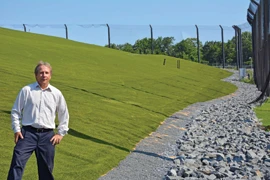
Watts drives around Lanchester Landfill’s 600 acres, checking on the residential drop-off area, compost area, working face, closed landfills, construction projects, landfill gas, and leachate treatment buildings. He supervises a staff of 25. Watts is the primary liaison with CCSWA’s landfill gas partner and wood recycler. In his public relations outreach, he is involved in site tours, local non-profits, and government meetings. He’s one of three CCSWA website webmasters and the webmaster for SWANA’s Keystone Chapter, answering e-mails within a day. Once a month, Watts takes trailers full of Styrofoam and plastic bags to a material recovery facility and unloads them by hand for recycling.
What Led Him to This Field
Watts’ childhood in Bucks County, PA,was spent fishing, backpacking, skiing, and canoeing. A chemical company near his high school treating liquid hazardous waste was also discharging some of it into a local stream, turning it various colors and killing fish. Watts’ mother worked at the newspaper which was covering the story, and he and a few friends entered the property to take photographs for the coverage. The facility became a Super Fund Site.
In high school, he helped organize the first Earth Day, producing a series of movies and filmstrips on “The Environmental Crisis” to his social studies class. Watts had originally wanted to open a ski shop, but an environmental studies class charted a new path.
He earned a B.S. in civil engineering from Utah State University. Guided by an adjunct professor, Watts pursued a Master’s degree in environmental engineering to develop the skills needed to design and operate a facility that manages waste.
“At that time, I was not sure what type of waste,” he says, “but I was sure it would be a challenge.” Watts would subsequently work for Pennsylvania’s Geological Resources Operations Waste Systems, New York’s Monroe Livingston Sanitary Landfill, Waste Management in Illinois, the New Hampshire/Vermont Solid Waste Project in New Hampshire, and New England Waste Service, before going to CCSWA.
What He Likes Best About His Work
Providing essential services to the county at a competitive rate with minimal environmental and neighborhood impact is Watt’s greatest satisfaction. “The CCSWA Board of Directors provides guidance without micromanaging,” he says. “Many employees have been here longer than me, but are still willing to try new ideas.”
His Biggest Challenge
Odor control is one challenge, with homes and businesses being constructed near landfills, Watts says. “Landfill gas odors are hard to neutralize. It takes time to mobilize a contractor to add more landfill gas extraction wells,” he says. “We expand our landfill gas collection system yearly, even though by regulation we could wait almost five years.”
Waste is covered daily to reduce odors. A final cap is placed on landfill areas a year within reaching final grade. Odor-neutralizing agents are used to reduce offsite odors. Preparing for Chester County’s solid waste management future is another challenge. Watts says CCSWA is approached by those claiming their conversion technologies will save money and utilize more of the waste stream as a resource. While he and board members are open-minded, they don’t want to be the first to try unproven technology, Watts says. To that point, he attends SWANA seminars in person and online to make educated evaluations of proposals and keep current with landfill technology.
Latest from Waste Today
- Worn Again Technologies unveils Accelerator plant to advance polycotton recycling
- Nashville Waste Services launches new digital route system
- ACUA landfill expansion project unanimously approved
- Clean Energy announces multiple RNG deals with fleets nationwide
- Interchange 360 to operate alternative collection program under Washington’s RRA
- Waste Pro files brief supporting pause of FMCSA CDL eligibility rule
- New Way Trucks expands US network with Joe Johnson Equipment
- Tire Industry Project publishes end-of-life tire management guide