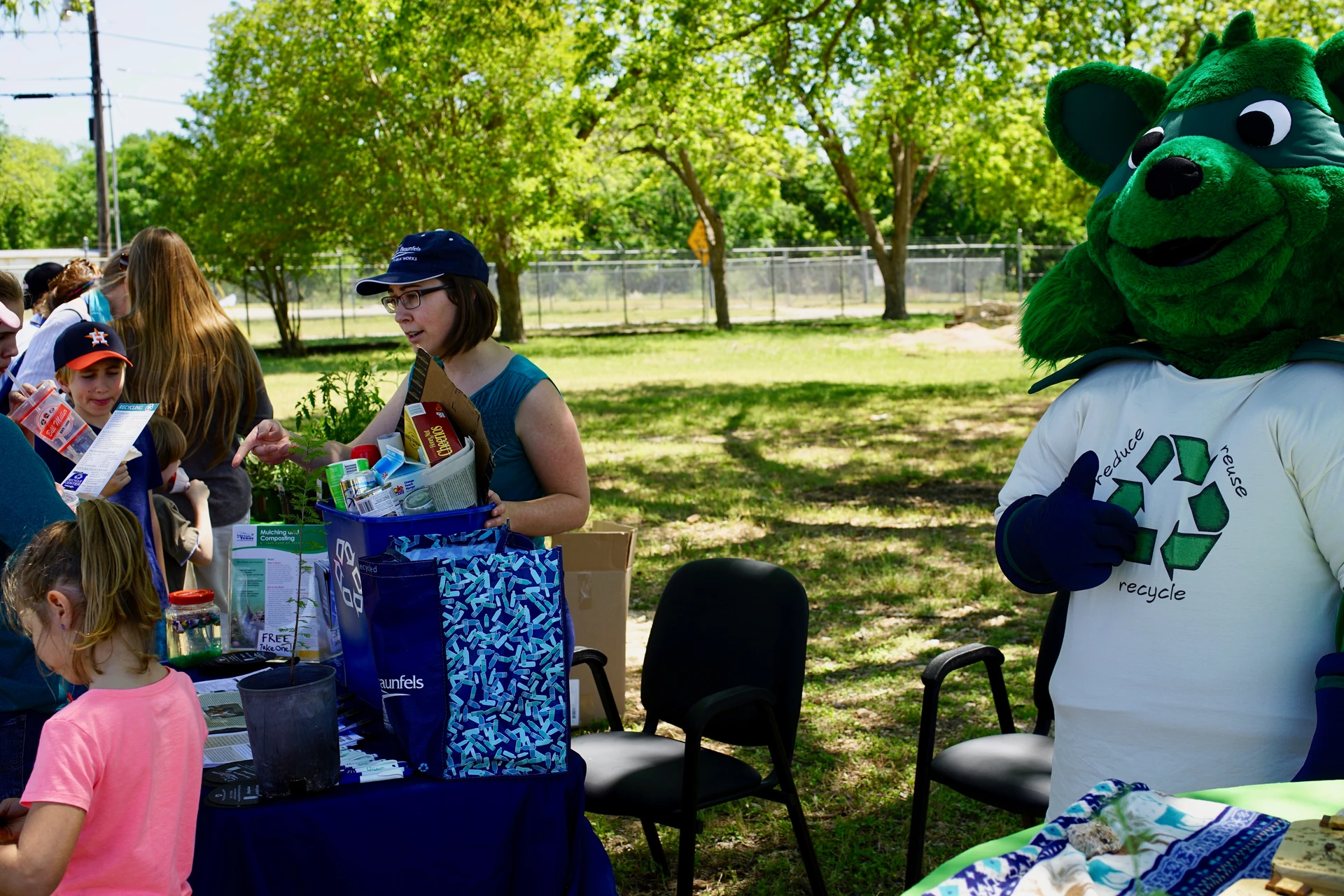
Over the past 10 years, Catelyn Scholwinski has inspired inquiring minds to reduce their environmental impact, practice waste reduction, and support local sustainability initiatives while in her role as recycling coordinator for the city of New Braunfels, Texas. She has worked on a myriad of projects in her tenure, including creating a 20-year plan, establishing a city-wide drop-off recycling program for expanded polystyrene, curriculum design and implementation, and modernized program communication. Scholwinski’s impact reaches beyond New Braunfels to the industry at large in the roles she actively serves with SWANA, including leadership roles in Communication, Education and Marketing, Young Professionals, and as the current director for Sustainable Materials Management. “I love connecting and learning from other professionals in the field and now as I shed the ‘young professional’ label, it is rewarding to lift others up so they can improve the industry on their journey,” Scholwinski says. Her accomplishments include launching an internal recycling program for city employees and successful grant application writing—including a Keep America Beautiful grant enabling the placement of 20 recycling bins in high-traffic parks. She communicates the recycling message through video scripts, public speaking, and writing, including storytelling copy and game concepts for a children’s activity book teaching about recycling, litter, and re-use. Scholwinski collaborated with the local school district to write a two-day, science-centric curriculum focused on waste reduction and recycling education that is given to every sixth-grader annually. She also established an annual electronics recycling event.
WHAT SHE DOES DAY TO DAY
Scholwinski spends most of her time in the office managing multiple projects, researching industry trends, and preparing communication materials. She also may teach recycling at the high school one day and give a formal community presentation the next. "The pandemic reduced some of the in-person education opportunities, but that does not mean people stopped having questions," she points out. “My team and I are diligent in our efforts to address all of the issues and ensure we achieve the very best for our customers, who are usually our neighbors, too.”
WHAT LED HER TO THIS LINE OF WORK
Scholwinski earned a B.A. degree from Trinity University with double majors in urban studies and sociology. She is currently working on an M.S. degree in sustainability studies at Texas State University. But like so many others in the solid waste industry, a career in recycling was not on her radar as she was growing up. The Texas native hadn't seen recycling practices and opportunities modeled. “It was not a priority, and we certainly did not talk about it in school,” she notes. While studying in Vancouver, Canada at Simon Fraser University where she received a post-baccalaureate diploma in sustainable community development, Scholwinski came to appreciate waste as a resource and was fascinated by all of the successful sustainability programs that had been implemented in the Vancouver area. "I met some wonderful people who opened the door to the world of waste reduction and why it matters,” says Scholwinski. “When I came back to Texas, I saw the job posting and was eager to start advancing recycling and diversion for my fellow Texans.”
WHAT SHE LIKES BEST ABOUT HER WORK
"There's something satisfying about pulling back the curtain of the waste industry for people,” Scholwinski points out. “I think the most enjoyable parts of my job have been revealing the underlying systems, people, and processes that truly make recycling happen. Whether they are old or young, people are always asking questions and I love being able to give them the answers.”
HER BIGGEST CHALLENGE
New Braunfels, like many other cities in Texas, has recently exploded with growth and the city has been feeling the impact of the rapid increase in population. More people living in the area has equated to more solid waste. In New Braunfels, in particular, it also has meant an increase in more contamination in single-stream recycling. “We continually put the message out there—even in the local movie theater—but we still have those people who are not motivated to recycle correctly,” Scholwinski points out. “Recently, we have doubled our efforts to increase public awareness and garner support that parallels the city’s growing pains.”
Latest from Waste Today
- My Green Michigan expands depackaging capacity
- Washington selects Circular Action Alliance as PRO
- Ten-8 Industrial opens new central Florida service center
- Triumvirate Environmental acquires Environmental Waste Minimization
- Official NYC Bin availability expands ahead of deadline
- US Food Waste Pact’s 2025 Impact Report shows decrease in food waste
- Coastal Waste & Recycling expands recycling operations with Machinex
- Reconomy acquires German-based GfAW