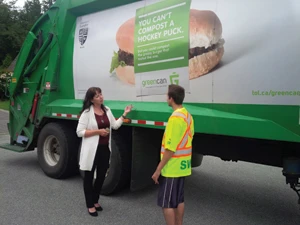
Noticing that a significant amount of landfilled waste was comprised of organics, the Township of Langley in British Columbia, Canada, implemented in 2011 the Green Can Program, whereby residents were encouraged to include food scraps with the weekly collected yard trimmings. With 35% of the waste going to landfill still comprised of organics and the provision of programs and facilities to handle the materials now in place, the region will be imposing an organics ban at its transfer stations and landfill in early 2015, to incentivize the use of the programs and reduce the amount of organics in the garbage. The Township of Langley’s public education efforts won a Gold Award from SWANA in 2013 and is one of several efforts to reduce waste. Overseeing those efforts is Solid Waste Coordinator Debbie Fleming, who manages the Township of Langley’s curbside collection programs, community education efforts, and an annual household hazardous waste dropoff event.
The Township, located on the eastern boundary of the Metro Vancouver, BC, region, is home to about 106,000 residents. The Metro Vancouver region, which encompasses 22 member municipalities, delivers regional services that also include overseeing the management of solid waste for 2.3 million residents. Metro Vancouver developed the Integrated Solid Waste and Resource Management Plan to better manage the 3 million tons of solid waste generated annually in the region. Since reaching the current diversion rate of 55%, the plan encompasses some ambitious goals, including reaching waste diversion of 70% by 2015, and 80% by 2020. Fleming brings to the Township of Langley 23 years of experience in municipal waste reduction and recycling, including the implementation of the municipal blue box recycling program in the early 1990s. Prior to starting work with the Township of Langley in 2008, Fleming spent 18 years as waste reduction officer for the City of Coquitlam, initiating various new programs such as the annual citywide garage sale, community recycling depots, and bear-resistant collection containers.
What She Does Day to Day
Fleming works with Sierra Waste Services, the current collection contractor, as well as a variety of consultants, internal staff, and in a liaison role with counterparts from other municipalities and the regional district. Fleming oversees the residential recycling, garbage, and green can organics collection programs.
“Coordinating residential participation surveys; door-to-door visits; and implementing pilot programs, large program promotions, and education campaigns are all essential components to achieving waste reduction goals,” she points out. “Currently, we are conducting an extensive review of our entire solid waste collection services and programs using a triple bottom-line approach with the goal to optimize processes, and programs with the aim of generating options for curbside waste collection programs, and to enable the township to meet diversion targets, as well as current and future waste reduction and servicing challenges.”
What Led Her to This Line of Work
Not having any solid waste educational background, “I just fell into garbage backwards,” says Fleming. “I didn’t set out with a goal of working in this field. I have no letters behind my name. In 1991, in my job with the City of Coquitlam, I started off answering phone calls and responding to resident inquiries about the then-new recycling program. Over the years, with experience and on-the-spot training, the job kept growing. I find my work very interesting, challenging, and rewarding.”
What She Likes Best About Her Work
The “world” of garbage recycling and waste reduction is ever-evolving, Fleming notes. “It’s very interesting and very busy,” she says. “I like that our work makes a difference in our little corner of the world by making things a little better for our environment.”
Her Greatest Challenge
The biggest challenge for Fleming isn’t so much implementing new programs, but in getting the message out in a way that will foster the behavior changes resulting in resident participation. “There’s always more we could do, and thankfully we have a great team,” says Fleming. “I am surrounded by very accomplished and energetic co-workers and management that is proactive, encourages thinking outside the box, and is always looking for ways to make improvements. The much-appreciated assistance of two or three summer students each year really helps make it all happen.”
Latest from Waste Today
- Vecoplan to present modular solutions at IFAT 2026
- Terex Ecotec appoints Bradley Equipment as Texas distributor
- My Green Michigan expands depackaging capacity
- Washington selects Circular Action Alliance as PRO
- Ten-8 Industrial opens new central Florida service center
- Triumvirate Environmental acquires Environmental Waste Minimization
- Official NYC Bin availability expands ahead of deadline
- US Food Waste Pact’s 2025 Impact Report shows decrease in food waste