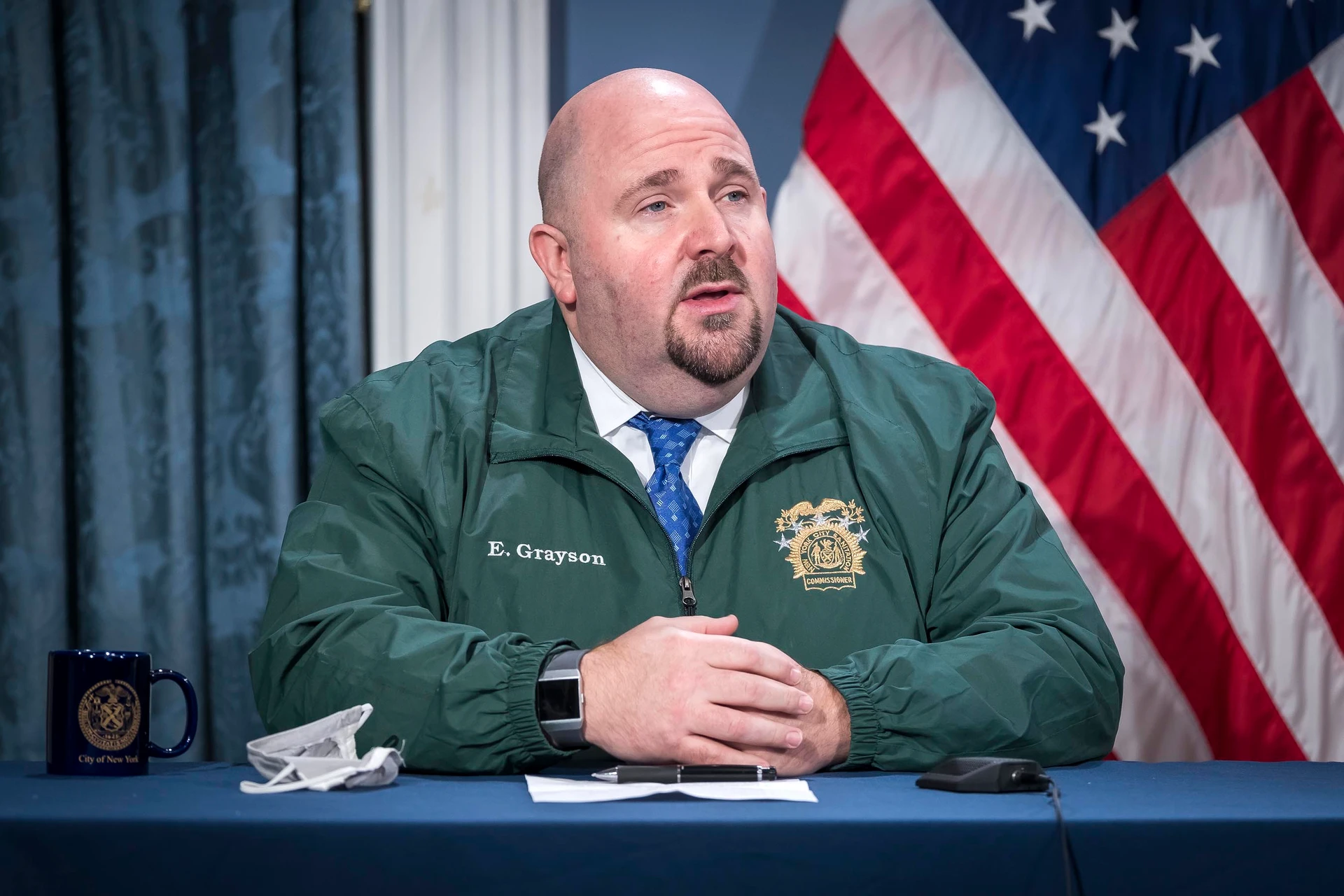
A teacher once asked Edward Grayson what he wanted to be when he grew up. His reply: “A garbage man.” He explained his father was a New York City sanitation worker. In 1989, Grayson’s mother became the city’s recycling outreach coordinator, overseeing the program’s genesis. Today, Grayson serves as the Commissioner of the New York City Department of Sanitation for which his parents worked. Grayson oversees 10,000 employees who on a daily basis pick up 12,000 tons of garbage and recyclables, empty 23,000 litter baskets, and remove snow on 19,000 routed miles for the city’s 8.8 million residents. The department’s fleet has more than 2,300 collection vehicles and hundreds more pieces of equipment that move solid waste to four marine transfer stations and a rail transfer transport to landfills along the Interstate 95 corridor. Relationships are maintained with a large vendor network. Following his appointment by New York City Mayor Bill de Blasio, Grayson took the helm of dealing with not only typical sanitation responsibilities, but also the impacts of COVID-19. At times, 25% of the workforce has been out due to COVID illness or exposure; 10 employees died. Employees’ vaccination rate has exceeded 90% with some 200 employees placed on unpaid leave for failing to comply with mandates.
What He Does Day to Day
Grayson’s day includes a rundown from command division chiefs and updates on the budget and legal affairs to stay abreast of schedules, throughput, remaining capacity and other operational issues. He checks in with elected officials and community leaders. “My favorite part of my day is discussing R&D and new challenges,” says Grayson. “We spend time planning how to meet the constituents’ needs and the changing landscape.” Multiple proactive plans address a myriad of possible outcomes. A 140-year-old department history applies institutional knowledge to present-day circumstances. Grayson finds it critical to check in on the workforce, including organized labor. “They are the department’s cornerstone,” he says. “Having grown up here and the fact that my parents worked for this department, I'm employee-centric. They are the absolute greatest bunch of people I've ever had the pleasure to work with. I want to make sure they’re OK.”
What Led Him to This Line of Work
After graduating from high school and taking college business courses, Grayson’s path to becoming a second-generation New York City sanitation worker opened up after he met all of the civil servant exam and medical screening requirements. He credits his parents for having planted the seed. Grayson’s 23-year path has seen him move through the ranks from driving a refuse truck to his current post.
What He Likes Best About His Work
“While being nameless and in a thankless profession can seem like a lot, you get to look at it through the rearview mirror and see how many people you've helped,” Grayson says. “I have been so fortunate to have a network of people who are the hardest-working, most genuine people I've ever met. It gives me joy to come in to work—it’s about the people, the work, and the services we provide.”
His Greatest Challenge
Getting everyone on the same page regarding recycling is Grayson’s biggest challenge. It’s been a challenge since his mother was hired to launch the recycling program in 1989, teaching people how to do curbside recycling. “How do you get 8.8 million New Yorkers to change their behavior, to do the right thing?” Grayson asks. He notes the department has the logistical and tactical deployment strategies to pave the way and that while legislative changes help govern and set standards, “the real point is we have to get into the into people's homes and have them make better decisions by choice. From the kitchen to the curb, we are doing everything that we can to ramp up and get back into a zero-waste goal.” NIMBY is another challenge. “For us, it’s trying to remind everybody on a daily basis that they are getting so much value out of having this department operated every single day and how do you help us find the land we need and build the infrastructure needed to provide the waste management system needed to continue for this great city?”
Latest from Waste Today
- Vecoplan to present modular solutions at IFAT 2026
- Terex Ecotec appoints Bradley Equipment as Texas distributor
- My Green Michigan expands depackaging capacity
- Washington selects Circular Action Alliance as PRO
- Ten-8 Industrial opens new central Florida service center
- Triumvirate Environmental acquires Environmental Waste Minimization
- Official NYC Bin availability expands ahead of deadline
- US Food Waste Pact’s 2025 Impact Report shows decrease in food waste