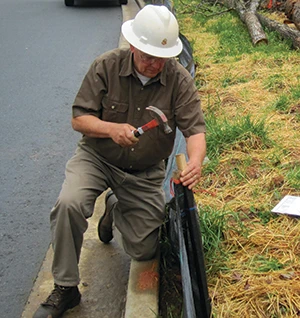
James W. Spotts’ vehicle license tag reads “Dr. Dirt.” It’s an apt description for his career as a soil scientist, which now focuses on his company, Southeast Environmental Consultants, in Atlanta, GA. The seeds were sown when, as a child in north Florida, Spotts dug a hole into sandy soil and jumped in, then couldn’t extract himself. Summoned by friends, his father rescued him and told his son: “If you are going to dig a hole, dig a big one!” Spotts would go on to dig many big holes in the service of erosion and sediment control. During 27 years of federal service, he received numerous recognitions, including the US Department of Interior’s Thousand Points of Light honor in 1991.
What He Does Day to Day
Spotts works with clients whose multiple construction locations require weekly inspections to evaluate the effectiveness of best management practices on the approved plan, making improvement recommendations. He monitors sites’ stormwater discharge as part of Georgia’s National Pollutant Discharge Elimination System requirements for disturbed areas. Spotts also teaches in the Georgia Soil and Water Conservation Commission Qualified Person training program. He’s contributed to the Manual for Erosion and Sediment Control in Georgia. Spotts has served as an expert witness in civil cases and court appearances. He also works as Chamblee, GA’s site inspector for city code compliance. “I first engage the contractors to correct site deficiencies, often with suggestions as how to keep the site in compliance rather than to face the consequences of noncompliance,” he notes. He is also heavily involved in the International Erosion Control Association.
What Led Him to This Line of Work
Spotts majored in forest management and minored in soil science at North Carolina State University, earning a B.S. degree. He worked for the US Forest Service, which needed soil scientists to map Arkansas soils. Following military service, Spotts resumed his role, mapping and interpreting soils for multiple uses. He earned an M.S. degree from the University of Arkansas. While studying agronomic and civil engineering aspects of soils, Spotts managed a portion of the soil testing laboratory. He earned a Ph.D. in soil physics from Texas A&M University, where he was the soil physics laboratory assistant, examining variations in a soil series previously not reported. He then joined the US Army Corps of Engineers’ Waterways Experiment Station in Vicksburg, MS, leading a field party collecting samples of dredged material from the nation’s waterways to check for pollutants and seek dewatering methods for “black soup” waters. Spotts demonstrated the effectiveness of vegetation in lieu of complex engineering alternatives. Following that, he served as the regional soils scientist in the US Department of Interior’s Kansas City, MO, Office of Surface Mining Reclamation and Enforcement (OSMRE). “At the time, streams below mining operations were filled with sediment, some very acidic,” notes Spotts. He was sent to Washington, D.C. to chair a national committee of leaders in hydrology, sedimentology, and erosion control programs that drafted sediment ponds regulations. He returned to Kansas City to set up the first field training program for state inspectors. Spotts moved to Pittsburgh, PA, to continue training and outreach programs. He spent two years in private practice, working mostly with university students in the jungles of Peru addressing agricultural production on steep mountain slopes prone to erosion and slides. He returned to OSMRE as a program manager, conducting mine plan reviews, training, and public outreach. In 1998, Spotts moved to Atlanta to provide construction plan erosion and sediment control for two consulting companies. He started Southeast Environmental Consultants in 2000, planning and managing cost-effective construction-site erosion and sediment control.
What He Likes Most About His Work
Spotts says his philosophy has been to focus educational efforts on the wise use of soil resources. “Soil is non-replaceable,” he says. “I am simply a caretaker of this resource. What we leave our children is important to me.”
His Biggest Challenge
“Soils are a mystery,” notes Spotts. “Every aspect of this living entity offers challenges.”
Among them: time. “Prioritizing goals is the biggest challenge,” he says. “In the long term, getting information I’ve learned into the hands and minds of others is the greatest challenge. No need for someone else to reinvent the wheel.”
Latest from Waste Today
- Worn Again Technologies unveils Accelerator plant to advance polycotton recycling
- Nashville Waste Services launches new digital route system
- ACUA landfill expansion project unanimously approved
- Clean Energy announces multiple RNG deals with fleets nationwide
- Interchange 360 to operate alternative collection program under Washington’s RRA
- Waste Pro files brief supporting pause of FMCSA CDL eligibility rule
- New Way Trucks expands US network with Joe Johnson Equipment
- Tire Industry Project publishes end-of-life tire management guide