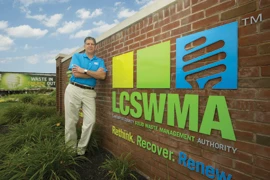
Lancaster County, PA, is a study in contrasts. Its name conjures images of the rolling hills of Pennsylvania Dutch farmland, symbolizing its agricultural economy. On the other hand, such companies as the MapQuest headquarters represent the present Information Age. Handling the solid waste needs of the 540,000 people in its service area is the Lancaster County Solid Waste Management Authority (LCSWMA), for which James D. Warner has served as chief executive officer since 1996. Warner directs all authority activities, including operations, planning, financing, recycling, engineering, business development, and capital improvements. He oversees 90 employees, a $53 million budget, and is responsible to a board of directors. LCSWMA’s integrated system combines the resources of a recycling program, state-of-the-art transfer station, waste-to-energy (WTE) facility, a household hazardous waste (HHW) facility that drew 50,000 visitors last year, and a landfill, with the waste flow significantly directed away from the latter. LCSWMA also has a wind-to-energy project with two wind turbines that sell electricity to the adjacent Turkey Hill Dairy, providing 25% of the energy needed for the factory to produce its ice cream and ice tea. “We are very much stretching what would be considered traditional boundaries of a waste authority,” notes Warner. Case in point: The LCSWMA is finalizing the purchase of a WTE plant in adjacent Dauphin County, expanding its system by 300,000 tons and increasing revenues by $30 million. “It’s not very often you see one public entity buying the assets of another, especially a waste-to-energy power plant,” says Warner. “It will bring significant benefits to Lancaster County and bring our operational expertise to Dauphin County where it’s much needed.”
What He Does Day to Day
Warner is a self-described “big picture” person. “I try to guide a big ship,” says Warner. “I set the course, interfacing with a board of directors. We see where we want to be anywhere from one to five years out, and I try to get us there. I have a lot of very capable people who put in a lot of the effort that gets us to where we decide we need to be.” The road to those goals is lined with numerous meetings with individuals, groups, or the senior management team for briefings on the various “tentacles we have out there on our business,” Warner says. “I’m checking daily reports, dealing with anyone from the general public to regulators to directors to legal counsel.” What he enjoys about the days he puts in on the job is that no two are the same.
What Led Him to This Line of Work
Warner’s first profession was that of schoolteacher. After teaching for a few years, he realized he didn’t like it. “It was too routine. I needed more challenge,” he says. “I decided to get out when I was young and poor.” Warner earned a Master of Science degree from Shippensburg University to pursue his interest in environmental issues. After he graduated, he was hired as one of the nation’s first public recycling coordinators in the mid-1980s in southern New Jersey. A few years later, Lancaster County hired him to head up recycling efforts for its waste authority, which had just been formed to build an integrated solid waste management system. Warner enjoyed the post but wanted to broaden his horizons through the business end of the waste business. “I found myself in the top seat sooner than I expected,” he says. “I was a young 38 when I became the authority’s CEO.”
What He Likes Best About His Job
Warner says seeing his managers and other employees do well and participate in “some pretty big successes of the organization” gives him his greatest sense of satisfaction.
His Biggest Challenge
Warner’s biggest challenge is practicing the patience to see long-term projects to their completion. “I’m a pretty impatient person,” he points out. “I like to see progress. I like to cut through red tape. In this business, you have to be prepared to put in year after year to get certain projects to the finish line. We’ve been very successful in doing that, but you have to be ready to sometimes pay a high price for a long time until you succeed.”
Latest from Waste Today
- Vecoplan to present modular solutions at IFAT 2026
- Terex Ecotec appoints Bradley Equipment as Texas distributor
- My Green Michigan expands depackaging capacity
- Washington selects Circular Action Alliance as PRO
- Ten-8 Industrial opens new central Florida service center
- Triumvirate Environmental acquires Environmental Waste Minimization
- Official NYC Bin availability expands ahead of deadline
- US Food Waste Pact’s 2025 Impact Report shows decrease in food waste