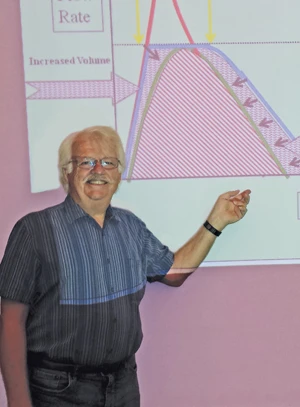
President Franklin D. Roosevelt’s words—”A nation that destroys its soil destroys itself”—always came to mind for Jan Briede as he worked jobs ranging from risk assessment to wetland work and site monitoring. Most of his jobs’ issues circled back to soil preservation, which is a core value in his work as a senior instructor in Virginia’s stormwater and erosion and sediment control training and certification program. Briede teaches program administrators, inspectors, and plan reviewers. In a previous role with the Virginia Department of Conservation and Recreation, as stormwater outreach manager in charge of the erosion and sediment control training and certification program and stormwater education, Briede assisted with the development of a new training and certification program in stormwater as required by the new Virginia Stormwater Management Act. He developed an introductory course on the new Virginia stormwater law and regulations and taught the course at various locations statewide. Briede served on committees that address Chesapeake Bay Total Maximum Daily Load issues and stormwater regulations. Briede—who speaks eight languages—has done environmental work around the globe, including international development work in Uganda, Nepal, and North Yemen. In addition to stormwater and erosion and sediment control issues, Briede specializes in program management, project management, low impact development, runoff reduction, wetland delineations, permitting and mitigation, ecosystem restoration, endangered species issues, environmental site assessments, industrial audits, toxicology, and international development.
What He Does Day to Day
Briede spends his days teaching, public speaking, and working on classroom and online training courses. He used to travel throughout Virginia to teach a one- or two-day class each week, but a less hectic schedule now allows for time for instructional design. Briede’s classes have about 60 students from various backgrounds whose common work is in erosion and sediment control or stormwater management. “I often joke with my wife that we could break down anywhere on a highway in Virginia and there would be an employee with the Virginia Department of Transportation who knows me,” says Briede.
What Led Him Into This Line of Work
His path has been somewhat circuitous, notes Briede.
“I started my career in international development and saw what rain can do to the landscape and receiving streams in countries like Nepal, where I worked for two years,” he says. “We often joked that there was a new island being developed off of the coast of Bangladesh in the Sea of Bengal, and that Nepal needed to claim it as part of their country. Deforestation was tremendous in that country, with all the disastrous results to follow. I still often use Nepal as an example in my classes.” After earning his doctoral degree in range management with a biology minor at age 37 from New Mexico State University, Briede landed a job in the coal mining industry, followed by environmental consulting jobs.
What He Likes Best About His Work
Briede loves to teach. “I enjoy meeting people from different walks of life and education levels and interacting with them,” he says. “I like that I can teach them something without talking down to them and like to see the lights come on in some of my students.” He hopes his work benefits the Chesapeake Bay, “a place I love so much,” he says. Briede tries to sail a few days each month and is restoring a “fixer-upper” sailboat. For Briede, the most important part of his work is doing something for the environment.
His Greatest Challenge
Travel has been Briede’s biggest challenge. Living in motel rooms away from home “gets old after a while,” he says, adding it’s difficult maintaining a healthy weight eating in restaurants all the time. He leverages his experience by blogging. “Being away from home and my sailboat during hurricane season also bugs me,” he says. He’s also challenged by pushback from those who believe efforts such as his are meant to stop all development. “I come from a long lineage of builders and developers and am absolutely not anti-development, and neither is the department I work for,” Briede says. “However, I am for wise, sustainable development, which in most of cases does not mean it is more expensive, but is protective of the environment.”
Latest from Waste Today
- Vecoplan to present modular solutions at IFAT 2026
- Terex Ecotec appoints Bradley Equipment as Texas distributor
- My Green Michigan expands depackaging capacity
- Washington selects Circular Action Alliance as PRO
- Ten-8 Industrial opens new central Florida service center
- Triumvirate Environmental acquires Environmental Waste Minimization
- Official NYC Bin availability expands ahead of deadline
- US Food Waste Pact’s 2025 Impact Report shows decrease in food waste