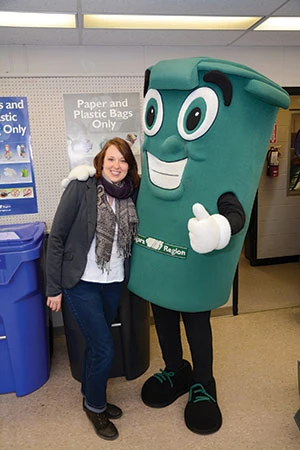
Solid waste collection goals have little traction without consumer behavior changes. Those changes are barely manifested without awareness brought about through education. Perhaps no one is more well suited to tackle that task than a former teacher. Such is Janet Rose, outreach coordinator for the Niagara Region Public Works waste management services, who played a key role in the organization’s successful illegal dumping outreach program.
Niagara Falls’ natural beauty speaks to the importance of proper waste management. Like many regions throughout North America, the Regional Municipality of Niagara in southern Ontario, Canada, had been experiencing problems with illegal dumping, which is an aesthetic and financial concern.
The Niagara region is a two-tier municipal structure made up of 12 area municipalities, with reports of illegal dumping handled through various regional and municipal operating procedures depending on the location. As a result, confusion ensued for residents reporting problems and customer service representatives appropriately directing calls.
In 2012, the Illegal Dumping Working Group—comprised of Niagara Region’s waste management, transportation, and corporate communications staff and 12 local area municipal representatives—was formed to create a common approach to address illegal dumping. A 2013 study revealed 87% of residents stated illegal dumping was an issue in the Niagara region. Only 11% indicated they had reported illegal dumping, and 34% cited not knowing how or where to report it as a barrier. Sixty-nine percent of respondents indicated an online tool would make doing so easier. In response, the Niagara Region’s waste management division piloted in 2013 an illegal dumping campaign centered around an illegal dumping digital mobile reporting tool as an avenue for residents to report illegal dumping from any electronic device.
Users can take and upload photos, report a site without a photo, and call the Regional Waste Management Info-Line to report. GPS allows users to confirm illegal dumpsite locations and municipal staff to find them. Also included: a monetary rewards system for reporting illegal dumping, print and media advertising, brochures, social media promotion, and new illegal dumping signage consistent across the region encouraging residents to report illegal dumping with a “See it. Report it.” message. The tool has enabled more efficient tracking of illegal dumping and sharing of illegal dumping reports among departments and municipal staff, resulting in faster cleanup. Six municipalities have included a widget or link to the reporting tool on their websites. A shared Intranet site enables municipalities to post, comment, and track illegal dumping information. Fine amounts were set at $500. Since that time, the number of illegal dumping reports increased, with many incidents reported through the tool. The tool was a 2015 SWANA Gold winner in communication, education, and marketing.
What She Does Day to Day
Rose coordinates the Niagara Region’s waste management division’s outreach and education programs, including promotional and educational material development, coordination of presentations, advertising, social media, website, and campaign development and implementation. The audience: a population of 427,421 in 189,845 households.
What Led Her Into This Line of Work
With a B.A. degree in education from Nipissing University, Rose had been a teacher for many years before seeking new opportunities to teach in an environment different from the traditional classroom. She moved to work in the waste management field of promotion, education, and outreach.
What She Likes Best About Her Work
“What I like best about my work is the ability to take my passion and enthusiasm for waste diversion and ignite interest in the next generation through our school outreach program,” says Rose. “I also love when I receive positive feedback from our residents on our education and outreach programs, especially stories of when something I have helped develop has prompted real behavior change when it comes to better waste diversion practices.”
Her Biggest Challenge
“My biggest challenge is keeping up with the constant changes in the waste management field,” notes Rose. “Ever-changing packaging types and processing requirements can make consistent messaging that avoids confusion to our residents an ongoing challenge. To meet this challenge, my colleagues and I, as a team, keep up on packaging trends and changes in market requirements, as well as leveraging electronic methods of communication, which can be more easily changed and updated on regular basis.”
Latest from Waste Today
- My Green Michigan expands depackaging capacity
- Washington selects Circular Action Alliance as PRO
- Ten-8 Industrial opens new central Florida service center
- Triumvirate Environmental acquires Environmental Waste Minimization
- Official NYC Bin availability expands ahead of deadline
- US Food Waste Pact’s 2025 Impact Report shows decrease in food waste
- Coastal Waste & Recycling expands recycling operations with Machinex
- Reconomy acquires German-based GfAW