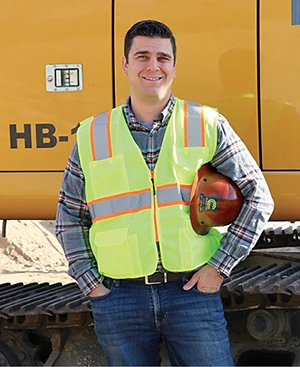
Over the 28 years since Bernie and Diane Catalano started Catalano Construction in Rhode Island, it has thrived despite numerous challenges. Bernie Catalano started his own business after working for another site work contractor, running the company out of his home. “They soon moved up to the space we’re in now, gradually doing more site work and increasing the company’s size,” says son Jason Catalano, adding that it hit its largest size in 2008 before the recession, forcing a downsize. Four years ago, Bernie Catalano’s unexpected death led to Jason Catalano running the company without a succession plan but with the full support of office and field staff. Two of Bernie Catalano’s original employees remain on staff, including a superintendent whose advice Catalano seeks on company operations.
“We’ve been able to get through the hardest days and we’ve been trending higher up with sales every year since,” he says. Catalano’s college classes in small business and family business management helped him avoid typical pitfalls. “My father and I always tried to have a healthy relationship where work would stay at work and wouldn’t bleed into family life,” he says. “In retrospect, I would have loved to have helped him out more when he was alive because I see the stress levels in the things I am dealing with.”
Catalano says while his company “might not be the cheapest when we bid jobs, we try to make sure there’s a value added to clients. We try to do a lot of private work. It’s a tough market. People will chase jobs for crazy amounts of money. I think our employees are comfortable working here. We create a culture where no one is screaming to get so many feet of pipe in per day. It’s more like let’s do it right, do it safely, and do it once as opposed to people rushing and making mistakes. There isn’t quality when you work like that. That culture has worked well for us.”
The company’s 35 full-time employees provide services in grading, excavation, water and sewer installation, concrete flatwork, underground drainage, and underground storage tanks. 40% of the work is in the government sector, with the majority at the Naval Station Newport through numerous projects over 13 years. 60% is in the private commercial sector, including projects such as site work for water parks, athletic fields, and playgrounds. Catalano owns the equipment in his fleet, “but as the market and our needs change and we’re looking to relocate our home office, I’m starting to rent some equipment,” he says. The company runs mostly John Deere equipment, one Hitachi, and Mack and Ford Super Duty trucks.
What Led Him to This Line of Work
Catalano studied architecture in college, then transferred to construction management, in which he earned a bachelor’s degree from Roger Williams University. He worked in the family business during high school and college summers but didn’t want to go back after college. Wanting to get general contracting experience, he took a job with a general contractor, then returned to the family business in 2004 as a project manager, leveraging the technical skills he had learned. After his father’s death, Catalano assumed his father’s role.
What He Does Day to Day
Catalano serves as the company’s “point man” for everything from the field to the office: seeking project leads, analyzing the fleet for repair or replacement, meeting with superintendents and project managers for status reports on projects, and staffing existing projects with the employees and assets needed to complete jobs.
What He Likes Best About His Work
Catalano says he appreciates his parents’ hard work and sacrifices to get the family business to its present position. Catalano keeps his father’s email account active. “We still get emails from long-time clients we haven’t heard from in a long time looking to do new work,” he says. “That’s the hard part, but the part that makes me happy is that we’re building off the impact he made.”
His Greatest Challenge
Catalano’s biggest challenge is finding qualified skilled employees. Currently, the company is looking to identify candidates for supervisory roles. In the past, he’s found success hiring from referrals from current employees. The company is initiating an apprenticeship program through the unions.
Latest from Waste Today
- My Green Michigan expands depackaging capacity
- Washington selects Circular Action Alliance as PRO
- Ten-8 Industrial opens new central Florida service center
- Triumvirate Environmental acquires Environmental Waste Minimization
- Official NYC Bin availability expands ahead of deadline
- US Food Waste Pact’s 2025 Impact Report shows decrease in food waste
- Coastal Waste & Recycling expands recycling operations with Machinex
- Reconomy acquires German-based GfAW