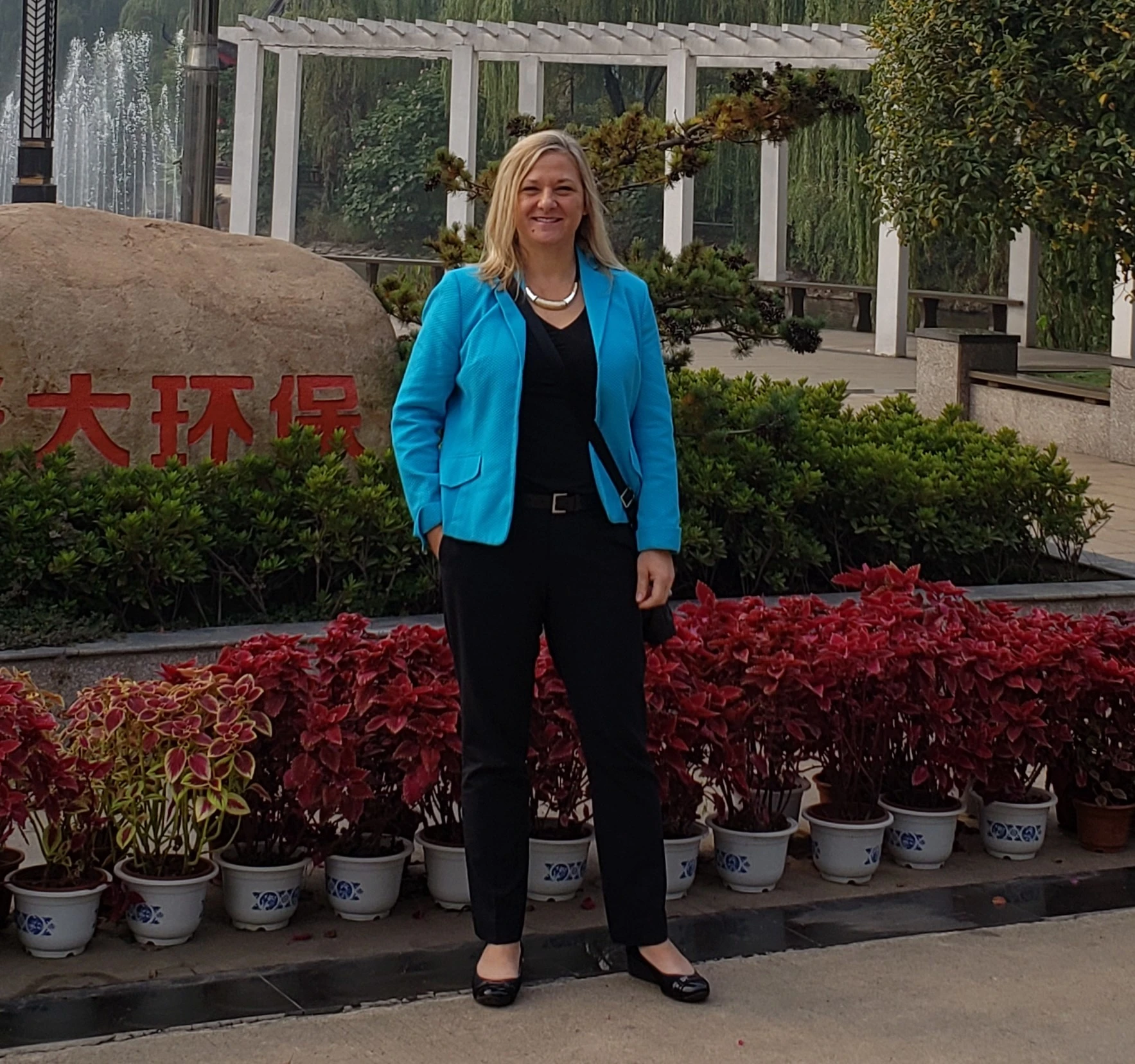
IN HER GLOBAL travels, Jean Lucas—president and CEO of Eco Waste Solutions (EWS) and vice director of SWANA’s Waste Conversion and Energy Recovery Technical Division—has concluded that “there is a huge lack of education on what energy from waste is and how it can benefit us. Unfortunately, it also is clear that North America is falling behind the rest of the world in the adoption of new technologies to address waste challenges.” EWS supplies modular thermal treatment and waste-to-energy (WTE) technology for the solid waste sector. Lucas uses her understanding of the industry’s challenges to drive the development of new products and technological improvements for EWS. She says she is passionate about the positive role thermal waste conversion can play on mitigating climate change by avoiding waste-generated methane gas. “While we can’t always avoid creating waste, we can try harder to treat it as a resource with valuable energy and materials to be recovered,” says Lucas. Lucas also is committed to advocating for workplace diversity and was recently named a Women’s Executive Network 2019 Canada’s Most Powerful Women: Top 100 Award Winner.
WHAT SHE DOES DAY TO DAY
Lucas’ primary responsibilities focus on managing her company’s operations and resources and communicating with its board of directors and shareholders. “I still interact directly with some of our customers,” she says. “I also get to work directly with our engineers on the development of new technology. We have patents and patents pending on a range of innovations. I also travel all over the world giving talks on the importance of community-scale waste-to-energy and meeting top experts in the field.”
WHAT LED HER INTO THIS LINE OF WORK
Lucas earned a Bachelor of Science degree in environmental science and biology from Brock University. “At the time, I probably had a vague idea of working for the government, maybe in conservation,” she says. “But I fell into waste management after working on a pollution prevention project for a local municipality. At the time, the city was getting ready to close an outdated waste-to-energy plant. When I saw how much waste was being diverted by the plant away from the landfill, I was blown away. I couldn’t stop thinking about how important these technologies could be.” Lucas began consulting on waste projects and 20 years ago landed at EWS, starting in sales and business development and eventually working her way up to CEO. “At Eco Waste, I can realize my vision of stabilizing waste and dramatically reducing what goes to landfill,” she says, “if we can also recover energy and materials that are even better.”
WHAT SHE LIKES BEST ABOUT HER WORK
“In the early days, the best part of my work was working with the engineers, testing different feedstocks, and learning how the technology can be adopted for different applications,” says Lucas. “I also came to see how thermal treatment is so important in some of the areas where we work. For example, in the Arctic where there is permafrost, waste conversion is the only approach that makes any sense. It minimizes human impacts on the land and wildlife.” Today, she says she is motivated most by the attention WTE and thermal conversion technology is getting outside of North America. “As the global population grows and developing countries begin to prosper, there’s an increasing market for proven solutions,” she says. “The world needs clean tech that not only addresses the waste problem but helps address climate change and can increase energy security.”
HER GREATEST CHALLENGE
“The greatest challenge is that while there is increased interest in thermal conversion of waste and waste-to-energy, a lot of the attention is focused on the mega projects processing millions of tons of waste every year,” says Lucas. “The reality is, a huge need and public-level interest in community-scale solutions exist. Markets like India are already focused on community-scale waste-to-energy projects and China is going there next. Smaller-scale waste-to-energy solutions that can process 200 to 500 tons of MSW per day are faster and easier to implement and work well within the circular economy, but unfortunately, they just don’t have the appeal of the mega projects.”
Latest from Waste Today
- Vecoplan to present modular solutions at IFAT 2026
- Terex Ecotec appoints Bradley Equipment as Texas distributor
- My Green Michigan expands depackaging capacity
- Washington selects Circular Action Alliance as PRO
- Ten-8 Industrial opens new central Florida service center
- Triumvirate Environmental acquires Environmental Waste Minimization
- Official NYC Bin availability expands ahead of deadline
- US Food Waste Pact’s 2025 Impact Report shows decrease in food waste