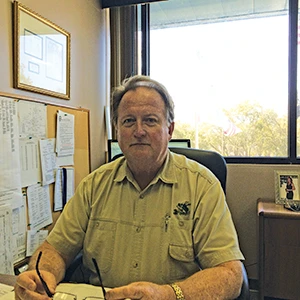
Throughout his career, John Power has continually sought ways to extract the optimal utilization from solid waste. As solid waste director for the Pasco County, FL, Integrated Solid Waste Management System (ISWM), two programs exemplify that: a waste-to-energy (WTE) facility and the reuse of ash as construction material aggregate. The Pasco County Solid Waste Resource Recovery Facility in Spring Hill, FL, started in May 1991 and exemplifies the success of a public-private partnership that has lasted through the cooperative efforts of the county’s ownership—Covanta as the private operator, and CDM Smith as the consulting engineer. Power lauds public-private partnerships as offering the ability to address issues quickly in an environment that requires such a response. The facility processes up to 1,050 tons per day of municipal solid waste, generating 31.2 MW of renewable energy sold to Duke Energy. It uses secondary sewer treatment effluent from a nearby wastewater treatment plant for part of its process water make-up. Another effective partnership is between the solid waste facility and university researchers. The Florida Department of Environmental Protection in December 2014 approved recycling of bottom ash from a WTE facility as a substitute for natural aggregates in concrete and asphalt pavement, along with use as base material under asphalt pavements, issuing Pasco County the first permit to do so. In partnership with the University of Florida, Pasco County recently completed a three-year research project for recycling bottom ash during which the chemical and physical properties of bottom ash went through a thorough testing and evaluation and was used for construction of a test road for long-term environmental monitoring. The efforts of the Pasco County ISWM earned SWANA’s WTE Gold honors for 2015.
What He Does Day to Day
Power oversees all Pasco County solid waste operations, including the WTE facility; a Class 1 MSW landfill; Class III C&D waste landfill; Class 1 ash monofill; used tire and wood waste receiving and processing centers; and drop-off centers for hazardous household waste, e-waste, and recyclables. The county also manages a 320-ton-per-day solid waste transfer station and monitors permit conditions at two closed landfills. Power also oversees the solid waste department’s $35.2 million budget and the WTE facility’s $17.5 million budget.
What Led Him Into This Line of Work
Power’s introduction to the partnership between waste and energy came after studying environmental science at Grand Valley State University in Michigan and completing his studies at the University of South Florida. He worked in a power generating facility, and then worked in phosphate mines. He then worked in Florida’s Hillsborough County’s building department when it started constructing its WTE facility. Power was tapped to oversee the county’s solid waste operations. He then went to work for Ogden Corporation—now known as Covanta—as its Southeast region environmental compliance manager. After 13 years, he accepted a job as solid waste director for Pasco County and has been in the position for 15 years.
What He Likes Best About His Job
Power likes the various opportunities inherent in his work. “Ash reuse is the tip of the iceberg,” he says. “We separate our ash from our municipal solid waste, so we’re looking to mine the ash piles we have in the back for metals and we’re thinking there’s enough in there to support buying the equipment and doing the work. After we’re done, we’re looking at having some kind of usable aggregate.”
His Biggest Challenge
The county’s growth from its current population of 479,340 poses the biggest challenge for Power and his operation. “We’re rapidly getting to a point where our facility is going to be at capacity and we have to look at alternative disposal options,” he says. “We do have capacity here to landfill, but we’d rather not do that. In the near future, we’re looking at what we’ll be doing with the growth, and with the amount of garbage that the group generates.”
The WTE facility is at capacity, and there is an option to expand the three 350-ton-per-day boiler units by another 600 tons. “We also have room to grow in our recycling efforts,” says Power, adding that’s being addressed in the county’s solid waste master plan.
Latest from Waste Today
- Vecoplan to present modular solutions at IFAT 2026
- Terex Ecotec appoints Bradley Equipment as Texas distributor
- My Green Michigan expands depackaging capacity
- Washington selects Circular Action Alliance as PRO
- Ten-8 Industrial opens new central Florida service center
- Triumvirate Environmental acquires Environmental Waste Minimization
- Official NYC Bin availability expands ahead of deadline
- US Food Waste Pact’s 2025 Impact Report shows decrease in food waste