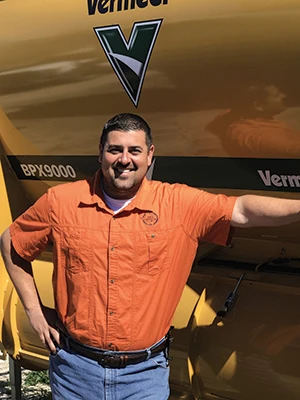
When Justin Hitchcock started his erosion control company, JTEX Contracting, in 2008, he decided to go against the grain of the traditional company growth strategy of starting small and building from there. The San Antonio, TX, company started with big projects and has kept its focus there. JTEX Contracting provides a range of erosion control services throughout Texas, Louisiana, and Mississippi with six employees, with 90% of the projects being outside city limits. Services include providing erosion control blankets, silt fencing, hydroseeding, hydromulching, drill seeding, hay blowing, crimping, soil analysis, dirt work, temporary irrigation, drainage bollards, and concrete work.
“We’ve been fortunate to be able to structure our business around large projects. A lot of people start by doing smaller projects and can’t handle the big stuff,” says Hitchcock. “The smallest job we started with was about 35 acres, and we’ve been growing from there. Our jobs average between 35 and 100 acres. We really don’t mess with a lot of small stuff. We specialize in larger projects. We have the equipment to do it efficiently, and it’s been successful.” That equipment includes two 1,200-gallon and one 600-gallon hydroseeding machines, a 108-horsepower and a 180-horsepower tractor, a hay blower, and two drill seeders. For silt fencing, the company has focused on projects that are 12 to 24 miles long. Another business strategy has been for the company to grow its own hay on a nearby ranch.
Hitchcock’s mission is to put client interests at the forefront, grow and innovate, and educate employees on new and emerging techniques to apply on the job site. When water becomes a challenge, as it has been in the past for Texas, Hitchcock says he’s upfront about seasons that are hot and dry not being a good time for certain work. “Some people will call me in the middle of July and say they have some acres they need hydroseeded and fertilized, and my first question is, ‘Are you going to water it?’ They say no, and I’ll tell them they’re not going to get very much out of it. The heat is going to burn it. Some people say I could have done it and made money, but I’m not the type of person to go in and have something fail for someone,” he says. “I’ve always wanted them to spend that money and be happy with it. I will recommend that we can hydroseed it, but let’s not put any fertilizer on it. Or we can fertilize it dry, drill-seed it, blow some hay on it, and let nature do its course. When it rains, it will liquefy and hopefully begin germinating.”
What He Does Day to Day
The day’s tasks vary with the project needs. “We have three separate crews that can do three separate jobs at the same time,” says Hitchcock. “It could be dry applications, seeding, silt fencing, hay blowing, hydromulching or hydroseeding.”
What Led Him to This Line of Work
While Hitchcock and his wife were dating, he observed his future father-in-law—who had been doing a lot of large civil engineering projects—on a job in Mississippi. “He was having about 100 acres hydroseeded, and the guy was blowing out the green stuff, as everyone calls it, and I asked him what that guy was doing. He told me it was called hydroseeding,” says Hitchcock. When Hitchcock learned the significant amount of greenbacks applying the green stuff was generating, he said, “Well, I can do that.” That led to him starting his own business.
What He Likes About His Work
“I like being told that it can’t be done and finding ways to make it happen,” he says. “What’s really pushed me is the challenge of bidding on projects, knowing what everything costs and what you’ve put into the job, and I challenge myself to go out there and do it for that or less and try to make more money. I enjoy it every day.”
His Biggest Challenge
Finding quality employees who care about his business as much as he does and finding incentives for them to strive to do better to help the business grow is his biggest challenge, says Hitchcock.
Latest from Waste Today
- Vecoplan to present modular solutions at IFAT 2026
- Terex Ecotec appoints Bradley Equipment as Texas distributor
- My Green Michigan expands depackaging capacity
- Washington selects Circular Action Alliance as PRO
- Ten-8 Industrial opens new central Florida service center
- Triumvirate Environmental acquires Environmental Waste Minimization
- Official NYC Bin availability expands ahead of deadline
- US Food Waste Pact’s 2025 Impact Report shows decrease in food waste