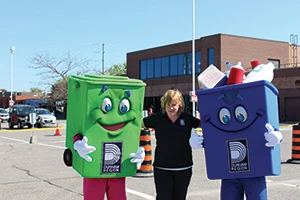
As a waste management technician with the Region of Durham in Ontario, Canada, Katherine Ross-Perron has seen the correlation between successful communication efforts and waste diversion goal progress. “Ongoing and consistent communication with residents has been critical to maintaining and improving public awareness and participation in our programs,” she says. Ross-Perron has played a key role in many of the Region’s projects, including the launch of the Integrated Waste Management Program in June 2006, the largest campaign ever undertaken by the Region’s waste management staff encompassing recycling, garbage collection, and yard waste. Its 2012 curbside battery recycling program—the first of its kind for a regional municipality in Canada—was introduced with a “Batteries dead? Recycle instead!” campaign to encourage residents to set out dead batteries in a recyclable orange bag. The launch of its waste app won SWANA’s 2016 Communication, Education, and Marketing silver award. Residents can access a personalized collection day calendar, set up reminder alerts, learn how to properly dispose of household waste, locate and call their local waste management facility, and report collection issues with photos. The app enables Durham Region to leverage data management and analytics, accessibility and operational efficiencies, and understand which promotions best attract residents’ reactions and where to better target budget investments.
What She Does Day to Day
Ross-Perron is focused on community outreach through various promotion and education activities to ensure that Durham Region’s 650,000 residents stay informed about and engaged in managing their waste. “Making it easier for them to access the information they need is key to reducing waste and meeting the region’s waste diversion goals,” she says. Her days may encompass developing radio advertising campaigns; designing print ads for events, operational needs, pilot programs, and diversion programs; writing television advertising scripts; preparing website content; designing the annual waste management calendars, coordinating events; developing and designing the waste management annual report; preparing award submissions; developing content for the external newsletter “Durham Works,” and researching and using new media tools.
What Led Her Into This Line of Work
Ross-Perron studied public relations at Durham College, then went on to land her role in Durham Region’s Waste Management division 16 years ago. “This line of work has been a natural fit for me, allowing me to utilize my creative talents and organizational skills,” she says. “I am an absolute perfectionist, which lends itself well to this role as I am required to pay attention to the smallest details.”
What She Likes Best About Her Work
“My job has changed in some way almost every year, which has kept things interesting,” says Ross-Perron. “I enjoy the challenge and freedom of creating something new, making it look good, and most importantly, communicating a message effectively. I love that the work I do to promote our programs and educate residents on how to participate can be seen throughout the community. I am fortunate to work with incredibly supportive colleagues who always make me laugh. It’s these friendships that make my job so much easier and have allowed me to collaborate on projects with great outcomes.”
Her Greatest Challenge
Promotion and education have proven to be major contributors to the success of the Region’s waste diversion programs in the past, and are important to achieving its 70% waste diversion goal, notes Ross-Perron. “Waste diversion is dependent on the motivation of residents to divert materials from garbage and the ability to overcome perceived barriers, such as inconvenience and lack of knowledge,” she says. “My ongoing challenge is to ensure all of Durham Region’s residents are motivated and have the information they need. We are a growing and increasingly diverse community with significant rural and urban populations. Staying-up-to-date on the needs of the changing community is important for me to be successful in this role. I am continually strategizing ways to address confusion that can occur as a result of the differences between our programs and those of neighboring municipalities.” Navigating the shift in how people access information—such as from print to electronic media—is another challenge. To address it, Ross-Perron expanded the number and type of tools used to communicate, including web, television, radio, social media, mobile applications, and print.
Latest from Waste Today
- Vermeer announces plan to build new facility in Des Moines metro area
- Buffalo Biodiesel shares updates on Part 360 application to DEC, Tonawanda facility progress
- Capstar Disposal expands roll off dumpster rental services
- Supreme Court strikes down IEEPA tariffs
- Casella details facility closures, expansion efforts
- Zero harm: Building a SIF prevention program for waste and recycling operations
- Casella posts a loss in Q4 2025
- McNeilus names Haaker Equipment first Dealer Partner of the Year