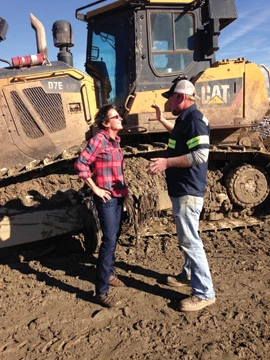
Who knew managing solid waste could be fun? Marcia Papin, the solid waste manager for Greenville County, SC, does. “Fun” wouldn’t be the first word that comes to mind considering her list of responsibilities: overseeing the state’s largest county’s solid waste operations (providing landfill services for more than 1,000 tons daily), as well as a yard waste grinding facility, six residential self-haul transfer facilities servicing about 18,000 customers weekly, 28 self-service recycling locations that collect nearly 6,000 tons of recyclables annually, litter awareness, and recycling education. Papin’s job is heavy on responsibility, her approach light-hearted though dedicated.
What She Does Day-to-Day
Papin’s day starts with an early morning run, bike ride, “or some other obsessive outdoor activity at the landfill, loosely veiled as ongoing community relations,” she notes. She wears many hats: human resource manager, supervisor, mechanic, janitor, administrative assistant, customer service representative, accountant, engineer, surveyor. Her tasks include reviewing various projects’ progress, asking and responding to technical questions, meetings, problem solving, and ongoing correspondence with regulators, customers, staff, and stakeholders. She fosters relationships with potential and existing customers, vendors, other county departments, and community groups. “I am always busy developing and improving the policies, performance standards, goals, and objectives that keep our tiny cog in the vast public works machinery working at maximum capacity,” she says.
What Led Her Into This Field
Papin’s 30 years of solid waste work began in the late 1970s, following her completion of a one-year course in heavy-equipment operation after three years of US Army service. While working as an equipment operator, Papin earned an associate degree in construction engineering. She searched for a job as an estimator, taking instead a job operating heavy equipment at the Greenville County landfill, earning $7.50 an hour, far more than most entry-level estimator positions. “Undaunted by the landfill “˜yuck’ factor or the impossibility of convincing the average circa 1983 landfill superintendent of the wisdom behind hiring a girl who didn’t weigh 100 pounds soaking wet to run his 50,000-pound dozer, I saw a lifetime of happiness hauling dirt, digging pits, building roads, and packing trash,” she says. She put her education to work in project management, surveying, and supervision and went on to complete a University of Wisconsin distance-learning course in sanitary landfill operations. Soon, she was in management. In conjunction with the “brilliance and dedication of the best group of people imaginable,” her subsequent accomplishments entailed constructing two Subtitle D landfills, closing two unlined landfills, closing a Subtitle D landfill, building three small transfer stations, and growing a recycling operation from scratch-all without incurring a dime of debt.
What She Likes Best About the Job
“I love the camaraderie and personal associations involved in managing junk: from the operators’ bawdy humor and contagious laughter, their genius for improvising, confidence in spite of great struggles against nature’s worst, impossible time constraints and crippling budgets to creating perfect solutions with engineers, planners, supervisors, and accountants to giggling with recyclers and celebrating every pound rescued from the grip of the evil trash trucks headed to the landfill,” says Papin. Her involvement transcends her county’s boundaries to serving on chapter and national SWANA boards. “I remain excited and proud to be around so many people who stay up until midnight in a hotel lobby, leaning close to hear someone pontificate about new legislation or technology that will advance the industry,” she says.
Her Biggest Challenge
Greenville County is a competitive open market for solid waste disposal services. Dwindling tipping fees accompanied dwindling tonnage numbers. “Hanging a $30-a-ton shingle on the front door didn’t cut it anymore,” Papin says. The challenge: transitioning from public sector finance strategies to a private sector model. “We became a lean, mean fighting machine through staff reductions, use of part-time employees, a very small management team, reduced equipment inventory, public/private partnerships, forestry management, expanded recycling for revenue-rich materials,” Papin says. “We implemented blended-rate tipping fees, volume discounts, and contracts for beneficial materials, and cut profit to pennies on the ton. We actively market to neighboring counties, municipalities, midsize haulers, demolition contractors, and industrial waste brokers. I never imagined implementing these practices even 10 years ago.”
Latest from Waste Today
- Vecoplan to present modular solutions at IFAT 2026
- Terex Ecotec appoints Bradley Equipment as Texas distributor
- My Green Michigan expands depackaging capacity
- Washington selects Circular Action Alliance as PRO
- Ten-8 Industrial opens new central Florida service center
- Triumvirate Environmental acquires Environmental Waste Minimization
- Official NYC Bin availability expands ahead of deadline
- US Food Waste Pact’s 2025 Impact Report shows decrease in food waste