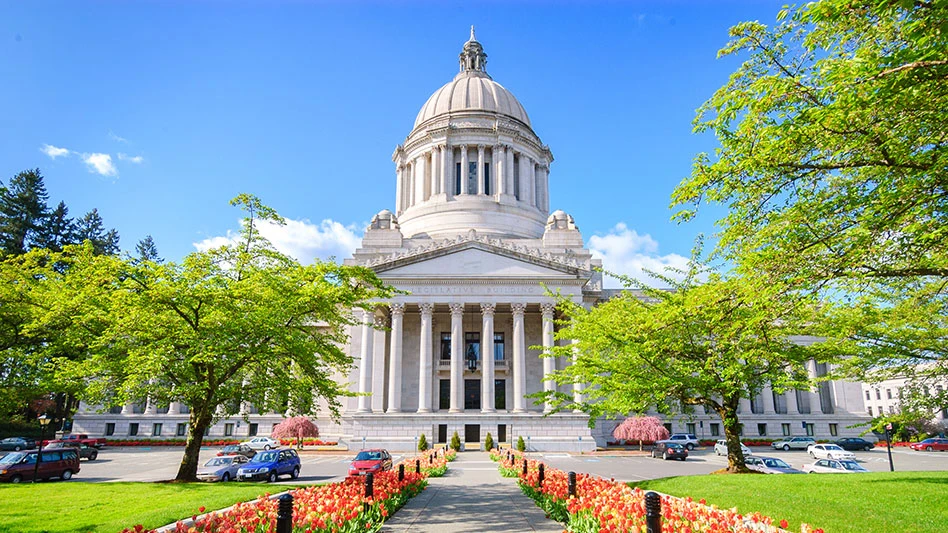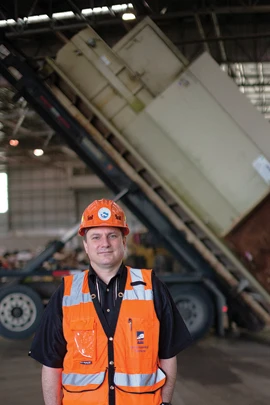
Michael Slevin III, P.E., passionately applies his best effort to whatever he does. Resulting accolades confirm that commitment. Under Slevin’s leadership as Tacoma, WA’s environmental services director, the Environmental Services Department achieved SWANA’s Gold Award for communications. City employees marketed the implementation of a foodwaste program in combination with switching its garbage collections to every other week by visiting every household with a brown foodwaste receptacle, talking with each person about the program and leaving printed information for those not home. Tacoma’s state-of-the-art transfer station won SWANA Gold for meeting LEED Silver and Gold requirements. It’s all in a life’s work for Slevin, who graduated summa cum laude with a B.S. degree in civil engineering from Washington State University. He also served as an airborne sapper, qualified as an explosive ordnance disposal (EOD) officer and was awarded two Bronze Stars for his actions during combat deployments in Desert Storm, Iraq, and Afghanistan before retiring from the Washington Army National Guard after 28 years of service. Slevin manages 500 personnel in a department encompassing solid waste, wastewater, and surface water and a biennial operating and capital budget of more than $380 million and total fund assets of $700 million. Says Slevin, “My passion and goal is to help redevelop and prepare Tacoma for the next century while protecting and restoring our community’s abundant natural resources, such as the Puget Sound, and by instituting sound, financially responsible, sustainable development and infrastructure programs and projects.”
What He Does Day to Day
Slevin’s days include dealing with budgets, personnel issues, union negotiations, regulatory agencies, traveling to represent the city on a national policy level with organizations such as SWANA, and meeting with policy makers and the public in determining the city’s future direction, which he outlines in his Environmental Services Strategic Plan. “Whether it’s food waste, garbage collection, or capturing biogas from the wastewater treatment plant and using it to fuel a garbage truck, we’re constantly focused as an environmental services group on how we can reduce the overall environmental footprint of each person in Tacoma,” Slevin says.
What Led Him to This Line of Work
Slevin developed skills in communication, leadership, and problem solving in the military. When he left enlisted service, he pursued a civil engineering degree, intending to do civilian demolition work. He earned an MBA from the University of Washington and is a graduate of the University of North Carolina Kenan-Flagler Business School Water and Wastewater Leadership Center. Slevin was hired by Tacoma and mentored by Karen Larkin, former Tacoma Environmental Services Manager and Bill Pugh, former Tacoma Public Works Director, both of whom gave him challenging work, and he fell in love with it. “It is good work, important work for our community, for ratepayers- it’s important nationally,” he says.
What He Likes Best About His Work
Maintaining the environment cost effectively for future generations fuels Slevin’s efforts each day, he says. He points out that Tacoma started out as a blue-collar industrial town that, over the course of a century, polluted its own backyard, ultimately resulting in its landfill and main waterway becoming Superfund sites. In recent decades, citizens have invested heavily in clean-up efforts and committed to avoiding future contamination. Ratepayers and policy makers in the Northwest support the idea that sustainability and environmental protection are not mutually exclusive from reasonable utility rates, Slevin says. Elected officials have made it a priority that Tacoma will lead the nation in being highly sustainable in solid waste, wastewater, and surface water, he adds.
His Greatest Challenge
The aging infrastructure-particularly roads and pipes-is presently the greatest challenge for Tacoma. Maintaining environmental sustainability and financial sustainability can be a tough sell against the national tendency to resist rate hikes to support true operating costs. Slevin sells the value and long-term effectiveness of rate hikes. Example: Every-other-week garbage collection and hydraulic hybrid diesel garbage trucks reap a 60% reduction in diesel costs, but the trucks cost more than $400,000. “Sometimes it’s cheaper to put it in the landfill, but it’s not as sustainable,” says Slevin. “It’s walking a tightrope: How do you charge a little bit more to get the maximum environmental benefit while not making it unaffordable?”
Latest from Waste Today
- Worn Again Technologies unveils Accelerator plant to advance polycotton recycling
- Nashville Waste Services launches new digital route system
- ACUA landfill expansion project unanimously approved
- Clean Energy announces multiple RNG deals with fleets nationwide
- Interchange 360 to operate alternative collection program under Washington’s RRA
- Waste Pro files brief supporting pause of FMCSA CDL eligibility rule
- New Way Trucks expands US network with Joe Johnson Equipment
- Tire Industry Project publishes end-of-life tire management guide