Payne Construction Services in Strafford, NH, dates to the late 1950s when Kenneth Payne jacked up cottages along the Massachusetts and New Hampshire coastline. His son Brian Payne officially started the family-owned and operated business in 1974, expanding services beyond coastal jacking to include bridge jacking, commercial lifting, raising and rigging, and home and commercial building relocation, as well as the transportation of power plant equipment, transformers, generators, and other large equipment.
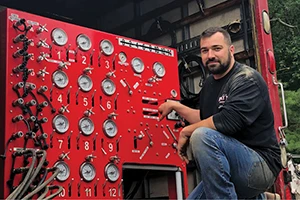
Now in its third generation under the leadership of Sean Payne—with the help of his brother Patrick—the company is carrying on what has become a more critical mission in the face of the need for increased coastal resilience for buildings. Thousands of buildings suffer damage annually due to sinking, the cause of which could be softening of the ground in low-lying areas, erosion, and the breakdown of foundation materials, Payne points out. Tearing down a structure and rebuilding or saving an existing structure through lifting is a decision property owners must make—his family’s company provides services to those opting to preserve the original construction. The company’s mission was amplified after Hurricane Sandy when it started offering services installing helical pile foundations, a FEMA-recognized alternative to timber and pre-cast concrete piles frequently used in coastal flood zones designed to save costs and minimize environmental disturbance while being corrosion-resistant and effective in any soil condition. Payne Construction Services provides house and structural relocation services throughout the Northeast with equipment fabricated in its in-house machine shop and maintained internally as well. At a nearby saw mill, employees cut cribbing and do custom sawing for timber and lumber for historic preservation projects on buildings dating back to 1654. Some of its projects have included moving massive stone and brick buildings into aircraft hangers and jacking up 1,500-ton bridges. At the company’s disposal are unified hydraulic jack systems, steel beams, steel rollers with needled bearings, radio remote-controlled cranes and moving dollies, articulated trailers, 24-foot box trucks containing the jack system, jacks, welders, compressors, generators, and other assorted tools.
What He Does Day to Day
“Although my father is still involved, I have taken over the everyday operations of the company with the help of my brother Patrick,” says Payne. Payne oversees a variety of work done by the company. One day it may be lifting a house for a new foundation or raising the roof on a commercial building to give it more interior height. “We can be relocating a historic structure for preservation one day, supporting and moving industrial machinery or monuments on another, and excavating and installing a helical pile foundation on the next,” notes Payne.
What Led Him Into This Line of Work
Payne took an interest in the family business at the age of four when he spent a day watching his father move a one-and-a-half story building on dollies several miles down a two-lane country road. At 15, he learned to operate a pull truck and moved his first building—measuring 28-feet wide by 82-feet long with a center fireplace—nearly three miles, flawlessly completing the move.
What He Likes Best About His Work
Being in the construction industry is rewarding in and of itself, says Payne. “It’s satisfying to see what we have done each day and how it has helped others,” he adds. “We have saved houses from caving in due to a crumbling foundation by lifting them to allow for replacement of the foundation, elevating and supporting homes that have been flooded by recent hurricanes, or have simply raised a home to alleviate the hefty cost of flood insurance that the owner pays. All aspects of this work are rewarding in one way or another.”
His Biggest Challenge
Like the vast majority of those managing companies in the construction industry, finding quality help is Payne’s biggest challenge. “There just isn’t enough of it out there,” he points out. “It’s a challenge to find skilled, interested and dedicated workers. It almost seems like the interest in this kind of work is being lost throughout the generations. The demand for construction work is there, but at times cannot be met due to the labor shortage this industry is facing.”
Latest from Waste Today
- Vermeer announces plan to build new facility in Des Moines metro area
- Buffalo Biodiesel shares updates on Part 360 application to DEC, Tonawanda facility progress
- Capstar Disposal expands roll off dumpster rental services
- Supreme Court strikes down IEEPA tariffs
- Casella details facility closures, expansion efforts
- Zero harm: Building a SIF prevention program for waste and recycling operations
- Casella posts a loss in Q4 2025
- McNeilus names Haaker Equipment first Dealer Partner of the Year