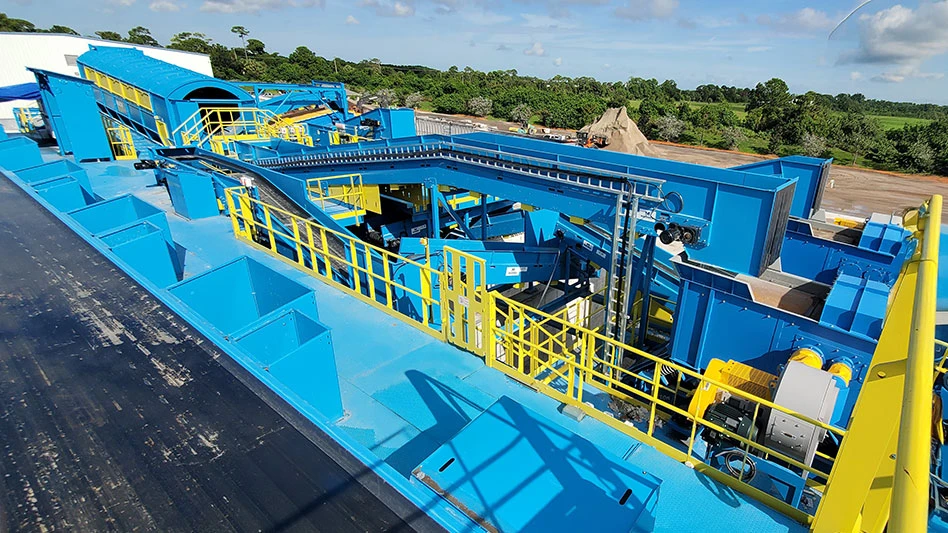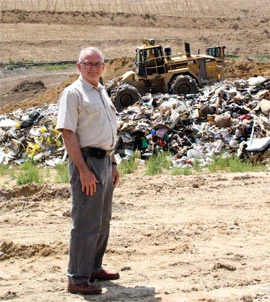
When Vance Kemler, general manager for solid waste and recycling services in Denton, TX, joined the department in May 2001, it consisted of rear-load manual collection with three people on a truck and a few dropoff centers for a small amount of recycling. Today, thanks to input from community groups, Denton serves as a national model with a 20-year solid waste master plan and extensive residential and commercial services, many of which do not require a property owner to go beyond the curb to dispose of a variety of items. Denton’s program includes curbside cart collection and a pay-as-you-throw refuse service that provides a reduced rate for small carts and a flat fee for recycling services to create the incentive for recycling. Denton is the sole source provider for integrated solid waste management services, including landfills and all lines of commercial and residential collection services. Collection services stay within city limits; landfill and recycling services are regional. Other programs include the TRASHion fashion runway program. Yardwaste collected curbside weekly is composted into Dyno Dirt products available for purchase. Household hazardous waste items in good condition collected curbside are offered through a ReUse Store; residents can take up to four items daily for free. Residents also can exchange four incandescent bulbs for four CFL bulbs for free as supplies last. The Texas Trade Up Appliance Rebate Program enables qualified residents to receive up to two recycling bonus rebates per household from an eligible list. Electronics are recycled domestically through ECS Refining. Denton has a Type 1 landfill at its ECO-W.E.R.C.S. (waste to energy, recycling, composting, and solar) complex. DTE Biomass Energy partners with the city in a landfill gas-to-energy operation; its generator is capable of producing 1.6 MW of power, which is sold to the local utility. Another partner is Pratt Industries, which put a 40,000-square-foot MRF onsite. A drug disposal kiosk for unwanted medications is located in the police department’s lobby. Plans call for a “second chance” store, in which a nonprofit outside contractor will sell building materials and other items in good condition, with revenues shared with the city.
What He Does Day to Day
Most of Kemler’s time is spent on program planning and development, educating the public, the public utility board, and the city council on solid waste and recycling projects. He develops and promotes programs to meet the city’s 40% waste diversion goal, which has been a measured process over 10 years. “As you divert more waste from the landfill, revenue streams tend to drop,” Kemler notes. “You cannot increase your rates in one year to magically develop a program that will give you the 40% quickly. One cannot achieve that goal without a financial plan.” Kemler also studies new technologies and works with universities to develop and implement industry research in the concept of sustainable landfills, “maximizing the reuse of resources as an asset rather than burying them, which includes the development of landfill mining as a methodology for long-term resource management in Texas,” he says. He also devotes time to the solid waste complex expansion. Kemler serves as an International Board representative for SWANA’s Texas Chapter.
What Led Him to This Line of Work
Kemler had been a university physical plant director. He enjoyed the work but saw no growth potential. He took a newly created job as assistant director of public works for solid waste services in Galveston, TX, to help shape up that program. “I found it quite interesting working in that field and stayed with it,” notes Kemler.
What He likes Best About His Work
Kemler enjoys introducing and helping implement new programs with the operation’s 115 employees, whom he credits along with management in being open to change “so that it’s not just the same old service it always has been,” he says, adding that it helps move the city’s breadth of services forward.
His Greatest Challenge
Kemler cites his greatest challenge as the education of the community and of policy makers, from the local to the state level, “to ensure good management of the solid waste industry and any balance of the industry’s use of public and private sector services so that we can achieve as sustainable an operation as possible.”
Latest from Waste Today
- Interchange 360 to operate alternative collection program under Washington’s RRA
- Waste Pro files brief supporting pause of FMCSA CDL eligibility rule
- New Way Trucks expands US network with Joe Johnson Equipment
- Tire Industry Project publishes end-of-life tire management guide
- Vecoplan to present modular solutions at IFAT 2026
- Terex Ecotec appoints Bradley Equipment as Texas distributor
- My Green Michigan expands depackaging capacity
- Washington selects Circular Action Alliance as PRO