Anaerobic digestion
UC Davis commissions biodigester
The University of California, Davis (UC Davis), and Sacramento-based technology partner CleanWorld officially unveiled the UC Davis Renewable Energy Anaerobic Digester at the campus’ former landfill on April 22, 2014, which was Earth Day.
 The anaerobic digestion (AD) technology invented by Dr. Ruihong Zhang, UC Davis professor of biological and agricultural engineering, is being used inside large, white, oxygen-deprived tanks. Bacterial microbes in the tanks digest campus and community food and yard waste, converting it into energy that feeds the campus electrical grid.
“It has been the thrust of my research to bring the innovations we made possible at UC Davis to commercial scale,” Zhang said. “This technology can change the way we manage our solid waste. It will allow us to be more economically and environmentally sustainable.”
The digester at UC Davis is the third commercial biodigester that CleanWorld has opened using Zhang’s technology within the past two years and is the nation’s largest anaerobic biodigester on a college campus, the company says.
The system is designed to convert 50 tons of organic waste to 12,000 kilowatt hours (kWh) of electricity each day and to divert 20,000 tons of waste from local landfills each year. The facility has taken advantage of its location at the now-closed UC Davis landfill by blending landfill gases with the biogas to create 5.6 million kWh per year of electricity. It is expected to reduce greenhouse gas emissions by 13,500 tons per year.
“The biodigester is the latest chapter in UC Davis’ world-renowned legacy of environmental sustainability,” says Linda P.B. Katehi, chancellor of UC Davis. “This project stands as a model public-private partnership and demonstrates what can be achieved when research universities and private industry collaborate to address society’s most pressing challenges.”
“There is so much to celebrate today as we recognize the far-reaching environmental and sustainability impacts this technology will have,” says CleanWorld CEO and UC Davis alumna Michele Wong. “It will enable the more than 100 million tons of organic waste each year that is currently being landfilled in the U.S. to be converted to clean energy and soil products. CleanWorld is proud to be the commercialization partner with Dr. Zhang and UC Davis for these game-changing innovations.”
The partners say that whatever is not turned into biogas to generate electricity can be used as fertilizer and soil amendments.
Nearly half of the feedstock needed to operate the biodigester to full capacity will come from UC Davis dining halls, animal facilities and grounds. CleanWorld is working with area food processing and distribution centers to supply the remaining amount. Meanwhile, UC Davis will earn 100 percent of the project’s green energy and carbon credits and receive all of the electricity generated.
CleanWorld financed much of the project with private equity and a commercial loan. About $2 million in public funding came from the U.S. Department of Energy and the California Energy Commission.
Legislation & regulations
Proposed EPA amendment adds allowances to NHSM rule
The U.S. Environmental Protection Agency (EPA) has issued its Non-Hazardous Secondary Materials (NHSM) proposed rule, expanding the list of materials that are recognized as “non-waste fuels” to include processed construction and demolition (C&D) wood, paper recycling residuals and creosote-treated railroad ties.
The American Forest & Paper Association (AF&PA), Washington, D.C., and the American Wood Council (AWC), Leesburg, Va., have applauded the move and released a statement expressing that manufacturing facilities are one step closer to having the needed assurance that the fuels can be used in industrial boilers rather than having them disposed of through incineration or landfill.
“We welcome EPA’s listing of paper recycling residuals and railroad ties as fuels, which provide substantial energy value to our facilities,” says Donna Harmon, AF&PA president and CEO. “On average, about two-thirds of the energy we use is produced on-site from renewable biomass, and these additions help reduce our reliance on nonrenewable fuel sources.”
Manufacturing facilities use the NHSM listing to help determine which EPA rule applies to them.
A link to the prepublication version of the proposed amendment is available at www.epa.gov/osw/nonhaz/define/pdfs/nhsm-proposed-amendments-prepub.pdf.
Conferences & Events
Renewable Energy from Waste Conference offers MBT workshop
 The Renewable Energy from Waste Conference is offering a workshop titled “Mechanical biological treatment (MBT) as a nonthermal treatment option for mixed and residual waste” on Nov. 17, 2014, at the Doubletree by Hilton in San Jose, California. Renowned MBT expert Dr. Matthias Kuehle-Weidemeier, CEO of the Germany-based waste treatment specialists Wasteconsult International, will lead the workshop.
MBT is a combination of mechanical and biological processes tailored for specific waste components. This preconference workshop will focus on MBT and automatic waste sorting technology as the bridge between the waste management, waste conversion and recycling industries. This half-day workshop will provide attendees with key insights into MBT, including:
- the development of efficient MBT systems that reduce landfill input;
- the basic components of MBT plants, the variety of technologies and processes available and how they work;
- implementing MBT processing as part of a solid waste management plan;
- practical experience and lessons learned from working MBT systems in Germany and other countries; and
- insight on how these systems could work in a North American context.
For details on the workshop and all of the Renewable Energy from Waste Conference activities, Nov. 17-20, 2014, visit www.REWConference.com.
Installations and startups
Mixed waste processing facility opens in Alabama
Infinitus Energy, based in Plantation, Florida, has announced the launch of residential recycling in the city of Montgomery, Alabama, and the opening of the company’s “advanced” mixed material recovery facility (MRF). The IREP (Infinitus Renewable Energy Park) at Montgomery is expected to create 110 local jobs and divert up to 80 percent of waste from landfill.
 Infinitus Energy says innovative technology, a progressive collection model and a partnership with the capital city helped to bring residential recycling to Montgomery.
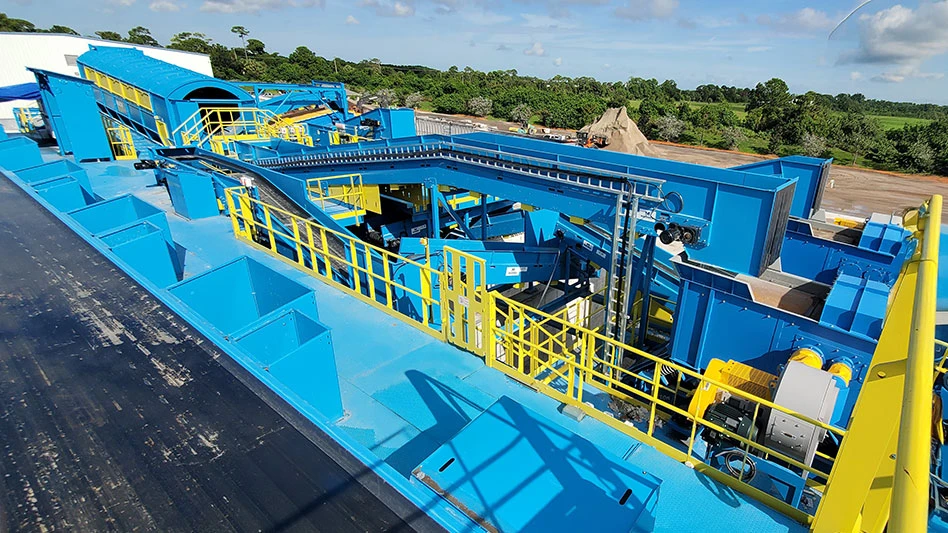
Residents will use one bin for waste and recyclables. The system, designed, manufactured and installed by Eugene, Ore.-based Bulk Handling Systems (BHS), features BHS screens and Nihot air and NRT optical separation technology designed to recover up to 95 percent of recyclables at a rate of 30 tons per hour. The system also will recover organic waste for composting.
“The Infinitus Energy team has delivered a facility that far exceeds the expectations we had upon originally issuing an RFP (request for proposal) to help us revive our recycling efforts,” said Montgomery Mayor Todd Strange at the April 14, 2014, grand opening.
Strange continued, “They have delivered the most sophisticated technology available in the world today to process our MSW (municipal solid waste) and reduce our operating costs — savings that we estimate could be as high as $1.8 million annually. In addition, this facility will help us achieve recycling rates that will be amongst the highest nationally and put the city of Montgomery at the leading edge of managing solid waste.”
“The delivery of the Montgomery advanced mixed materials recovery facility is an example of how our company is redefining waste through this decade and beyond,” said Infinitus CEO Kyle Mowitz. He added that the company’s missions were to reduce waste programming costs, increase overall recovery rates and boost landfill diversion rates.
“Recycling has never been more efficient than it is today,” said BHS CEO Steve Miller. “Infinitus is on the leading edge with its one-bin model, lowering collection costs while raising participation rates to 100 percent, allowing our equipment the opportunity to recover these valuable commodities that have previously gone to landfill.”
Plastics to oil
Global Clean Energy grows management team
Houston-based Global Clean Energy Inc. (GCE) has added Hakim Zahar to serve as chief scientific officer and William Hongchang to oversee quality and management engineering in China.
Zahar has more than 35 years of experience in the clean energy and environment sectors, having implemented more than 400 projects worldwide, the company says. He most recently worked with the International Finance Corp.-World Bank Group as program manager to develop resource efficiency programs in the Southern Hemisphere.
Hongchang will manage the operations and procurement between GCE and its Chinese suppliers.
“In their short time with the company Hakim and William have proved invaluable as the engineering demands on the firm have grown,” says Earl Azimov, CEO of GCE.
GCE says it is contracting with technology providers in Asia and Europe. The company also reports it expects an agreement to be in place with a leading Chinese pyrolysis group in the third quarter with systems destined to its operating sites in North America. GCE plans to build the first dual-line end-of-life plastic and tire pyrolysis operation in the Southeast U.S.
“GCE has systematically modeled and evaluated five distinct business units over the last 12 months on route to $24 million of investment to be made this year,” says Brian Levine, COO of GCE.

Municipal WTE
Covanta partners with Massachusetts municipalities
The waste management firm Covanta, Morristown, New Jersey, has announced a new partnership with nine Massachusetts municipalities for bundled sustainable waste management services. Covanta will provide waste disposal at its Springfield Energy-from-Waste facility (EfW), located in Agawam, Massachusetts, in addition to other waste services.
Covanta owns and operates the Springfield EfW where eight of the nine municipalities have disposed of their municipal solid waste since the facility opened in 1988.
Stephen Crane, town manager of Longmeadow, Massachusetts, one of the municipalities that signed the partnership with Covanta, says, “We are pleased to have reached an agreement with Covanta that we believe provides our citizens tremendous value. Not only are we continuing to keep waste out of landfills by using energy-from-waste technology, but we are now able to add other waste and recycling services that will further reduce our impact on the environment. This also reflects a tremendous collaboration between the Western Mass region and Covanta.”
The nine municipalities will send an estimated 25,000 tons of municipal solid waste to the facility, which generates renewable electricity for 5,000 homes. Covanta also will provide electronic scrap recycling, organics recycling and secure medication and bulk waste disposal. The new agreement is slated to begin in July 2014 with an initial term of three years followed by extension options.
“Covanta is very pleased to have been chosen by these municipalities to provide the sustainable waste services they seek,” says Stephen Diaz, vice president, Covanta Sustainable Solutions. “By bonding together and partnering with us, they will be provided a suite of services that includes zero-waste-to-landfill, all in one agreement. We look forward to delivering the value that our bundled offering provides.”
Tire-Derived Fuel
State and federal agencies work to boost tire recycling on the US/Mexico border
 The U.S. Environmental Protection Agency (EPA), along with the Texas Commission on Environmental Quality and the State of Texas Alliance for Recycling (STAR), recently held a workshop in El Paso, Texas, to help increase tire recycling on the U.S./Mexico border. The event brought together stakeholders from the U.S. and Mexico.
The EPA estimates each year, the U.S.-Mexico border region deals with millions of discarded tires. The EPA notes that finding ways to manage scrap tires is an important goal of the agency’s Border 2020 U.S.-Mexico environmental program. Over the past few years, the program has made progress by engaging local residents in cleanup efforts. This included removing 6 million tires from a pile in Ciudad Juarez, Mexico, which were converted into fuel.
Organizers say they hope ideas and practices discussed at the workshop can work in other areas of the world as well.
For more information on EPA’s Border 2020 program, visit www2.epa.gov/border2020.
Mass burn/incineration
Maryland WTE facility receives Clean Air Award from EPA
 The Montgomery County Resource Recovery Facility (RRF), located in Dickerson, Maryland, has received the 2014 Clean Air Technology Award from the U.S. EPA. The facility is operated by Covanta, Morristown, New Jersey.
In recognizing the facility with the award, the EPA notes that the facility has upgraded its emission control system to a low nitrogen oxides (LN) system that cut the facility’s nitrogen oxides (NOx) emissions in half.
Covanta says that it developed the LN technology as a retrofit for existing energy-from-waste (EfW) facilities such as the Montgomery County RRF.
Covanta retrofitted the Montgomery County RRF plant with an emission control system in March 2009, making it the first publicly owned EfW facility in the country to use the LN design. According to Covanta, since its inception, the LN technology has proven to reduce emissions of nitrogen oxides by 400 to 500 tons per year from preinstallation levels.
“I am especially proud that our Resource Recovery Facility, operated by Covanta Montgomery Inc., has been honored for recognizing the potential of new environmental technology such as the LN system and taking steps to upgrade our operation,” says Ike Leggett, Montgomery County executive.
Landfill gas
Cornerstone to provide landfill gas engineering on Kentucky project
Cornerstone Environmental Group LLC, an engineering and environmental consulting firm based in Middletown, New York, has announced plans to provide landfill gas engineering and air permitting services to the city of Glasgow, Kentucky, for a project that will convert methane gas produced by the city’s landfill into electrical power. According to Cornerstone, at peak production, the project will supply the electrical power needs of about 450 residences and serve as a back-up power source for the city’s wastewater treatment plant.
The project involves a partnership between Glasgow and the East Kentucky Power Cooperative (EKPC) through its local affiliate, Farmers Rural Electric Cooperative, to install a landfill gas collection system and sell the captured gas to EKPC at a wholesale rate. EKPC will generate electricity from the gas for sale to Farmers. The $1.3 million gas collection system is being funded by loans and grants.
Assisting in the funding project is the state of Kentucky, through its Kentucky Energy Conservation for Local Governments, which awarded the project a $100,000 grant. In awarding the grant, Kentucky Governor Steve Beshear said, “This effort is the ultimate recycling project using science and innovation to literally turn trash into energy. Thanks to the vision and creativity of both the public and private partners in this project, the city of Glasgow will have a renewable energy source, save local tax dollars and reduce its carbon footprint on the planet.”
Matthew Davies, co-president of Cornerstone, notes, “What sets the Glasgow project apart from other landfill gas-to-energy projects we have worked on is the extremely high level of collaboration among the partners and the leadership and foresight of Kentucky and Glasgow. This economic development project will provide high-quality jobs and affordable reliable renewable electricity, as well as environmental benefits.
Landfill gas
SCS Engineers to build scrubber at Idaho landfill
Environmental consulting firm SCS Engineers, Long Beach, California, has been selected by Ada County, Idaho, to design and build a $3.2 million hydrogen sulfide gas scrubber at the county-owned landfill. The scrubber will extract hydrogen sulfide from the landfill gas, diminishing odors and fugitive emissions and resulting in more gas available to generate renewable energy, according to SCS.
SCS adds the capture of additional renewable energy biogas will increase revenue for the landfill, helping to offset the cost of the scrubber system. Furthermore, removal of hydrogen sulfide not only increases available resources, it decreases sulfur dioxide emissions.
“SCS’s experience and expertise with solid waste and landfill gas control made them an obvious choice for this project,” says Dave Logan, Ada County operations department director.
Municipal WTE
Alberta city chooses SENA Waste Services to run waste management facilities
The city of Edmonton, Alberta, has contracted with SENA Waste Services on a five-year agreement worth approximately $75 million to operate two key portions of the Edmonton Waste Management Centre.
 Under the agreement, SENA Waste Services will maintain and operate the Edmonton Composting Facility (ECF) and provide maintenance support services for the Integrated Process and Transfer Facility (IPTF) and the Construction & Demolition (C&D) Facility.
SENA Solid Waste Holdings Inc., an Alberta-based corporation, is a joint venture between Suez Environnement North America and AECOM.
“This selection represents an important milestone that clearly demonstrates SENA Waste Services is well-regarded by the city of Edmonton, which is one of world’s most sustainable cities,” says Bertrand Camus, CEO of Suez Environnement North America. SENA Waste Services and its predecessor companies have worked with the city of Edmonton since 2001.
According to Philippe Allouche, general manager, SENA Waste Services, the Edmonton Waste Management Centre is a unique collection of advanced waste processing and research facilities. Owned and operated by the City of Edmonton Waste Management Services, the center is North America’s largest collection of modern, sustainable waste processing and research facilities and is an integral part of Edmonton’s approach to waste management.
“In just over 20 years Edmonton has traveled from a relatively simple waste management system to one of the most sophisticated in the world,” says Bud Latta, director, processing and disposal, Edmonton Waste Management Services. “We are proud of our accomplishments and excited to partner with SENA Waste Services in bringing innovative solutions to the residents and businesses of Edmonton.”
The IPTF maintained by SENA Waste Services allows the separation of waste into three categories:
- organics for composting;
- waste for landfill; and
- waste for conversion to ethanol at the on-site Waste-to-Biofuels Facility.
The C&D Facility recycles wood, drywall, asphalt shingles, concrete, metals and brush and trees. The ECF operated and maintained by SENA Waste Services is the largest composting facility in the country, allowing for composting of both organic solid waste and biosolids material.
According to Latta, the city of Edmonton currently diverts up to 60 percent of household waste from landfill through recycling and composting. The organic portion of the household waste is sorted out and composted. “Our waste diversion success is the result of effective, early strategic planning and now solid operational execution,” he says.
Plastics to oil
Ohio agency approves funding for Vadxx
 The state of Ohio’s Controlling Board has approved a $1.6 million loan through the agency’s Commercial Acceleration Loan Fund (CALF) to help fund Vadxx Energy LLC’s plastics-to-fuel facility in Akron, Ohio. The goal of the loan fund is to bridge the gap between early-stage entrepreneurs’ need for capital and traditional commercial sources of financing.
Vadxx Energy, which is headquartered in Cleveland, plans to build a facility in Akron that will allow the company to convert recyclable and nonrecyclable plastics into various energy products. The total project cost is expected to total $2.4 million. Vadxx’s technology captures the energy embedded in plastics and returns it to a useful form by essentially reversing the process by which plastics are created. The plastics are cooked, cleaned and cooled in a closed and controlled system. The process converts plastics back into diesel additive, fuel gas (similar to natural gas), and inert char (similar to carbon black).
Vadxx says it expects to produce more than 100,000 barrels of synthetic oil and gas per year. The equipment that will be installed at the Akron plant will cost $17 million and will be funded by Liberation Capital, headquartered in Charlotte, North Carolina. The building will be funded by a third party for approximately $4 million and will be leased to Vadxx Akron.
Landfill gas
Landfill-gas-to-electricity facility being developed in South Carolina
The utility company Lockhart Power Co., Lockhart, South Carolina, and the investment firm Pacolet Milliken Enterprises Inc., Spartanburg, South Carolina, have announced plans to develop, own and operate a landfill gas-to-power renewable energy facility at Republic Services’ Upstate Regional Landfill in Union County, South Carolina. The project will use methane gas captured from the landfill as fuel to make electricity.
Lockhart Power has formed a subsidiary called Lockhart BioEnergy LLC to develop and own the facility. The project will consist of two reciprocating combustion engines, each powering a 1,600-kilowatt generator. Initially the facility’s output will be purchased by Duke Energy, the company says.
“Before it was publicly announced, the project was referred to as Project Midas because it turns trash into figurative gold,” says Bryan Stone, COO of Lockhart Power. “We have proven with our Wellford (South Carolina) renewable energy project that this type of generation is not only feasible, but effective and economical. This project represents the sixth renewable energy facility we have developed or purchased during the last several years, and materially supports our corporate environmental sustainability mission by continuing to allow Lockhart Power to generate more than 99 percent of its power from renewable energy resources.”
Lockhart Power currently owns and operates a similar landfill gas-to-energy facility in Wellford through a partnership with Spartanburg County. The Wellford project transports a portion of the landfill gas by pipeline for use in Milliken & Co.’s Dewey plant in Inman, South Carolina, and uses the remaining landfill gas on site for power generation.
“This project is another example of our efforts to become a leader in implementing green power alternatives,” says Richard Webel, president of Pacolet Milliken, Lockhart Power’s parent company. “By capturing and beneficially utilizing landfill gas, we will reduce air pollution and tap into an otherwise wasted source of usable energy.”
The air permitting process for the facility was expected to be completed by May 2014.
Latest from Waste Today
- Waste Pro files brief supporting pause of FMCSA CDL eligibility rule
- New Way Trucks expands US network with Joe Johnson Equipment
- Tire Industry Project publishes end-of-life tire management guide
- Vecoplan to present modular solutions at IFAT 2026
- Terex Ecotec appoints Bradley Equipment as Texas distributor
- My Green Michigan expands depackaging capacity
- Washington selects Circular Action Alliance as PRO
- Ten-8 Industrial opens new central Florida service center