There used to be a job called an “elevator operator.” For those of us old enough to remember, the elevator operator was a man (usually wearing a sharp uniform like a fancy hotel concierge or doorman) who sat in an elevator car for his entire shift and manually operated the lift so that you would arrive safely and smoothly at your destination floor. Traditional elevator operators still exist in high-end establishments offering superior service to its residents or customers. But for the most part, the job has been superseded by automatic control buttons that the rider can push themselves and arrive efficiently at their chosen floor.
This job sums up the history of automation vs. labor. Very few human operators of elevators still remain. Passengers can use automated controls to arrive at their floor. The job itself wasn’t all that great. It was boring, repetitive, and while it required no heavy lifting, it required the operator to sit enclosed in a box for his entire shift. Nobody misses it, and it is not remembered with fond nostalgia. The loss of this job did not contribute to our structural unemployment as the former operators went on to better working conditions at better-paying jobs—jobs made possible and created by the same technological advances with higher pay made possible by increases in productivity.
Like every other industrial process, material recovery facilities (MRFs) continue to evolve with new technology and automation. The latest innovations have directly impacted the efficiency and profitability of individual MRF operations while indirectly affecting the solid waste management industry as a whole. Politics also plays a role in tariffs and state regulations, affecting both what can be recycled and how it can be recycled. The China Waste Ban is a perfect example of politics and economic planning interfering with the operation of the market—and how the market will respond, adjust, and evolve to meet these changes.
Types of Recycling Equipment
There are nearly 600 operational MRFs in the US processing over 91,00 tons daily. Most of them are in high population density areas such as the Northeast Corridor and California. MRF operations tend to concentrate on removing and recycling currently in demand. Recycling is a market-driven operation and responds to price signals from the market. Assuming that composting of organic waste is treated as a separate operation, a typical MRF will concentrate on removal of paper, plastic, metals, and glass.
There are two basic categories of MRFs: single-stream “dirty” MRFs and multiple-stream “clean MRFs.”
Stage 1: Pre-arrival—organic waste removal
Organic waste differs significantly from the rest of the waste stream in that it is composted instead of recycled. And so, the processes of removal, segregation, and processing differ significantly as well. Given its different source outside the main activities of home and business, organics can be easily isolated from the rest of the waste stream even before pickup and delivery by refuse haulers.
Stage 2A: Metal extraction—magnetic removal of ferrous metals
Ferrous metals are perhaps the easiest material to extract from the waste stream due to their magnetic characteristics. Fixed magnets and electromagnets can directly remove ferrous metals from conveyor belts as they pass under or over the magnets. Magnets can be set in an overhead position for direct removal, or underneath the belt, allowing the ferrous metal to stick to the belt while everything else falls off into a collection bin at the point where the belt moves past the last roller and turns under.
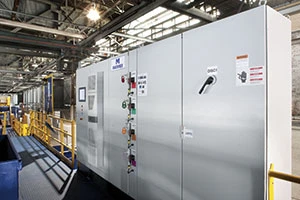
A Machinex control and supervisory system
Stage 2B:
Metal extraction—eddy current separation of nonferrous metals
Eddy-current separators remove the nonferrous metals that magnets cannot. Using rapidly rotating magnets, eddy-current separators send an electric current into nonferrous metal objects, which in turn create their own magnetic field of opposite polarity. This magnetic repulsion pushes the metal off the belt and into a collection bin.
Stage 3A: Paper extraction—removal of old corrugated cardboard (OCC)
Corrugated cardboard sheets and cardboard boxes tend to be large and relatively low-density. These low-density objects are best removed by disc screeners. Disc screens are large open-topped hoppers with a widespread floor bed. The floor bed is lined with rotating discs of varying sizes, dimensions, and shapes (round, oval, star, etc.) whose edges are set perpendicular to the bed surface. These discs are set to rotating at various speeds as waste is fed into the floor bed. Their various speeds and shapes create unique wave patterns in the waste (not unlike the rotator in a washing machine). The resultant churning lifts the larger and lighter OCC boxes and sheets to the top of the waste for easy removal.
Stage 3B: Paper extraction—removal of office paper, newsprint, and magazines
Lighter-weight and smaller pieces of paper are best removed with air currents. The air classifiers that lift up and remove pieces of paper are basically tall chimney stacks with a blower applying suction at the top of the stack. The waste stream is fed into the middle of the stack. The high-velocity air currents flowing up through the chimney apparatus suck the paper out of the waste stream while heavier objects fall to the bottom for further processing. Paper exits out of the open top for collection and further processing by an air cyclone that can separate different grades of paper.
Stage 4: Removal of dirt and debris—cleaning the remaining waste stream
Rotating trommels, originally used by mining operations to separate ore from slag, serve a similar purpose in waste processing—the removal of impurities from more valuable recyclables. They are basically a rotating drum with perforated sidewalls set at an angle to the horizontal. Attached to the axle is a series of vanes. As it rotates, waste is fed into the top and impacts the vanes as it falls. This spinning and impacts result in churning that shakes loose small heavy objects like dirt, stones, and debris. These then fall out of the sidewall perforations for collection and disposal. At the end of the process, only large recyclable objects emerge from the bottom of the drum for further processing.
Stage 5A: Glass removal—extraction of various glass colors with LSP
Color separation is a technology originally developed for the chemical and dye industries, allowing for the segregation of materials of differing colors. The technology of light spectrophotometry (LSP) can distinguish between colors of commercial glass (clear, amber, brown, or green) as well as cullet and ceramics—and differing types of plastic. It does so by reading the various wavelengths of light reflecting off of the surface of the object being examined. The system then tells a blower if this particular object should be removed from the waste stream conveyor belt. A blast of high-velocity, high-pressure air is used to push the object off of the belt and into an adjacent receptacle.
Stage 5B: Plastic removal—extraction of various types of plastic by near infrared
A similar technology to the LSP is the near infrared sensor. But instead of reading wavelengths of color, it is used to judge the density (and therefore the type) of plastic waste objects.
Lastly, there is the human element. Human workers will remain an important part of any MRF operation, even those that utilize advanced automation and robotics. Hand sorting will always be necessary because no system is ever perfectly automated. Operational decisions will continue to be made by human operators because MRF operations are not just a simple straight-through feed operation and the material being processed will remain very heterogeneous with unpredictable material characteristics and makeup. Humans have the flexibility to exercise judgment and respond to unpredictable situations. Common sense is something that cannot be automated.
Advances in Technology and Automation
This brings us to the main issue confronting every industry and industrial worker in America, not just MRF operations. One of the iron laws of capitalism is that companies must always strive to replace labor with capital machinery. It is why ditches are no longer dug by a gang of shovel-wielding workers but by one man with a backhoe. It is why clothing is stitched by machines instead of sewn by hand. It is why farming is done with combines and tractors instead of hand hoes or plows pulled by mules. Machines take over boring, resistive, dangerous, dirty jobs that most people would prefer not to do. In the end, technology has always improved productivity and created more real wealth and better jobs for all concerned.
For all of the headlines, the use of robotics and artificial intelligence in the recycling industry is still in its infancy. As for robotics in general, Greg Gesell of HDR notes, “Everyone seems to be talking about robotics and there are some applications. Right now, the technology cannot come close to replacing optical sorters or even screens, but as one example, a robot might serve a QC role to complement an optical sorter or to recover missed items in a residue line. The technology does a great job of recognizing many types of commodities but needs to improve its picking rate. This will be something to watch as improvements are made and costs come down.” For now, the biggest advance is in optical sorters; “They started with container capture and are now used in lots of locations and in lots of innovative labor-saving ways. The technology is able to successfully recover nearly every targeted object that is properly delivered to the sorter. Sometimes a team of optical sorters will capture multiple commodities in interesting combinations. Perhaps one of the best labor savers is quality control sorting on a fiber line after initial sorting with screens. The machines can produce a clean product and reject contaminated materials.”
As a result of automation, manufacturing has returned to the US (a process called “in-shoring”). America is once again the world’s leading manufacturer, but with far fewer industrial workers, and these workers need high tech skills and training, not just screwing a lug nut on a car passing down the assembly line. Like every industry, the recycling industry will tend to ever-increasing levels of sophistication of automation. In the meantime, advances will continue in the fields of controls, sensors, data acquisition and analysis, metering, remote operations, SCADA, and troubleshooting. In the meantime, the recycling industry will also have to adjust to political changes and new technological challenges.
Concerning the proper balance between manual operations and automation, Terry Schneider of the CP Group has this to say: “Only a handful of customers are willing to pay for higher-end data acquisition capabilities, mostly because more available data also means more time required to analyze it. At some point, even the most sophisticated and intelligent control system will only provide a small incremental increase in productivity or time/cost savings. A cost/benefit analysis always needs to be carried out to make sure the solution fits the customer’s needs. More intelligent machinery potentially means more complex operator interfaces and maintenance tasks. The requirement for high-quality maintenance personnel will continue to increase in order to get the highest performance out of the highly capable machinery. The trend goes towards quality managers vs. quantity employees (sorters).
Political Challenges—The China Plastic and Waste Ban
Technological challenges manifest themselves indirectly via political changes. After importing 7.3 metric tons of waste plastic from developed countries, China banned the importation of recyclable plastic and 23 other categories of solid waste materials last July. This campaign against “yang laji” or “foreign garbage” applies to plastic, textiles, and mixed paper, and comes as a surprise after decades of making scrap and recycling a foundation of the Chinese economy. As a result, China will be accepting much fewer recycled materials from the West. Beijing has stated that the ban is put in place out of environmental concerns. China’s economy is switching from manufacturing to a consumer-driven economy as its people become more prosperous and the Chinese government has pledged to clean up the environmental damage caused by its rush to industrialize. It claims to have found significant quantities of dirty and hazardous waste mixed in with the plastic shipped to China, a source of severe environmental degradation. While it is facing an environmental crisis, an outright ban of recycled material will merely shift the problem elsewhere.
So how are the former exporters of all that plastic and other recycled materials going to respond? Some forms of disposable plastic have been banned in certain countries (such as plastic drinking straws in France and the United Kingdom). In any case, more extensive plastic recycling efforts at home will have to be implemented. In addition to changing consumer behavior, some nations have adopted a more radical approach to managing waste plastic and municipal waste in general.
Major Suppliers
American Restoration & Preservation Systems Inc. is an industrial architectural design firm that believes that architectural form can be derived from function and practicality with honesty. This approach results in cost-effective ideas that can influence the facility design in aesthetically pleasing ways—even MRFs. Combining aesthetics, constructability, and durability, JRMA designs projects with quality that provides long-term value. This quality-infused design is guided by years of experience understanding the performance of building components and design elements. Mindful of every design’s role in the built environment, they consider every sustainable feature’s importance for minimizing potential impacts. The JRMA Design Team is continually guided by environmentally-sound design principles that generate healthier workplaces and establish the compatibility of the project within the natural environment as well as the built environment.
CP Group Manufacturing and its optical sorting division, MSS Inc., are constantly working on improving already proven technologies as well as developing new innovations that assist their customers in multiple areas in modern MRFs. CP is uniquely positioned in the MRF equipment vendor landscape since they operate their own MRF in San Diego, CA. This allows them to be on the forefront of new end-market development and requirements for new equipment and test their own equipment developments in depth in their own facility. CP is a manufacturing and service company, not a sales organization. For example, many of their projects involve retrofitting existing facilities, and they focus on engineering details that make retrofits more compact, efficient, and easier/less expensive to install. The ever-evolving material input composition (light weighting of all packaging materials, “Amazon” effect, flexible plastic packaging) provides them with many challenges.
HDR design services include design and operation of transfer stations, reviewing and updating of training material and operating standards across transfer stations, and MRF design and operation. One example of their expertise is the new Factoria Recycling and Transfer Station in Bellevue, WA, to replace an older outdated facility. This $52 million construction project, this new 70,000-square-foot station, improves hauling efficiency and decreases truck trips from the facility to the regional landfill. Its recycling and diversion efforts are designed to recover 5,000 tons of waste each year. Engineering services were provided for all three phases of the project: planning/conceptual design, detailed design phase and permitting, and construction. It has an enclosed solid waste transfer and processing area, administration area, fueling facility, maintenance shop, new household hazardous waste facility, recycling areas, hot load area, and an area separate from commercial traffic for self-haul customers to unload their waste, drop off recyclables, and safely dispose of household hazardous waste, and allow floor sorting and materials diversion.
A leader in sorting technologies for over 30 years, Machinex provides a wide range of recycling services (single-stream, mixed waste, construction and demolition, glass, scrap metal, organics, and plastics). In addition to providing advanced recycling products (such as screens, optical sorter, balers, compactors, and more), they are experts in MRF automation and control.
Their Control and Supervisory systems are designed to provide the necessary operating information and to reach maximum sorting efficiency. Their systems provide flexible control for the maintenance and operating crew, as well as powerful management tools for the plant supervisor. They are all tailored for recycling facilities and fully integrated into Machinex Sorting Systems. Their Automation and Control Department, from the beginning up to the commissioning, takes part in the design of the system. This greatly helps take into account important aspects such as safety, installation, start-up, operation, and maintenance. Their programmers are trained to integrate and program the power and control components of various world-renowned manufacturers, such as OMRON, Allen-Bradley, Siemens, and Schneider. They can also integrate Machinex equipment into existing systems provided by other manufacturers.
With over 340 MRFs and 2,400 recycling and sorting systems installed to date, Van Dyk Recycling Solutions provides turnkey high-performing recycling and sorting systems. In addition to providing Bollegraaf and TOMRA optical sorters, they provide whole system design and MRF system upgrades, including control and data systems. In doing so, they provide their customers with customized recycling systems to meet anticipated wastestream characteristics and flow through quantities.
Titus MRF Services is an integrator for MRF operators. The integration comes via a retrofit of an existing MRF by combining existing equipment with new equipment using the Titus MCC panel and control interface, as well as Titus supports, platforms, and handling components. Titus works with a variety of MRF equipment vendors and combines high-quality cutting-edge technology components from these vendors with a MRF’s existing equipment saving that MRF money. Titus provides the customer with design, build, and installation services. We have the ability to integrate old controls with new controls. The standard Titus Fixed Motor Control requires 80% less wiring than traditional motor starters and is easily switchable from local control via a keypad to a remote touchscreen.
Titus has two patents: One is a glass cleaning system that removes lights from heavies, allowing the glass to be used for re-melt end-users. The other is a secondary MRF where Titus takes all the first or primary MRFs for single-stream collection systems, chooses not to sort and, via an innovative equipment and blue bin accountability system, digs deeper in the blue bin. This increases the diversion for a typical city by 5% for blue bin collection systems.
Latest from Waste Today
- Worn Again Technologies unveils Accelerator plant to advance polycotton recycling
- Nashville Waste Services launches new digital route system
- ACUA landfill expansion project unanimously approved
- Clean Energy announces multiple RNG deals with fleets nationwide
- Interchange 360 to operate alternative collection program under Washington’s RRA
- Waste Pro files brief supporting pause of FMCSA CDL eligibility rule
- New Way Trucks expands US network with Joe Johnson Equipment
- Tire Industry Project publishes end-of-life tire management guide