The newest transfer trailers and live floor products in the solid waste industry are providing increased efficiency, versatility, reliability and safety factors to help operators address an ever-changing wastestream.
Some companies continue to offer products whose past innovations have withstood the test of time with features that continue to be relied upon.
FLOORS
The waste sector is having to manage more organics today being separated from the traditional wastestream, points out Richard Moffitt, vice president, sales and marketing, Hallco Industries.
“These organics pose a significant problem with collection due to higher water content in the materials,” he adds. “To combat this problem, Hallco has created a leak-proof unloading system for large transfer trailers called the Brute, which utilizes a hydraulic drive system to power the unloading slats inside the trailer.”
Traditional floor slat unloading systems utilize a hydraulic system mounted under the trailer, connecting to the floor slats from underneath, Moffitt notes.
“This does not allow a leak-proof trailer and puts mechanics in what you may call the ‘drip zone’. This is an area under the trailer where garbage juice and organics liquid may drip down onto the operator or maintenance personnel.
“The Hallco Brute mounts outside the trailer on the front with easy access to the controls and hydraulics for preventative maintenance. Being on the nose of the trailer allows for a fully sealed floor inside the trailer to capture the high liquid organics.”
The Hallco Brute also utilizes open spacing between the slats in the trailer to allow for washing out the finer materials which may build up over time, Moffitt points out, adding that by washing down the floor, an operator can increase the life of a floor system.
Electrification, automation, and remote operation are leading the design changes of the future, enabling end-users to do more with less, notes Moffitt.
“Integrated sensors and cameras will work with live floor controls, allowing the operators to work from a safe distance while unloading transfer trailers,” he adds. “Hallco is working to create new intuitive control systems which will make this transition to automation simpler and easier for transfer trailer manufacturers and operators.”
Currently, hydraulic power is still the most economical form of power for live floor systems, Moffitt says.
“The introduction of electrification in tractors/semi-trucks will be an interesting challenge for our industry, one we are working very hard to meet,” he adds.
Nolan Link, national trailer sales manager for J&J Truck Bodies & Trailers, notes that “while not a lot has changed in the waste sector of refuse trailers, our engineers have designed a new flip roof system for walking floor trailers.”
The system is designed to be a robust option for MSW hauling.
“Opening like French doors, the roof will provide a fully closed or open top, making it easy to load while 100% securing everything inside,” Link adds.
It’s part of the company’s line of offerings that include pushout/ejector trailers, walking floors, dump trailers with options of steel or aluminum, top-loading, or compactor loading, as well as a self-contained unit that essentially operates as a “huge compactor on wheels,” says Link.
KEITH Manufacturing recently introduced the J-MAX Floor, designed to maximize performance, versatility, and diversity and improve efficiency in solid waste operations facing tight labor markets and shrinking budgets, notes Mike Robinson, KEITH sales director.
Trailers equipped with KEITH Walking Floor systems are designed for fast unloading and the ability to unload without the assistance of a tipping system. Safety, versatility, and reliability are the key benefits of the technology, Robinson adds.
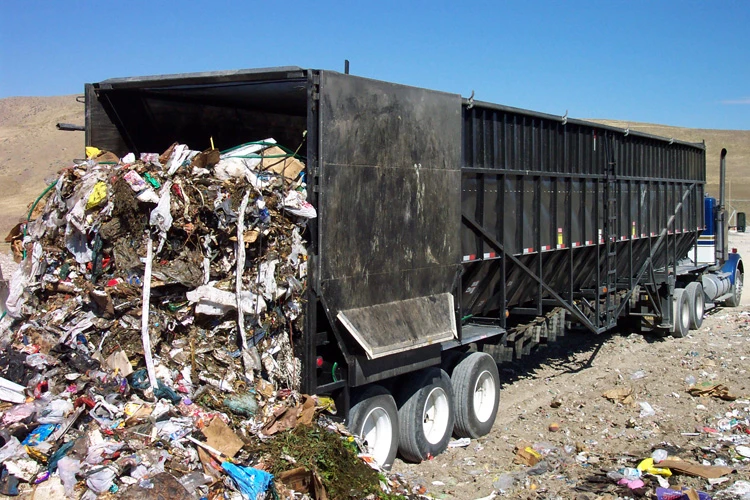
“The KEITH Walking Floor unloader is a moving floor system containing a series of reciprocating floor slats powered by a hydraulic drive that ‘walks’ material out the back of the trailer, with no tipping,” says Robinson. “The technology also is used in transfer stations and MRFs to store waste or recyclables until conveying them for further processing.”
Factors such as material abrasion, how the trailer will be loaded, and if the trailer needs to support forklift traffic should be considered when choosing a floor type, says Robinson.
“The J-MAX Floor is a good choice for haulers looking to unload a variety of materials, from MSW and light demolition to mulch and gravel,” he says. “It handles the more difficult products such as glass and sticky, abrasive materials. The J-shaped seal is designed to reduce sifting of material through the flooring.”
Robinson notes a key benefit of the J-MAX floor is the product diversity that haulers can unload. The ability to backhaul can double the efficiency of a trailer, so a floor slat that handles a variety of materials is a plus, he adds.
The J-MAX floor system is constructed of roll-formed high-strength steel to provide a longer slat life than standard aluminum flooring, says Robinson.
The unique J-shaped seal reduces material from sifting through the floor, making it a good choice for hauling sand, gravel and wood waste.
The J-MAX floor also is designed to withstand wear and tear in the demanding conditions of a solid waste operation, says Robinson, pointing out a trailer can be reloaded often six to eight times per day.
KEITH offers a variety of other slat profiles for the waste, notes Robinson, adding haulers need to match the flooring with the material.
“Aluminum IMPACT flooring is a standard in the industry due to its impact resistance, reliability, and longevity. The steel V-FLOOR slat is the ultimate heavy-duty model for materials like scrap cars, rock, and asphalt,” he adds.
Pointing out that worker safety is a major concern for the waste industry, the horizontal unloading of the Walking Floor system “not only prevents it from toppling like a dump trailer can, but it also eliminates the risk of hitting overhead utility lines or trees during the unloading process,” Robinson says.
“This offers haulers flexibility in unloading locations, allowing them to discharge loads inside buildings if necessary. Trailers can also unload adjacent to other equipment, which is not recommended for tipping trailers due to the increased risk of overturning. They can also safely unload on uneven ground and in windy conditions.”
Speaking to dependability, Robinson notes the hydraulic drive requires very little maintenance, especially compared to the daily maintenance required to keep a belt trailer in good working order.
“We recommend monthly visual checks with a more thorough inspection and filter change every six months,” says Robinson. “If you are running clean hydraulic oil, the problems will be few.”
TRANSFER TRAILERS
East Manufacturing continually designs refuse trailers with the latest technological advances in equipment, resulting in components that reduce weight yet maintain the ideal balance of weight and strength while incorporating components and procedures to guard against corrosion to increase life and residual value, notes Charlie Benton, product manager for refuse trailers.
Aluminum frame brackets are incorporated to not only reduce weight but reduce corrosion to increase durability of the floors, Benton adds.
“To accommodate additional payload, efforts are constantly being made to reduce the tare weight of East refuse trailers,” Benton says. “Emerging technology by suppliers and developments in new alloys and extrusion design continues to drive the effort forward to find ways to reduce the weight and maintain the efficiency of the equipment. East stresses the strength-to-weight ratio to provide maximum return to the investment dollar.”
The Truck-Lite 99 Series wiring harness is standard on all new East Tipper and Unloader trailers. The series is designed as a closed system by integrating a molded plug with two sealing surfaces rather than just one.
“This two-seal plug keeps moisture and debris out of the plug, guarding against corrosion. Truck-Lite is the first harness manufacturer to design a trapezoid-shaped connection, which makes installation quick and easy and allows operators to be confident that they have proper pin alignment and a positive lock,” Benton points out.
East uses the Alcoa Ultra ONE 22.5 x 8.25 wheel as standard on all of its trailers specified with a 22.5 dual-tire set-up. At 40 pounds, it is the lightest wheel in its class, he adds.
Its one-piece forged aluminum strength is five times stronger than steel wheels with a 7,400-pound load rating and 130 psi inflation rating, Benton notes.
The JOST International Alumilight HD Series of landing gear is an option on all Tipper and Unloader refuse trailers.
With no external gearbox that can be damaged and affect performance, the JOST Alumilight series aluminum landing gear is designed to be up to 50 pounds lighter per set than other market gear options for added payload and corrosion resistance, Benton says.
“Its 6061-T6 extruded aluminum upper leg combined with a polyester-coated HSLA steel lower leg provides durability to stand up to the harshest conditions,” he says. “The gearing mechanism is integrated into the sturdy leg column, so it protects the gearing and significantly minimizes water intrusion.
“A silicone-sealed steel cover keeps moisture out to further protect the landing gear from water and road chemical damage and freezing. East also reverse mounts the landing gear legs on the wing brackets for more stability when the trailer is loaded.”
In addition to its aluminum wheel and landing legs, East made aluminum air tanks standard on its refuse trailers. Weighing 10.7 pounds less, the aluminum air tanks are made with less corrosive and lighter material than steel air tanks.
Air tanks on trailers provide air pressure volume to operate the pneumatic system, including brake actuation and suspension performance—including lift and steer axles—tire inflation, and other factors, Benton says.
Each tandem axle East trailer has a minimum of two tanks with 21.4 pounds less weight.
“The more axles added to a trailer, the more tanks required,” notes Benton. “For instance, each lift axle and each steerable axle requires an additional tank. In addition to the lighter weight, the aluminum is less corrosive.”
For East, the details of current trailers that set them apart from past equipment offerings include the strength of the 5-1/4” I-beam cross members and its advanced wall-to-floor construction sets a strong foundation for the moving floor, says Benton.
The subframe uses an 11-inch extruded aluminum I-beam, an integrated push bumper, and two tow hooks, designed for greater durability.
“The most critical point in securing East trailer strength is in the advanced wall-to-floor construction—the welded union of cross members, floor plates, and sidewalls,” says Benton. “The cross members and floor plates interlock into the bottom rub rail, forming a pocket to accept the sidewall panels, providing a super-strong floor-to-wall attachment joint.”
East puts aluminum braces on each side of the drive unit for extra strength to prevent bowing of the bottom rails. Additionally, a driver-side access hole in the bulkhead is designed to provide easy access to the stainless steel tubing, giving technicians plenty of space to work on the hydraulics.
“Many waste haulers specify thicker walls and floors at the last four feet of the trailer, providing the best wear factor,” notes Benton.
The Genesis smooth-sided sidewalls play an important role in trailer durability and strength, Benson says.
“The wall design allows additional aluminum to be applied where needed for longer wear, and/or extra height for increased capacity,” he adds. “This enables users to exactly match their trailer to their loads and wear patterns.”
The East Genesis smooth-sided aluminum sidewalls in an aerodynamic design provides more cubic yard capacity than traditional external post trailers, says Benton, adding its innovations include superior strength and resistance to bowing, double-wall design to protect the outer wall from dents to improve resale value, and three-inch spacing of interior panel ribs with inside walls staying flatter and creating fewer high points to reduce wear.
It also features optional thicker aluminum in higher wear areas and easy repairs that can be inconspicuous and do not require the removal of the top rail as well as ease of cleaning, he adds.
Higher sidewalls and longer trailers enable recycling haulers looking for maximum cubic yard capacity to haul more at one time, notes Benson.
“Since recyclables weigh less, these trailers usually cube out before they reach their weight capacity. The additional capacity allows more material,” he adds.
The 3-inch spacing of interior panel ribs gives eight times more wall support than external posts positioned every 25 inches.
“The aerodynamic design consists of unique two-inch thick, double-wall extruded aluminum panels which are robotically welded vertically inside and out for superior strength and resistance to bowing,” says Benson.
“The inside walls stay flatter, creating fewer high points to decrease wear. Vertical panels reduce maintenance costs and resist bowing better than horizontal panel trailers. In addition to maximizing strength, welding inside and out reduces corrosion from road salt penetration.”
Matthew Simmons, director of waste products for MAC Trailer Manufacturing, notes that waste trailers have been continually evolving.
“Over the last six years, we've really put a focus on reducing the cost of ownership to the end user in creating a trailer that has a lot of value at the end of the day,” he says. “In our research and development center, we’ve spent a lot of time developing all aspects of the trailer to reduce cost of ownership from the weight savings to adding strength and longevity into the trailer.
“Companies that are hauling with the trailers don't have spare equipment and the maintenance personnel or the time to fix trailers like they used to. It’s important to them to have trailers that work every day.”
Mac has placed a man door in the bulkhead so the driver can gain access to the trailer for cleaning or other purposes without climbing up the back.
“We incorporate a lot of different safety features into how our gates open and how the trailer is laid out so the driver can couple and uncouple from a safe standpoint,” Simmons says.
There is a push to go maintenance-free on trailers, Simmons notes.
“We’re designing and implementing a lot of features that reduce the maintenance costs, using high-quality materials, a lot of stainless steel, a lot of grease impregnated bronze bushings, and galvanized steel products to build a trailer that is set up to withstand the rigors of what's out there today and to be maintenance-free.”
Summit Trailers offers 10 different trailers in its line-up. The company pioneered aluminum live floor transfer trailers in 1983—working with Keith and Hallco companies in doing so—and their design has withstood the test of time, notes Chuck Pishok, president.
“We’ve tended put attention not so much in the flash as in what really works, so the design has maintained durability over the years,” says Pishok.
The company offers traditional top load trailers and has designed some rear-load trailers to facilitate rear loading for specific applications, Pishok notes.
The trailers are designed to meet highway safety standards and to keep the operators as safe as possible, he adds.
Other features such as sensors are placed on the trailers at an end-user’s request.
Trail King offers a live bottom trailer with a V-shaped hopper and a conveyor-style floor.
“By offering a safer, faster, and more versatile unloading procedure, live bottom trailers don’t roll over, they can unload in rougher terrain with less job site preparation, and they can easily be partially unloaded—unload one trip in multiple locations,” notes Kara Kayser, Trail King marketing manager.
“They can unload while moving forward, aiding in the spread of the product,” she adds. “Live bottom trailers remain horizontal during the unloading process. The flow of material is always predictable and controllable. Live bottom trailers are ultra-stable as their center of gravity is never shifted during the unloading process.”
End-users will notice updates that provide better access points for simpler maintenance, such as the bolt-on upper coupler/kingpin and front fenders.
Hopper walls are constructed with longer-lasting .160” (4mm) thick AR450 wear plate in the rear half with the full length as an option. Round hopper cross members are attached to the sidewall with cast steel mountings, providing less opportunity for material buildup.
A heavy-duty 4-inch pitch roller chain and frictionless drive system is designed to provide efficient horizontal discharge while unloading in one revolution or less. The aerodynamic design features smooth side panels in aluminum or steel, providing corrosion prevention and a clean shiny finish, notes Kayser.
Depending on the products hauled, how waste is sorted, and the need to diversify transportation there are “virtually endless uses” for a Trinity belt trailer in the waste sector, notes Trinity Trailer spokesperson Keith Eastman.
Trinity’s 61-inch belt EagleBridge “gives the most volume and fastest unload of any Trinity belt trailer,” says Eastman. “Unloading in as little as two minutes, this trailer is perfect for an operation hauling lightweight bulk products for the waste and recycling industry such as shredded plastic, low moisture paper pulp, wood chips, and mulch, for example.”
Trinity also offers a 48-inch chain and flap option designed for heavier products hauled in bulk such as crushed glass, autofluff, shredded tires, ground-up demolition debris, biosolids, cardboard, and metal slag from foundries.
“Products with higher moisture may require our wet seals on our doors and a moisture containment system to catch liquid run-off,” notes Eastman.
Pairing those features with the Trinity EagleTron II remote system enables operation of the belt and rear hydraulic door without leaving the tractor cab.
Trinity offers a variety of plastic liner options, from 3/16-inch HMW plastic to 1/2-inch thick UHMW plastic for installation in a Trinity EagleBridge trailer.
The EagleBridge design gives the trailer 18 degrees of flex side to side over uneven terrain and for on or off paved roads, says Eastman, adding the company utilizes stainless steel as the primary metal in its belt trailers to ensure longevity in many environments.
Latest from Waste Today
- Vermeer announces plan to build new facility in Des Moines metro area
- Buffalo Biodiesel shares updates on Part 360 application to DEC, Tonawanda facility progress
- Capstar Disposal expands roll off dumpster rental services
- Supreme Court strikes down IEEPA tariffs
- Casella details facility closures, expansion efforts
- Zero harm: Building a SIF prevention program for waste and recycling operations
- Casella posts a loss in Q4 2025
- McNeilus names Haaker Equipment first Dealer Partner of the Year