Advanced Systems
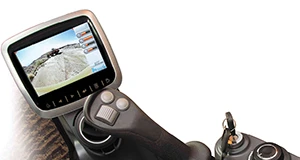
The obvious solution to a blind spot is the addition of visual cameras. These provide a view of blind areas to the driver by way of in cab monitoring screens. The cameras are mounted on the rear and sides of the truck as needed, and directed at appropriate angles to provide the driver an all-around view of the immediate zone adjacent to his vehicle.
Usually, these cameras are configured to provide overlapping fields of view, ensuring that the driver has complete visual awareness. The cameras are connected to the monitor screens by means of coaxial cables embedded or attached to the body/frame of the truck. Preferred camera systems are those that are completely weather proof, strong, and reliable, including shock resistance. An operator can choose from flush mount, surface mount, and side mount rear view cameras with CCD or CMOS image sensors and 120-, 130-, or 150-degrees viewing angles. Cameras come with and without RCA connectors or a black box additional camera to record and keep what the camera sees.
However, cameras depend on visible light. Unless combined with illuminating lights, they are of little use in the dark. This requires the use of integrated thermal cameras as well as infrared sensors. Perhaps more familiar as devices used in science fiction or action/adventure movies; infrared sight is mature technology that is widely used in industry and transport. As a passive collector of non-visible light waves in the infrared end of the spectrum, thermal imaging provides a view of heat based conditions from which actual objects and people can be discerned. These images are also displayed to the driver on in cab monitoring screens at a rate of about 30 frames/images per second. The operating range for a typical thermal imaging system typically runs from -4°Fahrenheit to 3,600°F at intervals of 0.4°F. The sensors themselves require no cooling and can operate at room temperatures.
In addition to thermal imaging, the ability to see in the dark can also be provided by night-vision equipment using image enhancement technology (IHT). Though similar in result, what IHT does is different than thermal imaging. Instead of passively accepting infrared light, IHT actively enhances available light by means of digital amplification. In the absence of either significant light or heat, IHT provides a clear view of the surroundings to the driver. It does so by use of a micro channel plate (MCP) device installed in the photocathode tube. This tube is used to collect light and convert the photons into electrons. As more and more electrons strike the MCP, the effect snowballs and amplifies the available light to form the image.
Radar is not just used for long distance detection of objects. It has also been applied to short distance applications to determine the relatively short distances between trucks and surrounding objects. This information is displayed graphically to the driver on in cab screens. To augment this information the screen will also display superimposed 3D graphics and range lines. There are two types of radar systems available for use by trucks, Doppler radar and pulsed radar. Doppler radar records both location and motion of a nearby objet by beaming microwaves at it and measuring the frequency of its reflection. The pulse radar determines the range to an object by means of pulse timing techniques.
Latest from Waste Today
- Vecoplan to present modular solutions at IFAT 2026
- Terex Ecotec appoints Bradley Equipment as Texas distributor
- My Green Michigan expands depackaging capacity
- Washington selects Circular Action Alliance as PRO
- Ten-8 Industrial opens new central Florida service center
- Triumvirate Environmental acquires Environmental Waste Minimization
- Official NYC Bin availability expands ahead of deadline
- US Food Waste Pact’s 2025 Impact Report shows decrease in food waste