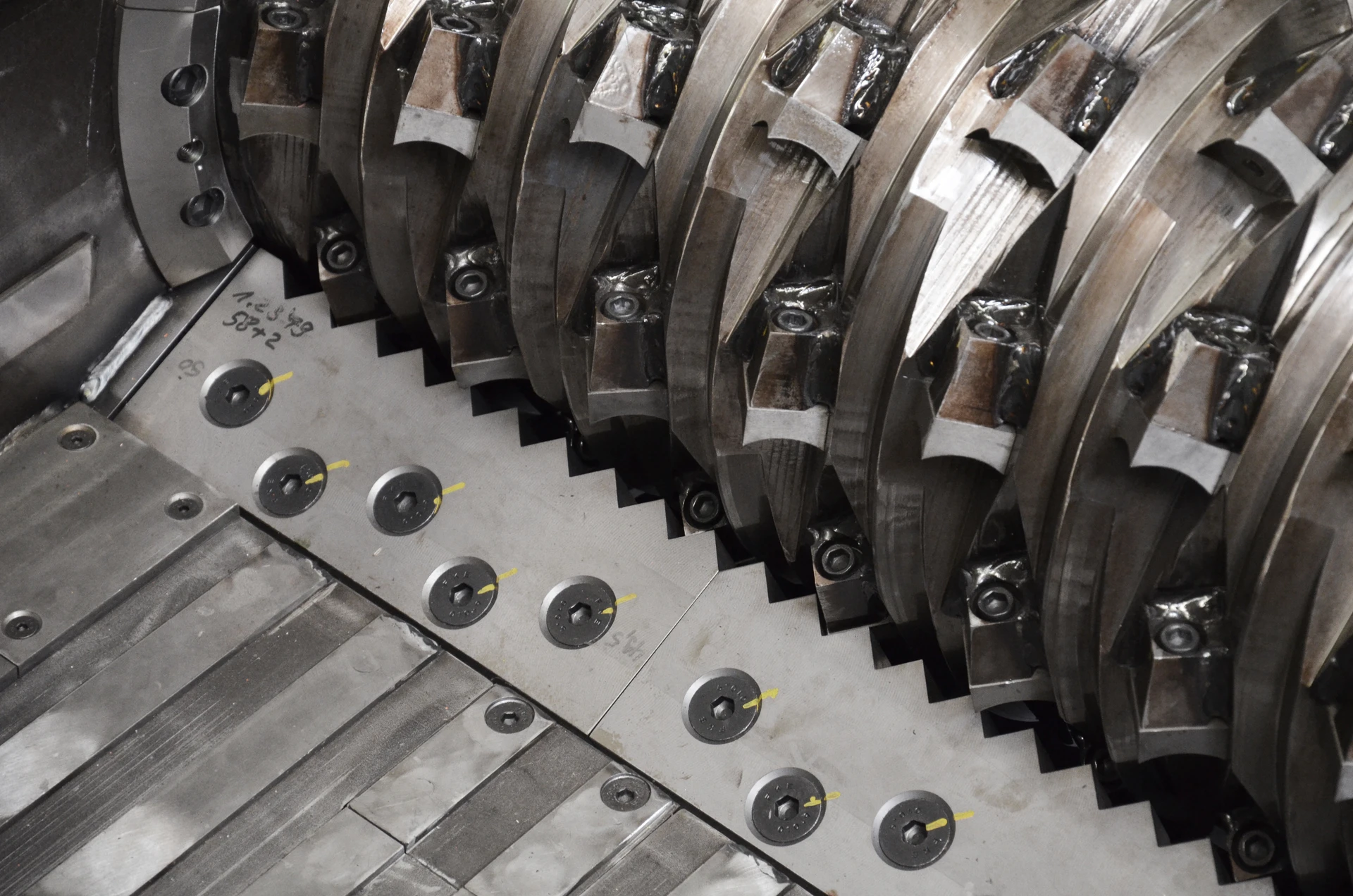
Shredders and grinders are valuable assets in an MSW operation in ensuring efficient waste processing for sorting material for use as raw material, to be sold on the market or for further uses such as energy production.
Grinders and shredders are dramatically different in the way they are constructed and the way they process organic material, notes Pat Crawford, vice president of products for Diamond Z.
“High-speed grinders are typically much more productive than slow-speed shredders and rotate at very high rpms, creating a very fast tip or cutter speed which impacts the organic material, breaking it down and forcing it through a pre-selected screen size,” says Crawford.
The screen size can typically vary from 8 inches down to a 1-inch hole size, resulting in a very small, consistent-sized finished product, allowing the high-speed grinder to process high volumes of organic material while producing a very consistent finished product, Crawford adds.
“This makes the high-speed grinder much more desirable in most land clearing and yard waste recycling operations,” says Crawford.
High-speed grinders are often used for the finer reduction of smaller and lighter materials or those processed by a pre-shredder, says Sean Richter, sales manager for Shred-Tech.
Matt Eul, Vermeer senior product marketing specialist for recycling, forestry, and pipeline and specialty excavation, notes that grinders are one of the most important machines for any wood waste facility.
The type and size of grinder a company needs depend on how much material is being processed, the type being processed, the facility size, and plans for the material after processing.
The Vermeer TG7000 tub grinder is an option for facilities processing significant amounts of loose green waste.
The grinders are designed to be gravity fed to enable the drive system to be more efficient and offer the operator access to the entire mill table when performing maintenance.
“To properly set up a tub grinder operation, a thrown object perimeter needs to be established all the way around the machine,” says Eul.
Horizontal grinders are best suited for limited space as they don’t require as much open space around the machine, says Eul, adding that the open-end feed design of most horizontal grinders is efficient when handling larger wood material.
For composting operations, the grinder can be augmented with a compost turner and trommel screen.
Vermeer has designed the Damage Defense system for tub and horizontal grinders to reduce the likelihood of major machine damage caused by certain metal contaminants entering the hammermill.
“If the mill comes in contact with these metals while grinding, the Damage Defense system will alert the grinder control and automatically initiate the shutdown process—idling the engine, reversing the infeed or tub, and disengaging the clutch,” says Eul. “Once the contaminant is cleared, normal operation can resume.”
Slow-speed shredders are typically much more tolerant to contamination, says Crawford.
There are typically three varieties of shredders: single shaft, two shaft, and four shaft designs, notes Richter.
“Shredders are primarily used for pre-sizing materials prior to secondary reduction or separation techniques,” says Richter, adding that they operate as high torque reducers at slow speeds of under 150 rpm.
WEIMA America spokesperson Audrey Brewer notes that shredders are used to size reduce all kinds of materials, including plastic, paper, wood, and certain light alloy metals, as well as various types of industrial and municipal solid waste.
“Within the Waste-to-Energy sector, WEIMA shredders are mostly used in the first step of a recycling line to pre-shred dirty and/or contaminated materials,” she adds. “The pre-shredded material can then be sorted through a series of conveyors, screens, magnets, etc. The sorted material can be sent to a secondary shredder for further processing in order to make a smaller particle size. We often see shredders used in this way in plants that aim to create refuse-derived fuels for an alternative energy source.”
WEIMA’s line of shredders is designed with 20- to 400-millimeter output/particle size capabilities depending on the shredder selected and can process a variety of materials, including household waste, metals, and a host of manufacturing waste products. They feature a PLC-control panel with touch screen, enabling custom control capabilities.
Electric and hydraulic drives are available, as are various screen sizes to further tailor the throughput to meet requirements.
The lift-up screen means knives and counter-knives can be rotated or replaced quickly as necessary, notes Brewer.
Both shredders and grinders can be used for materials ranging from plastics to tires, wood, e-wastes, light metals, fabrics, and more, notes Richter, adding that virtually every material recycled will pass through one or more reduction units.
Richter points out that the machine’s capabilities are defined by several factors, including the type of material to be processed, volume material to be processed per house, shred size required, method of feeding, the shredder’s cutting chamber size, and the machine’s horsepower, torque, and shaft speed.
Currently, there is an industry demand for equipment that does bag breaking to improve the removal of plastic materials, says Mark Lyman, West Salem Machinery’s president, adding that it’s an area of development on which his company is focusing.
“Bag openers act as a pre-shredder,” he says. “That’s a direction we see the industry heading. The trick is to make a high-quality compost and avoid getting a lot of contaminants in the compost,” he says.
Metso Waste has tapped into that demand to deal with plastic compounds and plastic bags creating challenges in the recycling process by opening bags at the beginning of the recycling process to mitigate the potential for plastic bags and plastic films jamming up the recycling process.
Reducing them to a homogenous grain size makes screening and separating plastic no different than processing any other type of waste.
The plastic is thus used as a raw material in manufacturing new products or as energy production in waste fuels such as residue derived fuel (RDF) and solid recovered fuel (SRF).
Metso develops and supplies equipment and services for metal and waste recycling. The company offers a line of shredders designed for both applications.
“To process municipal waste profitably, the waste treatment equipment must be able to handle many materials of different shapes and sizes,” points out company spokesperson Anne Rantanen.
“Rocks, stones, plastic bags, and other resistant components should not jam the production, and despite the variety in the material, the end product must be homogenous and optimally sized for further processing.”
Metso Waste’s pre-shredders and fine shredders are designed to turn municipal solid waste into the right grain size to be screened and sorted faster and more accurately and to be later utilized in other applications such as energy production.
West Salem Machinery manufactures various grinding and shredding machines used for size reduction. Typical feedstocks and materials processed include green waste, food waste, construction and demolition, wood, and compost-type applications.
The company’s machines are stationary and electric for fixed site installations and are often used in high-volume large landfills, compost facilities, and C&D facilities with infrastructure and a power supply to run electric machines.
West Salem Machinery manufactures horizontally-fed grinders typically used for green waste materials and land clearing debris, converting it to a size that can be either composted or turned into a mulch-type product.
The heavy-duty machines feature up to 1,200 hp electric drives with 50 to 100 tons an hour of capacity and designed for a service life of 20 or more years, notes Lyman.
The company’s line of vertical-fed machines is typically used in a sorting line or process flow, and the machines are often incorporated to regrind material, taking something that has been pre-shredded to a certain size and regrinding it down to a smaller size to turn it into a marketable product, says Lyman.
Construction and demolition debris is a typical application. “Many end-users will sort the clean wood waste out of their mixed feedstock, grind it up, and sometimes sell it as a mulch product or a boiler fuel,” he says.
West Salem Machinery augments its grinders and shredders with screening equipment; the machines are designed to work together—including with conveying equipment—to deliver a finished product in an efficient manner, says Lyman.
In Tulsa, OK, John Bowles, the city’s mulch facility and land reclamation site supervisor, runs two CW Mill Equipment’s HogZilla tub grinders—the electric-powered model TC-1664SE and the diesel-powered model TCII-1564P—to meet different needs for the city.
Bowles favors the diesel for its portability.
“We are able to move about the facility and to other areas within the city if needed in a situation of a big storm,” he says. “The other unit is an electric grinder which cuts down on maintenance costs dramatically and it’s also cheaper to run versus running diesel. It’s fixed in place, but it will have a much longer lifespan.”
The city is able to easily process 3,000 cubic yards per day if needed of ground mulch of different sizes, says Bowles. The mulch is used at area parks, gardens, and museums.
Bowles says another factor in making a choice for the grinding equipment is manufacturer support and parts availability after the investment.
“The best part about the new electric tub grinder that we’re using from them is the maintenance part of it,” says Bowles, adding that he need not be concerned about oil and filter changes.
Angie Lourance, the spokesperson for CW Mill Equipment Co., notes that end-users of the company’s equipment do so for land clearing operations and to grind wood debris onsite. They are used in mulch yards and at compost facilities.
Some grind wood waste material specifically for boiler fuel.
“Others are ‘storm chasers’ who work with government agencies such as FEMA after hurricanes and tornados,” she says. “HogZilla grinders also have the capability to process tires. In the case of municipalities, larger cities have wood waste facilities and utilize the ground material in different ways, with some selling it or giving the mulch back to residents.”
Production rates for grinders such as the TCII-1564P include 150 to 200 tons per hour for yard waste, 85 to 120 tons per hour for stumps and logs, and 75 to 120 tons per hour for pallets and construction waste.
Hurricanes can pack a punch to vegetation, creating a tangled mess of wood waste necessitating long hours invested in cleanup that can put a strain on solid waste management.
Hurricane Irma’s impact on Florida in early September 2017 not only brought winds but also flooding that rendered tree roots unstable.
Such was the case in Fort Myers, where the MW Horticulture Recycling Facility took in loads from independent contractors and municipal crews who removed more than 60,000 cubic yards of debris from throughout the city.
The family-owned organic compost producer had to bring in several additional machines to its already sizable fleet, notes owner Denise Houghtaling, who says company employees jokingly called the significant pile of vegetation “Mount Irma.”
MW Horticulture Recycling Facility’s primary grinder was a Vermeer TG7000 tub grinder. The company used Vermeer TR521 and TR626 trommel screens to separate compost, dirt, and mulch mixtures. Since the hurricane, the company has added a Vermeer HG8000 horizontal grinder.
“We are extremely diligent about our composting process; it takes a full eight months for us to ensure the end product is up to our standards,” says Houghtaling. “With two locations in Fort Myers, there was just no way we could process all the raw material fast enough.
“The Vermeer HG8000 horizontal grinder has been a lifesaver for us,” says Houghtaling, adding that the amount of material it pushes through is “unbelievable.”
The team recycles 100% of the material it takes in. “We don’t add any biosolids, manure, pretreated wood, or any other foreign objects to our compost, topsoil, or mulch,” says Houghtaling. “All of our products are produced from yard debris only.”
After grinding is complete, MW Horticulture Recycling Facility processes compost for eight months with watering, aerating, and heating to produce certified organic compost that is Organic Material Review Institute listed.
“The University of Florida Soiling Testing Laboratory has said our nutrient values are well above average,” says Houghtaling.
Following the eight-month process, the team at MW Horticulture Recycling Facility screens the material through its Vermeer trommel screen and blends it with other material to produce three different types of compost, including its certified organic blend that is approved by the US Composting Council—a vegetable blend mixed with peat moss, vermiculite, perlite and planting potting soil made from compost, and native mulch. The company also distributes acidic soil, citrus soil, nursery soil, topsoil, and a variety of mulches.
End-users range from homeowners wanting a bag for gardening to wholesale manufacturing plants that purchase in bulk and then bag it.
Pointing out changing commodity prices and government legislation, EDGE Design offers suggestions on factors to consider when purchasing a waste shredder.
Five factors to consider before making a decision include the reason behind the purchase, technical specifications, operational considerations, budget, and due diligence—see the shredder in action, request a trial using your own material, speak to existing customers, and investigate the service/backup infrastructure.
Factors influencing the decision include statutory legislation, economic factors, technological advances, the efficiency of waste solutions, and corporate social responsibility.
Other considerations: the material being shredded, its level of contamination, the end product’s particle size, and what will happen to the resulting fractions.
Technical specifications will include the cutting system and screen, required pre-shredding, machine dimensions and site space, and capacity and throughput.
Operational considerations include CE certification, low noise levels to protect operator hearing, foreign object protection, control panel logistics, and fire suppression and explosion protection.
Budget considerations will focus on capital expenditure—the initial outlay and how that will impact the business. Operational costs include power consumption/ton, spares and repairs, uptime statistics, and ease of maintenance.
Latest from Waste Today
- WeSort.AI recovers critical raw materials from recycling plants
- Collective Waste Solutions acquires Alcop Resource Recycling transfer station
- A blueprint for curbside composting
- Aemetis narrows net loss in 2025
- Fleetio launches AI capability to accelerate fleet maintenance approvals
- Recycle Ann Arbor extends drop-off station operating hours
- Sybilion seeks to help manufacturers confidently address volatility
- Ecowaste Solutions partners with city of Trinity, Texas