The frequency and intensity of extreme weather events have increased, according to the United States Environmental Protection Agency, creating a greater need for efficient disaster cleanup solutions. With more frequent and severe storms, speed and efficiency in cleanup operations have become critical.
Natural disasters leave communities with overwhelming amounts of debris requiring efficient processing. The large volumes of mixed materials—including wood, building materials and household debris—complicate cleanup efforts. Efficient processing accelerates recovery and supports recycling initiatives.
The Federal Emergency Management Agency says delayed disaster recovery can prolong economic hardship and lead to infrastructure failures and health risks for affected communities. Fast recovery after a natural disaster is crucial because prolonged disrepair makes rebuilding more challenging.
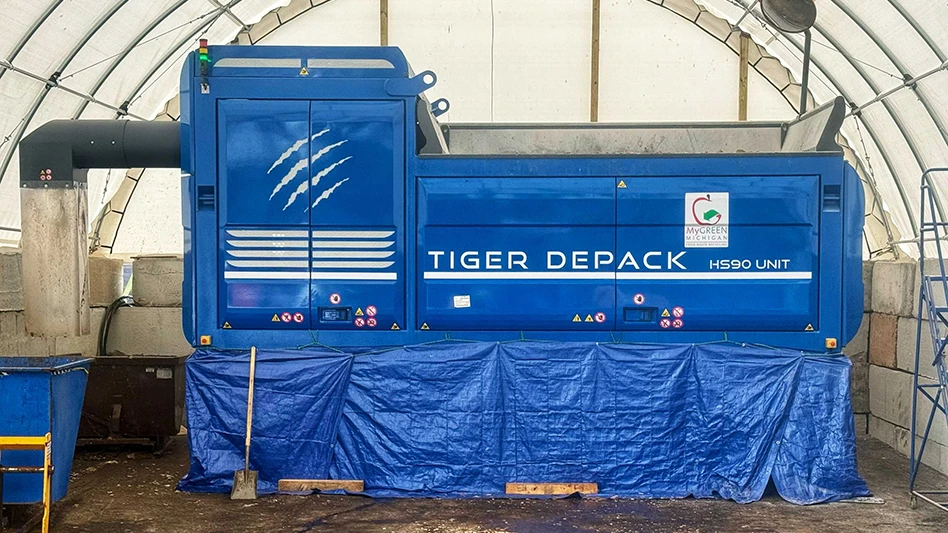
Low-speed shredders are becoming a key component in storm cleanup. While not commonly used for disaster recovery in the past, these shredders are gaining popularity as efficiency becomes a top priority in response to more frequent and severe storms.
Low speeds, high versatility
Low-speed shredders are versatile machines, excelling in processing material with contaminants given their low rotor speed and high torque configuration. They can handle a wide range of material streams, including construction and demolition (C&D) debris, contaminated green waste, municipal solid waste, storm debris and materials from land-clearing operations where crews might encounter more than organic material.
Storm-damaged areas contain a complex mix of materials. Typical tornado debris includes wood structural components and framing, roofing materials and siding, furniture and household items, plumbing and electrical components, flooring, carpet and wallboard. High-speed grinders struggle with materials containing metal contaminants, whereas low-speed shredders manage mixed materials more effectively because of their tolerance for ferrous contaminants.
Each piece of equipment has a specific role in cleanup operations. Low-speed shredders are best for processing commingled construction and demolition debris. Horizontal grinders and tub grinders provide a more efficient solution for clean green waste. When debris consists mostly of tree waste without contaminants, high-speed grinders are the preferred option.
Logistical savings
Low-speed shredders deliver significant logistical advantages for disaster cleanup operations. By compacting raw debris that contains substantial air space, they enable more efficient transportation, increasing the volume of material per load while helping to reduce costs and accelerate cleanup timelines.
This compaction process benefits transportation and landfill operations. Preshredded debris requires using fewer trucks to transport material and makes disposal more efficient by eliminating large air gaps, which helps extend landfill life while enabling contractors to complete jobs more quickly.
The efficiency gained is critical for community recovery. In a recent tornado cleanup operation, crews processed most debris within just two weeks, demonstrating how these shredders help communities return to normalcy faster following increasingly frequent severe weather events.

Greenfield tornado recovery
When an EF4 tornado hit Greenfield, Iowa, in May 2024, it left behind thousands of tons of debris across multiple counties. The cleanup effort that followed demonstrated how specialized equipment could transform disaster recovery operations.
The tornado reached estimated wind speeds of 185 mph, carving a 42.4-mile path through Page, Taylor, Adams and Adair counties in Iowa. The storm led to more than $31 million in property damage. Hundreds of structures were destroyed or damaged, resulting in five fatalities and 35 reported injuries.
“The devastation we witnessed in Greenfield was extensive,” says Jeremy Boka, the Altoona, Iowa-based vice president of business development at environmental remediation contractor EIS Holdings, Westlake, Texas. “These types of disasters create complex cleanup scenarios where efficiency becomes crucial to helping communities recover.”
Within 48 hours of mobilizing to Greenfield, EIS Holdings deployed a LS3600TX low-speed shredder from Vermeer Corp., Pella, Iowa, to process the mixed C&D debris scattered throughout the community.
“Time is of the essence in restoring the town to normalcy so that public safety can function effectively,” Boka says, highlighting EIS Holdings’ cleanup strategy. “We began hauling bulk material almost immediately because the timing was critical to prevent the piles from accumulating too quickly, but we were able to have the shredders on-site within 48 hours of our mobilization and the start of that process.”
Coordinated cleanup approach
“The cleanup process starts with a lot of phone calls and coordination right after the disaster happens so that you can communicate with all the necessary folks,” Boka explains. “From city streets to the county, public works, emergency management, state and local level— [disaster recovery is] all about coordination and careful planning.”
In Greenfield, the operation followed five key phases:
- collection in the downtown area using skid loaders, rubber track excavators and loaders;
- loading debris into dump trucks specifically chosen for navigating tight downtown spaces;
- transportation to processing sites at a transfer facility and a quarry;
- material processing through the low-speed shredder; and
- final transportation to three different landfills for disposal.
“The work that we do is important in disaster recovery because it gives people a sense of home and cleanliness,” Boka says. “When we can clean up the town and get [the debris] out of there, out of sight and out of mind is better. So, we try to process it off-site with the low-speed shredder to do the dirty work where it’s not visible and try to get people back to a normal routine.”
Operational results
The low-speed shredder became the operational cornerstone of the Greenfield cleanup, delivering substantial improvements in processing capacity and transportation efficiency. The impact was measurable, with EIS Holdings documenting a remarkable 40-50 percent increase in load capacity after processing material through the shredder.
The shredding process delivered multiple operational benefits:
- Increased load capacities. “We were getting in the neighborhood of 7-9 tons a truck when it was bulk debris prior to [shredding], and now we’re getting 13-15 tons,” Boka says.
- More efficient transportation. “The shredder reduced our trucking needs by a third. We could move with two trucks what used to require three trucks—that was substantial savings in fuel, time and resources,” he says.
- Reduced loading time. According to Boka, processing with the low-speed shredder reduced truck loading time from 20 minutes to seven minutes per load, dramatically improving daily throughput capacity.
- Better landfill utilization. “By shredding with the low-speed shredder, we achieve 40-50 percent better capacity and significantly reduce landfill airspace usage,” Boka says.
- Landfill processing efficiency. Boka says preshredding saved significant time at the landfill as debris could be processed and compacted more efficiently when it arrived already reduced in size.
“With landfills an hour-and-a-half away in each direction, we had significant truck time,” he says. “By shredding the debris, we increased load volume by 40-50 percent. When running a time and materials project, that stretched our budget further so we could get more done without having to extend orders or request additional funding.”
The bottom line
The Greenfield storm cleanup operation demonstrated clear operational advantages. The 40-50 percent increase in load capacity meant fewer truck trips, reduced fuel consumption and lower labor costs per ton processed. Cutting loading times from 20 minutes to seven minutes per truck allowed EIS Holdings to process significantly more material per day with the same crew size.
When landfills are hours away, eliminating every third truck trip represents substantial savings in fuel, driver wages and equipment wear.
As extreme weather events become more frequent and severe, municipalities and emergency management agencies increasingly seek contractors with proven capabilities to handle complex, mixed-debris scenarios efficiently.
Low-speed shredders enable contractors to optimize landfill space and create recycling opportunities that weren’t previously viable with approaches that use more conventional shredding and grinding equipment.
For environmental remediation contractors that are evaluating their equipment options, low-speed shredders can offer demonstrated results in real-world disaster scenarios, making them increasingly valuable tools for modern disaster recovery operations.

Explore the March 2026 Issue
Check out more from this issue and find your next story to read.