In the late 1960s, a young Olof Hallstrom, who was raised on a dairy farm in Oregon, was faced with the prospect of endlessly shoveling manure off a truck. This reality of life on a dairy farm motivated him to seek a career as an engineer. As things would have it, circumstances brought him back to the family dairy farm but his education and a drive for innovation provided him an opportunity to toss out the shovel and put his engineering savvy to work. That motive became Hallco Live Floors.
“Hallstrom invented a machine that used the friction, that had caused him so much sweat shoveling, to move the load off his wagon while he watched with a cold drink in his hand. His machine made the floorboards of his wagon come alive under the load,” says Richard Moffitt, Vice President of Sales and Marketing of Hallco Industries, Inc.
Whether unloading agriculture or waste, Hallco has a floor to allow for unloading on uneven surfaces. He cites the floor slats as the key to maintaining static friction with the material being unloaded, adding, “We utilize a specific grade of aluminum and we can’t use other materials because those products don’t have the same friction coefficient, which is important to the efficiency of discharging your products,” Moffitt says.
“Back in the day, our first live floors operated with a hydraulic rotating crank mechanism, and that evolved to hydraulic cylinders. Today, modern PTO pumps push the fluid to the drive system, which is a 6-cylinder dual-acting set of cylinders moving the pile 10 inches at a time through the advance and retract motion of the three series of slats at a time.
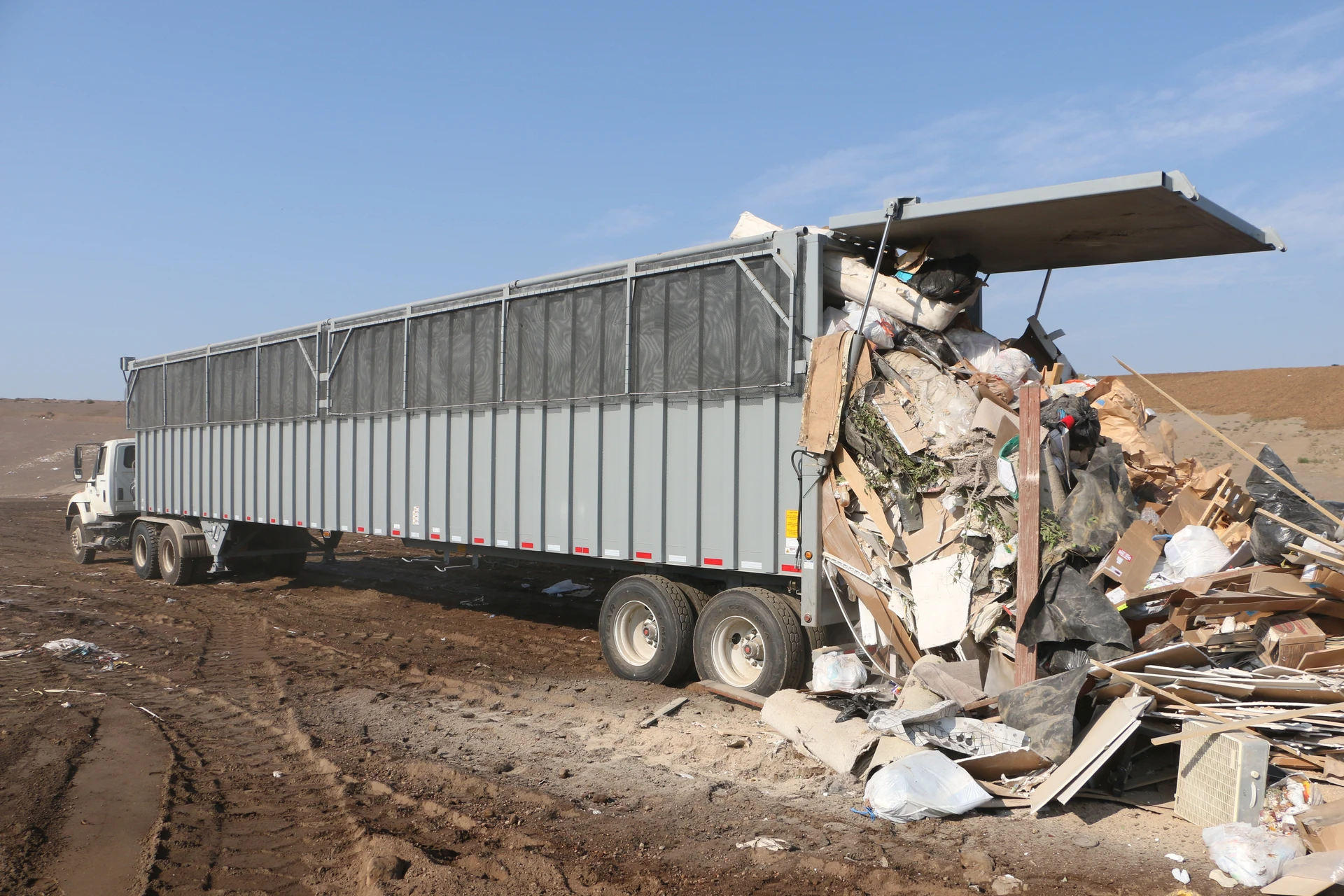
The live floor allows for unloading over rough terrain and uneven ground, allowing for a safer unload of products.
The Hallco floor slats come in a variety of widths that are mounted on either steel or aluminum subdeck. Moffitt says their low friction High-Density Polyethylene (HDPE) bearings are key to the efficiency of the forward and retraction motion of the systems. Metal on metal causes friction and wear. Using HDPE bearings reduces friction and helps to provide longer life to the systems. Each trailer manufacturer has custom variations to fit into their systems because no one size fits all.
He adds that a unique system to Hallco is the Brute Leak-Proof system which is ideal for wetter applications in MSW and organics.
“Using the trailer floor pan to create a solid floor, the Hallco raised subdeck allows for simplified washdown of fines, dirt, and grit. As the industry moves toward a more regulated collection of biomass and organics, this meets those needs perfectly as a truly leakproof unit."
Increasing Loads but Still Looking Good
As refuse trailers play a vital role as an essential part of our nation’s waste management system, conventional wisdom finds that the moving floor plays an important role. Product manager Charlie Benton of Randolph, Ohio-based East Manufacturing Corporation says the moving floor "is ideal for areas where self-unloading is preferred and areas not dependent on a separate means of unloading."
Moving floor trailers are the best choice, he says, to carry bulk commodities as they are "equipped to maximize the volume of materials being hauled and the ease of unloading over uneven terrain.
"Moving floor trailers built to be forklift compatible can also be used for hauling palletized loads, Gaylord boxes, and super sacks."
The strength of the East subframe which uses an 11-inch extruded aluminum I-beam for durability, and its advanced wall-to-floor construction, set a strong foundation for the moving floor, Benton says.
"These have an integrated push bumper and two tow hooks, designed for greater durability.
"But, the most critical point in securing East trailer strength is in our advanced wall-to-floor construction," which Benton explains is the "welded union of cross members, floor plates, and sidewalls.
"The cross members and floor plates interlock into the bottom rub rail, forming a pocket to accept the sidewall panels, which provides a super-strong floor-to-wall attachment.
He says that the company revolutionized the refuse trailer with their Genesis smooth-sided aluminum sidewalls with an aerodynamic design that is easier to clean, and "will not show any dents on the outside, and this is important to not only improve resale value but in keeping the trailer looking good."
This wall design allows additional aluminum to be applied where needed for longer wear, and/or extra height for increased capacity. "This allows users to exactly match their trailer to their loads and wear patterns," Benton says.
He highlights the specific Genesis trailer attributes to include a double-wall design, superior strength that has resistance to bowing, and 3-inch spacing of interior panels "which means the inside walls stay flatter and create few high points to reduce wear.
"This 3-inch spacing of interior panel ribs gives 8 times more wall support than external posts positioned every 25 inches. And the aerodynamic design consists of our unique 2-inch-thick, double-wall extruded aluminum panels which are robotically welded vertically inside and give you superior strength," Benton explains.
"Overall, the outboard Genesis design provides more cubic yard capacity than traditional external post trailers."
Built for the Long Haul
That is the tag line for J&J trailers, says company sales manager, Director of Sales, Jason Cornell who adds, “We can build just about anything you want and you know it will last for the long haul."
“We build a heavier duty trailer using materials and our engineered design that can, as we say, go the long haul. But MSW is not just a function performed on the highway. Our trailers are used in transfer stations, C&D sites, and more, but wherever they are, they will hold up to the job and they have a reputation for not breaking down."
Cornell says their niche is the push-out trailer but they also build dump, heavy-duty scrap, live load, tipper, and “any other kind of custom trailer that is needed.”
He says that J&J is continuously looking for the means to integrate lighter weight components with the latest technologies “and these weight savings let the customer haul more weight, which in the end is what hauling is all about. So while we manufacture a product regarded as heavy-duty because of the robust design, our goal is to be lighter in doing that.”
Tim Simpson, Trailer Engineer explains that on the push-out trailers the hydraulic cylinder is the only moving part and the hydraulic valve levers are operated from in the cab or operated through remote control. The tractor powers the push-out ram with its engine, "or you can have a stand-alone auxiliary system that is either diesel or electric."
The system is designed to minimize risk to operators and since there are few components, once it is deployed “it can clear a trailer of its load in less than a few minutes, which is almost the same as a live floor.”
One of their latest innovations Simpson describes is the new roof design.
"We've designed a new hydraulic operated roof which functions on a slow drive and is hinged at the top in two panels like French doors. We fabricated these panels from a design incorporating aluminum tubing and lightweight Versatex panels. Then, these fold down over the side of the trailer.”
Simpson says they designed this system to replace the roll tarp as customers were asking about a more robust roofing system.
“Originally we designed this for a county solid waste agency who asked us to create a lighter unit, so this was our solution and is a terrific replacement for framed roll tarps and is much more durable than a vinyl and mesh system.”
He adds that another version of their transfer trailer line is EVO aluminum extrusion panels.
“You just snap these together and the configuration of aluminum extrusion is less weight than a conventional design. It’s also better aerodynamically as it is a double wall system similar to cardboard. The EVO panels are tough and engineered to handle heavy payloads."
Making a Clean Sweep of Hauling
At KEITH Manufacturing, sales director Mike Robinson says in his nearly 25 years with the company, he has witnessed a dramatic evolution.
“Although we started out building agricultural equipment back in the 70s, by the end of that decade, we had shifted to manufacturing for the waste industry,” he says.
“Our KEITH WALKING FLOOR system is designed to unload a trailer in about four minutes in just about any condition and location. We tailor our design to align with that of the moving floor trailer manufacturers. Once the floor is installed in your trailer, it handles the unloading of just about every bulk commodity or product you can imagine, making it fast, safe, and efficient to use.”
For solid waste, Robinson says, “We go to the municipalities and show them what options are available. We explain how the system works to offload raw refuse or baled materials at their transfer station or landfill. We will often bring along a trailer manufacturer so they can see how the total package—WALKING FLOOR system and trailer—works. Even though we don't sell to the end-user, we feel these in-person meetings are valuable in helping them make good buying decisions with one of our dealers."
The floor slats that discharge the load come in a variety of profiles and are fabricated from aluminum or steel, depending on the application.
“Our V-9 series is used for MSW, recyclables, and light C&D work, while our V-9 steel slat is for heavy, abrasive jobs like scrap metal, aggregate, asphalt, and heavy C&D. We also have leakproof flooring that can hold 12 inches of standing water. Our original aluminum WALKING FLOOR slat profile is perfect for recyclables, shredded paper, MSW, and forest products.”
The floor slats are powered by a hydraulic drive that runs off the PTO system on the truck.
"The slats are attached to the frame on the trailer and fitted with bearings to allow for the movement of the slats. As the slats move in their sequence, the material is quickly discharged out the back of the trailer."
A recent innovation by the company, the CleenSweep tarp system, assists with the trailer cleanout, explains Robinson.
"What we've done is create a sweep system that cleans the trailer out as you are unloading. The tarp is attached to a winch that, before unloading, hangs at the front of the trailer and about three-feet onto the floor." The winch can be either hydraulically or electrically powered.
Material is loaded directly onto the tarp and then, “As the load discharges, the weight of the load drags the tarp toward the back of the trailer, resulting in a literal 'clean sweep' when the job is done. The driver never has to sweep out in person—no brooms or manual tarps—so this is both a great time-saver and safety feature,” Robinson says.
Efficiency Calls for Evolution
At Boise, Idaho-based Western Trailers, Director of Sales Dan Taylor says their trailblazing began with sliced bread.
"Our company started as a truck body manufacturer in the late 1950s and one of our first customers was Eddy's bread; they were looking for a more efficient way to deliver bread. So, we came up with a way to expand the cab of a P- series Ford truck by 6 inches and keeping the truck the legal width of 8 feet at the time. This innovation gave the space to haul an extra rack of bread,” Taylor explains.
Western Trailers then moved into the trailer business in the late 1960s building some of, if not the first, all-aluminum cattle trailers in the west. “In the early ’80s we built our first live floor transfer trailers and today we have 5 different lines of trailers that we manufacture with the ability to customize any trailers to meet a customer’s needs.”
Taylor says customers generally come to them with pretty specific specifications in mind and with that “we can build a live floor transfer trailer to meet their needs.
"For example, we use stainless steel fasteners in all of the high wear areas of the trailer; our side panels are made of corrosion and dent-resistant aluminum sheet. Our trailer design is very easy to repair with no welding needed and you can purchase side panels and posts pre-punched and preassembled, saving you downtime.
“This method of repair brings all of%
Latest from Waste Today
- My Green Michigan expands depackaging capacity
- Washington selects Circular Action Alliance as PRO
- Ten-8 Industrial opens new central Florida service center
- Triumvirate Environmental acquires Environmental Waste Minimization
- Official NYC Bin availability expands ahead of deadline
- US Food Waste Pact’s 2025 Impact Report shows decrease in food waste
- Coastal Waste & Recycling expands recycling operations with Machinex
- Reconomy acquires German-based GfAW