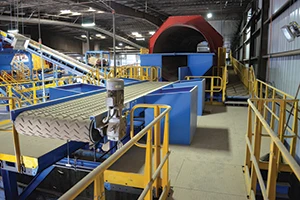
The solid waste department of Mecklenburg County in North Carolina converted to single stream, as did the surrounding towns with which the county has interlocal agreements. “Those towns feed us their recyclables and then we also negotiate solid waste fees at the local landfill,” says Geoff Burdick, project manager for the solid waste department. “At that time, we changed the type of recyclables we were going to take in the facility during the dual stream time.
“We only did 1s and 2s, and metal and aluminum, but with this new CP Manufacturing intricate state-of-the-art system, we were able to up the ante and begin taking plastics 1 to 7, except number 6, which is Styrofoam. Then, we began to take empty aerosol bottles and orange juice aseptic containers, so we increased the amount of recyclables that we started to take in to the facility.”
After the switch, Mecklenburg County saw a 20% jump in recyclables coming in. At the time the region switched to single stream, the cities also converted to compacting trucks. Mecklenburg County contracted with CP Manufacturing to design and install a single-stream sorting system.
Efficiency was the driving factor for the change, which then creating a change in the wastestream. “It took trucks off of the road,” notes Burdick. “It was an air quality issue. Charlotte wasn’t known to have the best air quality city. I know we improved.”
The routes became more efficient. “If during a dual stream you look at the containers they were collecting versus the paper that they had to separate, the containers were more bulky and they filled up that compartment more than it did the paper side,” says Burdick. “So trucks were coming off of routes half full and were not very efficient. Also, the efficiency of the automated arm to collect instead of the driver having to stop the vehicle, step out of the vehicle, and then sort the material at the truck—you can imagine the time it took to sort that material.”
Other changes Burdick is noting is less paper at the recycling facility, with more people getting their news digitally.
The recycling facility has increased the opportunity for people to recycle rigid plastics as well as the 3–7 mixed plastics. “We still see that and sort it,” says Burdick. “The market on that side is soft; obviously with oil prices, it really has downgraded how fast we can move plastics.”
CP Group equipment and systems offer end users MRF operator insight, in-house manufacturing and engineering capabilities, system maintainability, user-friendly control systems, safety systems, low-maintenance rubber cam-style discs, and custom-designed system integration, notes Davis.
CP Group owns and operates a MRF in San Diego, CA. The facility serves as an R&D location where the company tests its innovations. “Being a MRF operator gives us key insight into the challenges faced by MRF operators,” points out Davis.
The equipment is designed to be accessible for maintenance or cleaning, with covers and guards designed to be easily removed for servicing and minimal down time, says Davis.
The CP Screen is designed to be used for both MSW processing and single stream. “Its small screen openings decrease loss of fiber to the container line,” says Davis, adding that additionally, CP’s rubber cam-style discs are specially engineered to have consistent spacing at all points at all times to make discs highly resistant to both jamming and wrapping while keeping maintenance costs low.
Advanced MRF, CP Group’s electrical controls division is certified in designing and building control systems using Siemens automation products and software, notes Davis. “Our user-friendly panels help the end user acquire information, maximize run time and eliminate unforeseen downtime,” she says. “Our system designs are tailored to match the material flow and specific customer needs.”
The CP Group offers turnkey custom MRF solutions for single-stream recycling, MSW Recycling, front-end fuel preparation, construction and demolition, commercial and industrial waste, and electronic waste.
Latest from Waste Today
- Worn Again Technologies unveils Accelerator plant to advance polycotton recycling
- Nashville Waste Services launches new digital route system
- ACUA landfill expansion project unanimously approved
- Clean Energy announces multiple RNG deals with fleets nationwide
- Interchange 360 to operate alternative collection program under Washington’s RRA
- Waste Pro files brief supporting pause of FMCSA CDL eligibility rule
- New Way Trucks expands US network with Joe Johnson Equipment
- Tire Industry Project publishes end-of-life tire management guide