Much of the automated recycling equipment utilized by MRFs is derived from mining applications.
The equipment has been modified from its original purpose in separating slag from ore, and in both waste and mining operations, size matters. That is to say, the smaller the better. Smaller-size pieces and objects are easier to handle, store, transport, and process.
There are two main types of MRFs: the multistream “clean” MRF, and single-stream “dirty” MRF. A clean MRF accepts multiple streams of presorted wastes from homes and businesses. These multiple steams consist of individual types of wastes (paper, metals, plastics, etc.) that arrive at the clean MRF already sorted. The relatively simple job of the clean MRF is to organize and collate the individual wastes types for resale on the scrap market. These tasks can be preformed almost exclusively by human labor, without the need for advanced processing machinery.
Single-Stream MRF Operations: The Basics
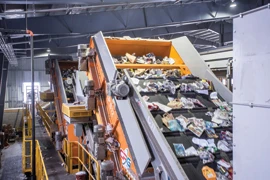
Dirty MRFs, on the other hand, accept a single, unprepared, and unprocessed stream of waste consisting of all types of wastes mixed together. Once this waste arrives at the MRF, it is separated as much as possible by machinery. The more technically advanced a MRF is, the less it relies on manual sorting and separation. The operating and performance requirements of these machines depend on the anticipated constituents of the incoming wastestream and their physical characteristics. Typically, municipal solid waste consists of the following materials (by weight):
- Paper, including office paper, newsprint, corrugated cardboard: 35%
- Yardwaste, such as grass clippings, leaves, garden waste: 12%
- Foodwaste, from homes and restaurants: 12%
- Plastics, such as HDPE, PCV, or PET: 11%
- Metals, ferrous and nonferrous: 8%
- Glass, all colors (clear, amber, brown, clear) including ceramics: 5%
- Wood, including building waste, clearing debris, and furniture: 6%
- Miscellaneous materials, such as rubber, leather, or textiles: 11%
- Total: 100%
Each material has a unique set of physical characteristics (moisture and organic content, electromagnetic characteristics, size, shape, weight, and color). Each has a different end use or recycling potential (compost, incineration to produce energy and steam, forging as scrap metal, conversion into building material such as aggregate, and even complete recycling back into its original form and function). Each type of waste is removed at a difference stage in the material recovery process by machines uniquely designed for the task. Each MRF has its own unique process, but the basic equipment tends to remain the same.
Usually, metals are removed first, with ferrous metals being removed by electromagnets and nonferrous metals by eddy-current separators. Electromagnetic separators are the simplest of MRF equipment. They can be used in different configurations: overhead to pull ferrous objects from the wastestream as it passes by on a belt below, or as part of the belt itself so that the ferrous waste sticks to the belt while the rest of the wastestream falls off into a waiting bin as the belts turns under at a roller. The main sources of ferrous waste are containers, cans, and appliances (automobile car parts and steel rebar extracted from reinforced concrete are not normally handled by MRFs).
Nonferrous metals are a little trickier to remove. Lacking inherent magnetism, direct removal by electromagnets is not possible. Instead, magnetic attraction has to be induced in them by means of rapidly spinning magnetic rotors. This induces an electrical current in the metal object which it turn generates its own, opposing and repelling magnetic field. So instead of attracting, this equipment repels, causing the nonferrous metals to jump off the conveyor belt and into an adjacent collection bin.
Most of the remaining waste is separated by size and weight. Cardboard and other large, lightweight objects are removed by disc screens. Large, heavy objects (construction debris, appliances, etc.) are managed by bulk handling systems. These stages typically occur after the metal has been removed. A disc screener consists of an enclosed floor whose bed is lined with multiple discs of various sizes and configurations (circular, oval, star-shaped, etc.) arranged in intermeshing rows. The wastestream enters the disc screen by means of an inflow bin that provides sure capacity and thereby regulates the inflow rate. As waste travels along the floor, the rotating disks create a wave action in the waste that carries large, light objects to the top for easy removal as the smaller, heavier objects pass through to the next removal stage. By these means, large but lightweight object (like corrugated cardboard boxes and sheets) are removed from the wastestream.
Bulk handling systems are in a separate category, and not always to be found at a MRF. “Bulk handler” is a generic term that applies primarily to machinery that processes, sorts, separates, and extracts different varieties of large debris, automobile fluff, appliances and large waste objects. These can include car compactors, asphalt pavement crushers, screeners for various types of aggregate and crushed concrete, steel rebar extraction machinery, and concrete shears for breaking up reinforced concrete.
While disc screeners and bulk handlers handle both light and heavy large objects respectively, smaller objects must also be removed from the wastestream. Smaller, heavier objects are extracted by rotating trommels. Such small, light objects as sheets of paper are separated from the remainder of the wastestream by means of air classifiers and air knives.
Rotating trommels are perforated drums that slowly rotate at a shallow angle to the horizontal. With a sloped interior angle, gravity forces the continuous feed of waste through the trommel. This allows the remaining wastestream to pass through the trommel and emerge at the lower, open end. The drum’s wall is perforated with holes appropriately sized, depending on the characteristics of the wastestream, to allow small objects (fines, grit, shards, and organics) to exit the wastestream. These smaller objects are not necessarily worth recycling, but their removal makes for a cleaner, purer final product. To ensure the retention of larger objects and their passage to the next stage of recycling, the interior of a trommel usually comes equipped with parallel spiraling vanes that retain large recyclables.
Smaller, lighter objects are managed by blasts of air generated by either air classifiers or air knives. Air classifiers look like chimneys. They utilize a large blower to suck air out of the top of the stack by inducing a high-velocity air stream. Waste enters at approximately the midpoint of the stack. From there, lightweight materials (office paper and newsprint, for example) can be easily extracted by the blower. Meanwhile, heavier objects fall to the bottom for collection and removal. The light materials are often further transported by ducts to cyclone separators. These cyclones further refine the sorting of this material by size and weight. Using the same principles as an air clarifier, air knives more precisely sort lightweight materials into distinct grades of paper that differ only slightly in mass and density. This is accomplished by means of multiple, parallel “sheets” of high-velocity airflows. The parallel configuration of the air blasts is important to prevent swirling and the remixing of the extracted materials.
Finally, the residue of the wastestream that has passed through the previous recycling stages has a relatively high content of glass and plastics.
A Cat wheeled excavator feeds a Pri-Max grinder.
The technology of light spectrophotometry (LSP) allows these materials to be separated by means of color sorting. LSP can distinguish between values colors of commercial glass (clear, amber, brown, or green) as well as cullet and ceramics. A near-infrared sensor determines what the color is and triggers a puff of air from a blower that pushes the material into the appropriate sorting bin. Most kinds of consumer plastics (PET, PETE, HDPE, LDPE, PE, PP, Nylon, Teflon, PS, ABS, or FRP) can also be sorted with optical sensors. To remove and sort plastics, these sensors can also differentiate between various densities of the different kind of plastics found in the wastestream.
So where does size reduction fit into this complicated, multistage this process? To better understand the usefulness of size reduction to the automated recycling process, we should return for a moment to our initial comparison with mining operations. In fact, it would not be a stretch to describe recycling as another kind of mining operation. The “ore” in this case being the wastestream itself, while recycling to remove valuable raw materials is a form of “mineral processing.”
Comparisons With Mining Operations
There are four general stages in mineral processing: reduction of particle sizes (comminution), screening and classification of particle sizes (sizing), extraction of minerals via physical and surface chemical properties (concentration), and the separating of liquid and solid portions (dewatering). It is this first stage, comminution, that directly relates to waste recycling. The other ore and slag separation stages are analogous to MRF operations that extract recyclables, but differ in method and effort.
The point of mineral processing is to separate gangue (the commercially worthless material, such as slag, that encompasses or is mixed with the more valuable mineral ores. For any type of ore, the ratio of ore to gangue is one half of the equation that determines the commercial viability of the material being extracted. The other half is the economic demand for the material. The same rules apply to waste recycling. The market price of the recyclable, less the costs of the methods used to extract them from the waste stream, determines the need and desirability of the recycling effort.
Crushing and grinding are the two primary comminution processes. They are physical in nature and rely on the application of impact, attrition, and compression forces. Crushers primarily use compression and impact, while grinders rely on attrition derived from high-pressure friction. Crushing equipment includes jaw crushers, gyratory crushers and cone crushers. Grinding equipment includes rod mills and ball mills. In mineral extraction, crushing is a dry process while grinding can be performed on wet slurries. Comminution is also necessary to the recycling process, though in waste processing, shredders are also used. Shredder operations rely on the application of shear forces to render materials into smaller and more uniform sizes.
The Purpose of Size Reduction
So why shred municipal solid waste? Size reduction of incoming MSW is an essential first step in the recycling process. In general, a number of terms can refer to the process of size reduction (such as grinding, shredding, and crushing). Shredding is performed on most types of mixed wastes while granulating is performed on some plastics and grinding is used to reduce glass. Mixed waste is reduced in size for the same reason ore is crushed and ground. The resultant size reduction aids in the production and extraction of recyclable materials, increasing efficiency and productivity.
The aim of the process is to produce smaller objects based upon a small maximum particle size. Initial size reduction, referred to as coarse or primary shredding, reduces bulky items to particles whose sizes are compatible with the separating equipment. It also creates material of uniform shapes and sizes having a narrow particle size distribution. Both results are essential to the efficient operation of most mechanical sorting systems. After primary shredding, a secondary or even tertiary shredding is often performed whenever a particle size of 10 cm or less is required. Customer demand and user specifications may require very small particle sizes to allow for post-recycling of ferrous metals, nonferrous metals, and glass. For example, large cages of extracted rebar would be difficult to extract with standard electromagnets. Chopping the rebar into smaller segments reduces its weight and size, making removal from the wastestream easier and allowing for an electric-arc furnace to produce new steel from the scrap.
But in addition to adding the recycling process, size reduction simplifies post-extraction transport, sorting, and the overall quality of the final products. By reducing volume (and thereby increasing density) of recycled materials, higher tonnages can be transported for fewer truck or train miles. This results in significant cost savings to the overall process. The resultant increase in density-and decrease in volume-varies for each type of recycled material.
For example, a load of whole glass bottles with less than 10% of the bottles broken has a typical density (with their empty interiors) of only 500 pounds per cubic yard of clear glass and 550 pounds per cubic yard for green or amber (colored glass being intrinsically more dense than clear glass). Glass crushed to average shard sizes of 1.5 inches has a bulk density of 1,800 pounds per cubic yard. Crushed even further to furnace-ready cullet no bigger than three-eighths of an inch in size, glass has a bulk density of 2,700 pounds per cubic yard. At the risk of oversimplifying, crushed glass has a density up to five times that of whole-bottle glass. This means one truckload can carry five times as much crushed glass as it could whole bottles. All other factors being equal, this results in an 80% reduction in hauling costs to the purchaser using the recycled glass.
Equal or better levels of densification can be achieved for other waste materials. Similarly higher densities and lower transportation costs can be achieved by compacting aluminum cans (45 pounds per cubic yard for individual cans) to a flattened mass of aluminum (200 pounds per cubic yard). Inherently low-density waste, such as plastic, can be compacted even further. Plastic 2-liter PET bottles have an effective density of 6.5 bottles per pound, but can be compacted an effective density of 220 bottles per cubic yard-a greater than 33-times increase in mass density-again, with commensurate reductions in transportation costs.
Types of Size Reduction Equipment
Typical size reduction equipment at MRFs includes large-scale shredders, hammer mill shredders, glass crushers, can compactors, granulators, and bulk balers. The choice of shredder will depend on several factors. These include the physical characteristics of the material being shredded, the energy requirements of the shredding operation (which again depend on the physical characteristics of the materials), and the required final size of the material (as determined by separator machine operations and/or customer specifications). For example, large-scale shredders can be used to deal with large items (appliances, furniture, cars, or car parts) that are usually the first items removed from the wastestream.
High-speed hammermill shredders, on the other hand, are usually used to reduce the size of typical mixed-waste objects. Low-speed flail mill shredders and shear shredders are also sometimes used, but only for coarse shredding. There are two basic types of hammermills, (depending on the orientation of the rotor), either vertical or horizontal-with the horizontal configuration most commonly used for waste processing. By rapidly rotating heavy “hammers” (at speeds between 1,000 to 1,500 rpm), the hammermill shredder reduces incoming material sizes by means of impact collisions with the waste objects. The hammers are either fixed to the rotor or free to swing on their own. The impact process continues until the waste is reduced to a particle size that can fall freely through the sizing grates at the bottom of the shredder. The amount of time waste spends in a hammermill shredder depends on the type and nature of the waste and the required final particle size.
Glass crushers pulverize glass bottles, plate glass, and glass jars into glass cullet suitable for resale. Given the abrasive nature of glass, and the increased wear and tear from operations, these units usually require high maintenance and frequent repair. They also produce significant quantities of dust, which also has to be properly managed. Moderately sized glass crushers (1 to 2 horsepower) can process between 3 to 6 tons per hour of crushed glass. Larger models (7.5 horsepower) can process up to 15 tons per hour. Typical ranges of particle sizes of pulverized glass produced by crushers ranges from one-eighth to three-eighths of an inch.
A can compactor, as the name suggests, is a device for flattening aluminum and tin cans. Also known as a densifier, its compaction is typically performed by a steel drum equipped with hardened cleats. The drum rotates along the flat surface of a strike plate or an adjacent, counter-rotating drum. Can compactor production can range up to 2 tons of flattened aluminum cans per hour for a 7.5-horsepower compactor.
Plastics granulators are used to reduce solid objects made from commercial plastics, such as PET or HDPE, into granulated, flake-like particles. They operate much like large-scale shredders but with an overlarge chamber due to the low density of the incoming plastic waste. The process aims to produce particle flakes smaller than one-eighth of an inch to three-eighths of an inch. Like glass crushing, plastic granulation requires high levels of maintenance and dust suppression. Each plastic type passes through a granulator and baler for compaction and preparation for shipping.
Balers are machines that take in bulk waste, or separated recyclable materials, and compact it to a high density and either bundle it with wire so it holds its shape, or rely on the post compaction adhesion of the waste to hold the bale’s shape. This shape is usually a rectangular block whose dimensions typically range from 3 feet to 8 feet. The bales resemble larger versions of standard hay bales or very large blocks. Afterwards, the waste bales can be stacked like blocks for shipping or for disposal. Baling achieves a much higher density with an additional one-third reduction in waste volume. For example, instead of 0.6 tons per cubic yard for mixed waste, a baler can achieve densities of 0.9 tons per cubic yard, a 50% increase. Similar increases in density and decreases in size can be achieved with such separated recyclables as aluminum cans and newsprint. Baler production rates range from 5 to 6 tons per hour for 50-horsepower machines to over 30 tons per hour for 30-horsepower balers.
Latest from Waste Today
- Vermeer announces plan to build new facility in Des Moines metro area
- Buffalo Biodiesel shares updates on Part 360 application to DEC, Tonawanda facility progress
- Capstar Disposal expands roll off dumpster rental services
- Supreme Court strikes down IEEPA tariffs
- Casella details facility closures, expansion efforts
- Zero harm: Building a SIF prevention program for waste and recycling operations
- Casella posts a loss in Q4 2025
- McNeilus names Haaker Equipment first Dealer Partner of the Year