A waste collection truck, like any other heavy-duty truck or vehicle, rides on three things: tires, brakes, and the suspension. Given the specialized nature of waste collection operations, as opposed to long-haul trucking, the types of tires, brakes, and suspensions used by waste collection trucks can have a significant effect on their overall efficiency and cost-effectiveness. The economy of movement while out in the field and its required maintenance cycle goes a long way to determining the profitability of individual trucks as well as the entire waste collection fleet. Given the importance of this equipment, operators need to train their drivers in waste collection operations so as to maximize efficiency and productivity. The fleet owner needs to carefully chose the kinds of tires used by his trucks and maintain the trucks’ suspension system and brakes to ensure maximum cost effectiveness and guard against wear and tear.
Organized by Task—Types of Waste Collection Trucks
The number and types of waste collection trucks depend on the different types of tasks performed. First, there are waste collection trucks and recycling collection trucks. The waste collection trucks are further divided into residential and commercial collection. Residential waste collection trucks are categorized by loading operations (automated, semi-automated, traditional manual rear-loading, and retrofitted rear-loading). Furthermore, the commercial collection is divided into standard (front-loading) commercial trucks and large (rolloff compactor) commercial trucks. Recycling trucks are also divided into residential and commercial categories, with the residential truck models being either all manual roll-up style doors or semi-automated loading. Commercial recycling trucks utilize automated loading almost exclusively given that they deal primarily with large industrial loads of recycled waste.
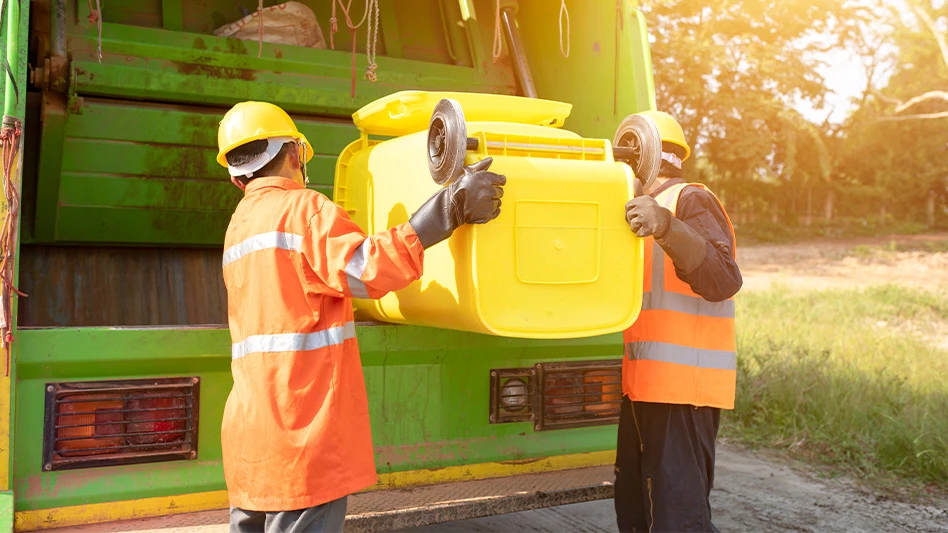
The traditional manual rear-loading residential waste collection truck performs the simplest type of waste collection operation. It operates at residential waste pickups and can utilize any kind or size of waste bin that can still be handled manually. A worker on the collection crew retrieves and carries the waste can to the rear of the truck and manually disposes of its contents in the rear hopper. On occasion, a manual worker can roll a small dumpster to the rear of the truck and attach it to a tipping bar which lifts the dumpster and tips its contents into the back of the hopper. A retrofitted rear loader utilizes a standard cart but can also be modified to handle non-standard waste containers. Loading on this type of truck is performed by a specific lifting mechanism (often referred to as “flippers”) once the worker rolls the waste container into place. With the small non-standardized waste can, manual loading can be performed in the same way as the traditional rear loader.
The standard commercial waste collection truck utilizes a front-end loader to lift and deposit waste containers into a top hopper opening. This type of truck performs waste pickup at large apartment complexes, commercial and business locations, and industrial or construction sites. These trucks come equipped with a fork loader attachment at the front of the vehicle. The driver aligns the fork tines with metal sleeves welded to the outside of the dumpster box, inserts the fork, and then lifts up the dumpster to flip it and dump its contents into the top hopper opening. Once emptied, the fork motion is reversed and the dumpster put back in its original place. To handle waste containers much bigger than a 2- to 4-cubic-yard dumpster, rolloff waste compactor commercial trucks are used. These large rolloff containers are picked up with a mechanical winch and pulled onto the flat frame of the truck. Once secured in place, the truck and the entire waste container with its contents is hauled away. Upon arrival, a hydraulic hoist device is used to take the container off of the truck and empty its contents.
Larger-scale commercial recycling seldom requires containers as large as a rolloff box or even a large dumpster. However, it typically utilizes standardized containers containing either mix or segregated recyclables. As with automated waste collection, commercial recycling trucks use a mechanical lifting device to pick up containers which are either grabbed directly by the truck loading arm or wheeled into place for lifting by manual workers.
Stop and Go—Waste Collection and Disposal Operations
Unlike other long-haul trucks or utility vehicles, waste collection trucks are subject to both high mileage and severe wear and tear. According to the Energy Information Administration (EIA), a typical waste collection truck racks up 20,000–30,000 miles annually at a fuel consumption rate of fewer than 3 miles per gallon of diesel, consuming up to 10,000 gallons each year. Three costs (labor, fuel, and maintenance) determine the overall costs of collecting waste and operating a waste collection truck fleet. The average annual waste collection cost per truck in a typical urban area works out to approximately $400,000 to $500,000, with each truck in the fleet servicing an average of 2,000 to 3,000 residential households.
Collection operations typically coincide with landfill operating hours. That is, the bulk of waste collection is performed on a five-day work week, with a half day on Saturday morning. Residential waste pickups are typically divided among the five weekly work days. At a minimum 2,000 residential stops per collection truck, a five-day work week requires an average of about 400 stops per day. For a 12-hour shift, assuming up to an hour drive out to the starting point of that day’s collection route—and a similar hour-long return trip from the end of the collection route—the truck and its crew spend 10 hours or more traversing its collection route with stops at every residential customer along the way. That could equal 40 stops per hour or almost a stop approximately every one and a half minutes. This represents the high end of collection truck productivity, but it illustrates the sheer number of stops and starts made by a waste collection truck during a normal workday.
Even nonprofit governmental waste management departments have to meet budget constraints, if not the bottom-line. At the large scale, waste collection truck movements are determined by the direction and alignments of their individual collection routes. But there are several factors that affect the overall costs of waste truck operations. Certain costs are irreducible, but significant cost savings can be achieved by operating the waste collection truck in the most efficient manner possible. That is to say, minimize (if not eliminate entirely) any unnecessary movements.
This brings the truck back to the movements and operations required for individual waste pickups. The goal is to minimize unnecessary actions and the resultant costs. And it is not just the costs of the time spent (or wasted) on the road and at the landfill that matter. The movements themselves have indirect cost impact caused by increased wear and tear on a collection truck and its mechanical systems. The estimates above give a figure of hundreds of stops each working day. That means hundreds of applications of the brakes to halt movement and allow for waste loading, no matter if the loading is performed manually or automated. This greatly exceeds the braking required for equivalent long-haul trucks which also cover considerable mileage. The distance traveled by waste collection trucks to and along the collection routes greatly exceeds the movement distances required for heavy construction equipment which also continuously engage their brakes and reverse gears.
In terms of wear and tear on the mechanical components, waste collection trucks combine the worst of both worlds.
Where the Rubber Meets the Road—Tires
The first mechanical system worn out by waste collection truck operations isn’t mechanical at all. It is the truck’s set of tires. So how are tires chosen for waste collection trucks?
It is not easy being a waste truck tire. Waste collection truck tires operate in some of the harshest working environments in industry and construction. But performance, safety, and reliability can be maintained, and even improved, by the use of customized suspensions, wheels, tires, and especially brakes. “Customized” in this context does not mean “specialized.” Waste collection truck working environments are as varied as they are harsh. These include long mile pavements on highways, stop and go on residential streets, gravel service secondary in rural areas and service roads within the landfill, and the waste-strewn environment of the working face with its steep, irregular slopes and large, sharp waste protrusions. These will vary further whether the operations involve commercial or residential customers, or waste disposal or recycling operations. Depending on operating conditions, waste truck tires can last six weeks or six months. Rarely do they last more than a year of full-time operations.
As such, tire manufacturers have created a category of waste haul tires distinct from standard commercial truck tires. Typically, waste collection and hauling trucks ride on tires with a size rating of 315/80R22.5. This tire rating has a durable construction and has a longer tread life. This is a standard load tire which limits the load that can be supported with a maximum inflation pressure of 35 psi. In general, waste haul tires for waste collection vehicles of all types (rolloffs, front loaders, and auto-side loaders) are made with built-in puncture resistance, chip and cut resistant rubber, deeper and wider treads, heavier beads, heavier heat resistant casings, and special tread compounds that resist the harsh environments of waste haul operations. The ability to retread a waste truck tire is a must because it is a great cost saver for the fleet operator. Even on smooth residential roads, waste truck tires are subject to heat stress from constant braking and damage from curb impacts.
Some waste trucks use extra load-rated tires which are limited to the load that can be carried at a maximum inflation pressure of 41 psi. Standard load tires do not normally include a special designation mark. However, extra load tires will be designated as “XL.” A special designation P is sometimes used to designate a P-Metric tire which meets certain US DOT requirements for passenger tires and do not apply to heavy-duty truck tires. Other designations can be applied as well, given the tires’ construction and intended use. “LT” is a designation for light duty trucks. “R” refers to radial tire construction. If a truck has a high (H) speed rating, it can safely travel at a maximum speed of 130 miles per hour. A “DOT” symbol indicates that the tire meets all applicable Federal Motor Vehicle Safety Standards. “TIN” consists of up to 12 numbers and letters to identify the factory location as well as the week and year that the tire was manufactured.
The standard tire designations include basic operational information. The first two or three numbers on the tire rating before the slash refer to the tire’s width in millimeters as measured from sidewall to sidewall. The standard waste truck tire is 315 millimeters wide (almost 12 1/2 inches). The next two numbers after the slash are the tire’s aspect ratio—the ratio of the tire’s width to the height of the tire as measured from the outer edge of the rim to the treads. So, a standard waste truck tire with an aspect ratio of 80 has a height equal to 80% of the tire width, or 252 mm (nearly 10 inches). In general, a higher aspect ratio means larger sidewalls. After the aspect ratio number, the next designation tells the size of the wheel that the tire can be fitted to. In the case of standard waste truck tires, R22.5 refers to a wheel with a 22.5-inch diameter. The load range, designated with an “L,” indicates the maximum load that a tire can support when properly inflated. Typically, a waste haul truck tire has a load range L marking (9,090 pounds). However, it will actually have a load rating of 10,000 pounds in order to carry the typical 20,000-pound front axle of waste haulers.
Operationally, tire life can be extended by a thorough understanding of the waste haul routes. This allows the manager to anticipate wear conditions. This can usually be done quickly and easily by comparing tire wear and tear on trucks assigned to differing routes. Taking into account the operational environment of each route will allow the manager to anticipate tire needs. This is far more important to a waste truck fleet than other trucking operations since waste truck tires tend to be priced more highly than standard commercial truck tire and therefore represent a higher percentage of operating costs.
Safety First—Brakes
Second only to tires are the truck brakes. As mentioned above, waste collection truck brakes are subjected to a brutal repetitive regime day in and day out. Just compare what a waste truck goes through with hundreds of heavy brake applications each shift compared to an over-the-road truck whose brakes may be applied only a few times a day. Over-the-road trucks typically see 125–150°F brake temperatures on average. By comparison, refuse trucks can have brake temperatures running at 450–500°F. The result is excessive shoe-lining wear in only a few months and the need for complete drum replacements with every third shoe replacement.
The need for shoe replacement becomes apparent during normal maintenance procedures and routine chassis lubrication. Observations through the access holes will easily show worn brake shoes. Under normal circumstances, S-cam brakes would require shoe replacement every 250,000 to 300,000 miles. Direct measurements can be made utilizing a simple brake wear gauge. More accurate measurements can indicate the need for shoe and drum replacement sooner. If 50% of the shoe is worn away at 300,000 miles, drum replacement can also be performed at 500,000 miles.
Smooth Rider—Suspensions
As with tires and brakes, the harsh operating environment of waste collection trucks requires both an extensive suspension system like those found in long-haul trucks and extensive maintenance programs to combat wear and tear. Suspension systems have to allow a truck to smoothly transition from smoothly paved highways to rough service roads at landfills without loss of efficiency or handling. In keeping with their tough work environment, waste trucks have different engine specs and structural requirements. Suspension systems need to be designed so as to be properly integrated with these other modifications.
Waste collection truck suspension design needs to meet four criteria: articulation, durability, minimizing maintenance costs, and ease of ride and handling. Articulation is the amount of flexing a suspension can withstand without sustaining damage. This is critical for waste truck operating over irregular terrain. As mentioned above, durability as a desired characteristic speaks for itself. A smooth ride and easy handling for the driver is, again, essential for operations in rough terrain or operations involving continuous stopping and starting. And all three should add up to cheaper maintenance costs. There can be variations in suspension design depending on the specific functions of the truck. For example, a front-end loader or a grappler will require a heavy, rigid suspension at the point of lifting (front for the loader and the side for the grappler). Rear loaders and rolloff, on the other hand, do not need a heavy front suspension.
The types of suspension joints used by waste collection trucks include rubber block, steel spring, and steel taper leaf suspensions. These provide the most flexure for rough terrain movements. Air suspension or any other system vulnerable to sharp protruding objects at a landfill are not suitable for waste truck operations. However, this is not a concern for those trucks operating exclusively at transfer stations or recycling facilities. Any design that can reduce suspension system dead weight while still ensuring its strength and durability is to be desired as these weight savings can be translated into waste payload and additional revenue per truck. In short, there is no one-size-fits-all solution to waste truck suspension design. But there is only one maintenance approach—constant inspection.
Major Suppliers
Alliance Tire Americas Inc. (ATG) is a provider of a wide variety of commercial and industrial tires, including specialized solid tires for use in the solid waste industry. Non-pneumatic tires, while a more extreme design, offer a significant advantage for waste hauling applications. They are optimized for use in environments where trucks are operating in puncture prone conditions, such as demolition sites, landfills, and scrapyards. Made from a wear resistant compound, they also perform well on asphalt and concrete paved surfaces. Durability is their other prime characteristic, lasting three to four times longer than pneumatic tires. This reduces downtime, maintenance requirements, and repair costs, reducing the total cost of ownership. In addition to their Beefy Baby SDS, ATG provides three new solid Galaxy-class tires: the LHD 500 SDS L-5, the Super Smooth SDS L-5, and the YardMaster SDS, all of which are superior performers for the waste management industry.
Link Manufacturing has more than 35 years of experience engineering reliable and durable heavy-duty cab, chassis, and auxiliary suspensions solutions for vocational vehicles, including refuse trucks. For chassis suspension, Link’s new Air Link Gen 3 Tandem Drive Suspension has been engineered with improved geometry and relocated components for better handling with less roll steer. Refuse fleets in northern climates will appreciate that Air Link Gen 3 is also the only suspension engineered to support 315 tires with snow chains. Its unique combination of air spring and walking beam technology lowers maintenance costs, reduces damage to chassis and mounted equipment, and lengthens tire life. The walking beam design provides even weight distribution between axles for maximum traction, while the dual height control valves maintain optimum ride height independent of load, and levels vehicle side-to-side. It is also significantly lighter than other suspensions on the market, weighing in at less than 900 pounds as configured for most OEM applications. Air Link Gen 3 is available in 46,000-pound and 52,000-pound capacities and can be configured up to 84,000-pound capacities. All Gen 3 suspensions also include Link’s anti-corrosion protective coating—Link-KOAT. Completely redesigned for 2018, Link’s Self-Steer Auxiliary Suspensions feature SwiftMount technology and are available in 8,000-, 10,000-, 13,500-, and 20,000-pound capacities. Using patented interchangeable ride height brackets and integrated air kits, Link’s Auxiliary Suspensions offer 50–75% faster installation than other brands and feature a “stepped-edge” to help center the suspension on the vehicle, new rugged cast arms for improved durability, a new air disc brake configuration (13,500-pound axles only), push to connect fittings, and Link-KOAT migratory self-healing metal treatment.
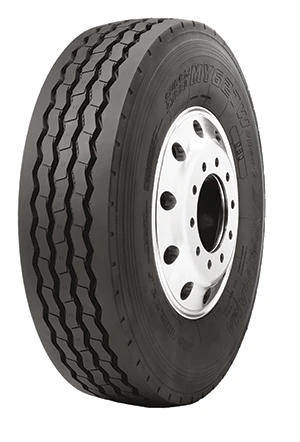
The wide product line of the Yokohama Tire Corporation includes their specialty tire for waste and sanitation hauling applications. Their MY627W Spec-2 is a heavy-duty tire designed to withstand the rigors of waste collection and transport. Its material make-up results in very long-lasting protection in harsh waste management conditions. Its advanced casing design ensures long life and retreadability and its enhanced tread pattern provides safe operations even in rough and uneven terrain.
Bendix Commercial Vehicle Systems LLC, the North American leader in developing and manufacturing leading-edge active safety and braking technologies, offers a range of components that can enhance the safety, performance, and durability of waste collection trucks’ brake systems. It is a preferred OEM supplier of brake parts and complete air brake systems. Their integrated systems include complete product lines of compressors, valves, ABS, stability systems, driver assistance systems, and industry standard air dryers. They even provide brake insurance coverage through Bendix Spicer Foundation Brake (a joint venture with the Dana Corporation). An innovator in air brake system technologies, Bendix continues to develop systems that meet sophisticated engineering and service requirements. One such system is their Bendix Slack Adjusters such as the Bendix Versajust LS with the WearMax Clutch. This precise system allows for a more gradual, continuous, and concise adjustment rate. This results in extended lining and drum life, optimized brake performance, and lower maintenance costs by reducing need for brake adjustments.
In 2017, Bendix introduced the EnduraSure-Pro spring brake—a premium sealed chamber for foundation drum brakes that is ideal for harsh environmental conditions. Since the number one failure mode for a spring brake is a broken power spring that is accelerated by corrosion, EnduraSure-Pro was engineered to prevent the moisture and contaminants that lead to corrosion from entering the chamber. To achieve this sealed design, Bendix eliminated park-side drain holes and integrated a one-way check valve into the screw-in dust plug. This unique dust plug opens momentarily when the park brakes are released to allow air to escape while keeping moisture and contaminants out. As a result, the EnduraSure-Pro power spring life is up to 1.5 times longer than other sealed spring brakes available today.
The EnduraSure-Pro also features a pushrod designed with higher hardness and lubricity, to help extend center seal life and reduce the risk of air leaks. In addition, the spring park-side spring housing is “E-coated” to offer improved corrosion resistance. Field testing, in which the spring brake was subjected to extreme corrosive conditions—in severe-duty applications on vehicles in eastern Canada—demonstrated its success in resisting corrosion.
Last year, Bendix also launched the BA232R brake lining, a 23K aftermarket friction designed to handle applications such as heavy line haul, heavy pickup and delivery, severe duty, and refuse. The BA232R will keep trucks compliant with reduced stopping distance (RSD) requirement
Latest from Waste Today
- Vermeer announces plan to build new facility in Des Moines metro area
- Buffalo Biodiesel shares updates on Part 360 application to DEC, Tonawanda facility progress
- Capstar Disposal expands roll off dumpster rental services
- Supreme Court strikes down IEEPA tariffs
- Casella details facility closures, expansion efforts
- Zero harm: Building a SIF prevention program for waste and recycling operations
- Casella posts a loss in Q4 2025
- McNeilus names Haaker Equipment first Dealer Partner of the Year