Malodor resulting from waste disposal is a persistent issue. “Decomposition is at the heart of most solid waste odors,” states Josh Rembusch, vice president of business development for Byers Scientific & Mfg. Odors are caused by decomposing waste, creating a mixture of odor-causing compounds such as hydrogen sulfide and ammonia. The most noteworthy compounds, he continues, are amines: putrescine and cadaverine. According to ACD Chemistry for Life, amines, derived from ammonia, are foul-smelling compounds produced when amino acids decompose in decaying animals.
Decomposing waste also creates anaerobic bacteria that produce methane, carbon dioxide, and volatile organic compounds, adds Laura Haupert, Ph.D., OMI Industries. Chemical reactions of the waste component can increase VOCs. Food waste produces sulfur-containing chemicals: hydrogen sulfide and mercaptans.
When most material arrives at waste processing facilities, it’s already in some state of decomposition, excreting odorous gases that attract bacteria, amoeba, worms, and other things in search of nutrients. As David Hill, CEO, GOC Technologies, says, these creatures accelerate decomposition, increasing the volume of odorous discharge.
Contributing factors include temperature, humidity, wind, and elevation. Elevation differences can result in “pockets of odors,” Haupert warns. Stagnant air can increase the concentration of gases. Warmer temperatures increase the concentration of VOCs and allow bacteria to thrive. Higher humidity allows the growth of bacteria, which produce gaseous odor.
“Another source of odors at a landfill is leachate ponds,” Haupert continues. As rainwater flows through the waste and collects in ponds, water becomes contaminated and odorous.
Neighbors, Nuisance Odor, Strategies, and S232
Decomposing solid waste and organics create nuisance odors that can lead to complaints. Strategies for odor control are important to the continued profitable operation of solid waste disposal facilities and transfer stations, says Rick O’Sadnick, senior scientist at Benzaco Scientific. “Odor complaints have long been the cause of numerous legal battles for the entire solid waste industry. Neighbors perceive odor as a threat to their quality of life and are organized and prepared to fight for a complete resolution of the matter.”
Social media makes it easier for neighbors to voice complaints, Haupert interjects. Not only does that contribute to a negative image for the facility, but it can also result in fines from local, state, or federal agencies; lawsuits; or even closure.
Also, stricter regulations for odor control are being written into permits, based on the number of complaints, according to O’Sadnick.
“Community adversity, unrest, social media shaming, compliance-driven enforcement actions, new regulations (such as S232 in New Jersey), and delays on landfill expansions and permits are just a few examples of what can happen when odor problems are not properly addressed,” Rembusch lists.
Even when they are attended to, Rembusch explains that fatigue or lingering bitterness from protracted battles can lead to an impasse on proposed solutions. He mentions one landfill that invested in a gas collection system and the collection of data regarding its effectiveness. "And yet, the community's perception [didn't] improve," proving that odors are challenging to quantify and reactions are subjective.
Escalation can occur through enforcement actions like Notice-of-Violations, public complaints, and litigation or legislation. New Jersey’s S232 regulation is focused on burdened communities (ranked in the bottom 33% for median household income) to protect neighborhoods when waste companies seek permits for new facilities or expansion of an existing facility.
According to the regulation, the Department of Environmental Protection must prepare a report assessing the environmental impact of the proposal, detailing potential impacts. If, after a public hearing, the DEP decides the facility would constitute an unreasonable health and environmental risk, it could deny the permit.
Mitigation at MRFs and Transfer Stations
Doorways and loading zones at MRFs and transfer stations are considered a last line of defense to contain odors, Jesse Levin, vice president of NCM Environmental Solutions, believes. Containment is more difficult at landfills due to the openness, variable topography, amount, and diversity of waste.
No single product can eliminate 100% of all odors, but Levin thinks the best choice for MRFs and transfer stations is an odor control neutralizer. NCM offers different types, from water-based odor neutralizers to solid forms of treatment, such as odor granules, which he says are a cost-effective method to mitigate tough-to-treat areas at MRFs and transfer stations.
Available in a winter-grade version to prevent freezing, NCM’s neutralizers eliminate odor through adsorption before they become fugitive.
Byers Scientific developed a new sustainable approach to sequester odorous molecules associated with MRFs and transfer stations. Their MT-6 Molecular Scrubbing System delivers 6,000 cfm per unit with carbon efficacy validated to ASHRAE (American Society of Heating, Refrigeration and Air Conditioning Engineers) 1452 and ISO 10121-2 standards. Their low amp draw requires minimal power. “These scrubbers are most effective when paired with industrial air curtains to minimize the amount of air escaping from the facility,” Rembusch says.
The Vapor-Phase Odor Neutralization System induces a plant-based liquid neutralizer into its vapor state. This technology is effective due to Van der Waals forces, a general term used to define the attraction of intermolecular forces between molecules. The neutralizer molecules form a weak electrostatic bond with the odorous molecules to mitigate, not mask, the odor.
Byers’ patented process accomplishes it in one step, creating a dry vapor consisting of safe, natural plant-based compounds, which are released directly into the air stream, allowing the vaporized neutralizer to first contact with, and then through a weak electrostatic bond, adsorb and then absorb to bind, encapsulate, and mitigate the malodorous molecules.
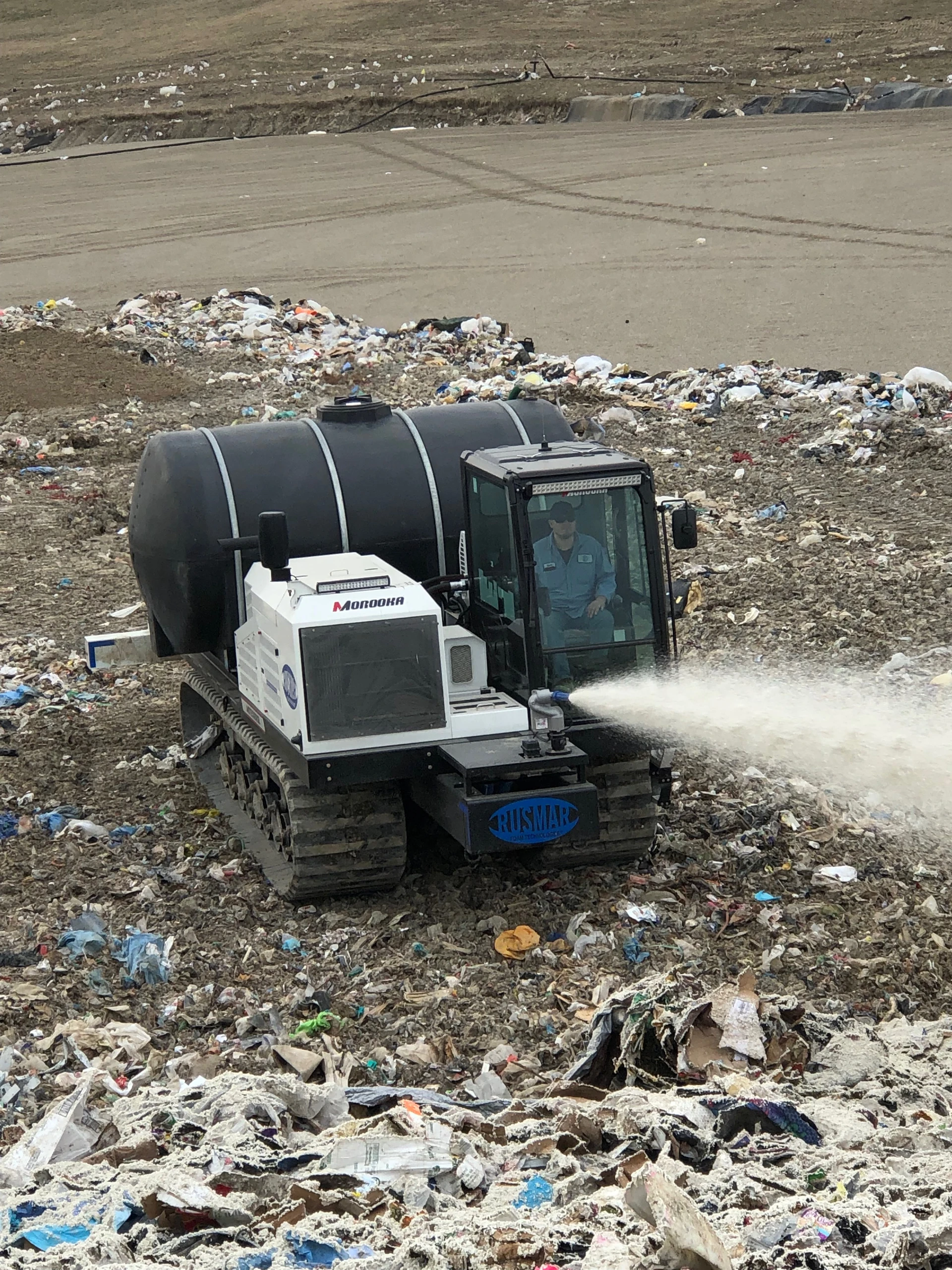
Benzaco Scientific recommends waterless odor-management solutions for transfer stations, recycling centers, compost facilities, and landfills. Their proprietary counteractant solution, ODOR-ARMOR, is a concentrated liquid that treats odors when fogged with water downwind through a series of high-pressure pumps, hoses, and nozzles. Vapor-Phase deployment units are designed for ODOR-ARMOR VPS. “These new formulations are freeze-proof and do not require dilution before application," O’Sadnick indicates. This makes them suitable for year-round application in northern climates, at locations that have water restrictions, and where conventional fogging is not practical. “Typically, ODOR-ARMOR is used as a finishing touch.”
 Social media has made it easier to voice odor complaints.Benzaco Scientific
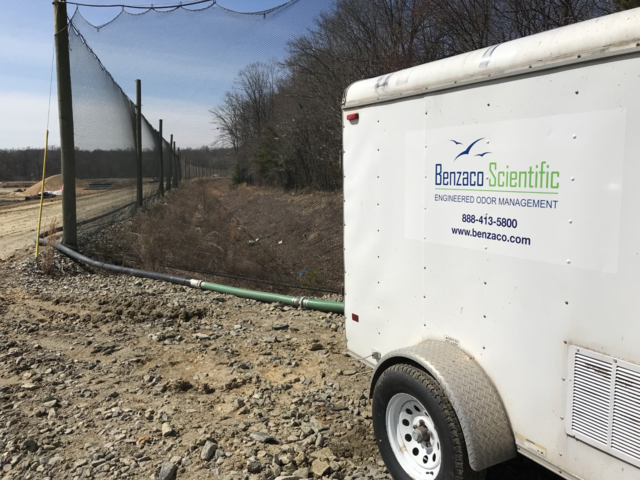 Benzaco recommends waterless odor-management solutions.Benzaco ScientificMitigation at Landfills
When an odorous load arrives at a landfill, Hill says the best method of suppression is to cover it immediately, but he admits that escaping odors will have to be chased—just as at recycling centers and transfer stations, odors must be treated after they have volatilized into the air.
"I use the phrase 'chasing escaping odors,'" Hill says. "This is literally what is happening." In most open-air situations where the air is not collected and treated by a scrubber or biofilter, typical methods have involved water-diluted neutralizers and masking agents, he explains. "These have had some positive impact and have been the industry's standard response for decades. But there is a fundamental flaw with this technique."
Hill points out that even the lightest water-based particle is several hundred times heavier than the heaviest gas particle. Thus, the water-based mist is only as effective as the percentage of neutralizer that volatilizes before the water evaporating or falling to the ground.
GOC Technologies does something different; they convert a specially designed deodorizer into gas and distribute it into the air. "We are not trying to output fragrance or neutralizer," Hill states. "We want to physically contact the odorous particle and react with it, converting it to an odorless compound. We chase gas with gas."
Advantages of the vapor technology Hill lists include the fact that it stays in the air longer, travels on air currents like odors do, and is carried by the wind to the same location odors are. He criticizes systems that use essential oils because, he explains, converting oil-based chemicals to vapor requires higher heat, pressure, and energy.
The deodorizers used by GOC are constructed of combinations of amino acids that are converted to gas with low energy. They make contact with the odor and decompose it into less- or non-odorous components. For better results, individual formulations work on specific classes of odorous compounds, such as sulfides and mercaptans, organic acids, and aldehydes and ketones.
Acknowledging that most of the many products used to mitigate odor only mask it with perfume, Katerina Piscitelli, manager, Marketing & Customer Experience for Ecolo Odor Control Technologies Inc.%3
Latest from Waste Today
- Vermeer announces plan to build new facility in Des Moines metro area
- Buffalo Biodiesel shares updates on Part 360 application to DEC, Tonawanda facility progress
- Capstar Disposal expands roll off dumpster rental services
- Supreme Court strikes down IEEPA tariffs
- Casella details facility closures, expansion efforts
- Zero harm: Building a SIF prevention program for waste and recycling operations
- Casella posts a loss in Q4 2025
- McNeilus names Haaker Equipment first Dealer Partner of the Year