If a waste hauling truck or other vehicle can prove it’s being used at optimum efficiency and legal weight requirements, that department is ahead of the game. Scales and software continue to be there, adapting and changing according to the requirements of the times as well as saving time and money for fleets oftentimes stretched to their limits.
The Changing Reasons for Weight-Consciousness
The whole industry is becoming more weight conscious, and the reason for this has also changed, according to Michael Ferguson, national account manager for Air-Weigh Scales. “In the past, it was always about fines and fees, but now it’s about people being concerned that they’re a good citizen and not overloading the truck, because it makes it more dangerous on the street,” explains Ferguson. “This in turn makes it a liability issue if you have an overloaded truck. If it’s overloaded and unsafe and doesn’t brake fast enough, you have a huge obligation on your hands.
“The second issue deals with the fact that every time the trucks are overloaded, problems arise because trucks are being built lighter and lighter all the time. The metal is thinner. Trucks are as light as possible so that they can be loaded with as much trash as they can possibly get on them. But the problem is the trucks end up in the maintenance shop far more than they should, as engines are breaking and other parts are not working as a result of this. It is extremely important now for each company to monitor the weight on the truck or else you will have an overloaded truck.”
The scales may now contain a warning for the operator, letting him know when the truck is getting to the maximum weight. When the proper weight is reached, it can in turn shut the hydraulics off so that no more weight is added to the truck. Even if they want to add weight, they are unable to do so and must go off-road. This is an open road protection system.
Quite a few schools and colleges are now having to show how much material handled is recyclable, points out Ferguson. “We’ve released two new systems within the past year-and-a-half, the BinMax and the BinMaxXL systems. Those are specifically for front-load trucks where we are weighing individual containers.” Previously, there were systems for forklifts in which the sensors were located in the forks themselves.
“But the downside to those is that they are notoriously difficult to stay calibrated,” Ferguson says. “You have to reset them after they’ve taken a pounding from handling containers, and they are also very expensive-$15,000 to $20,000 in price.”
In the new system, Air-Weigh takes the existing technology in use for its standard system and modifies it a bit so with the sensors connected directly to the arms rather than the fork so that they don’t take that constant pounding. What is measured is simply the amount of flex in the arm with the container. So now, for about a third of the cost, you can get an air-loader scale for each individual container and not worry about the constant calibration.
“This is a huge hit for us because we have a lot of customers that want to audit, to see that they are setting their weights appropriately and the routes are good. That is what the scale allows them to do. Then we have an Excel system doing everything with the BinMax system, but it also means those weights will be signaled to a home office computer to measure any driver in action.
“The home office will have an automatic report for each location, what the container weighed, and the GPS coordinates. This gives waste hauling companies a way to make sure they are charging customers the appropriate amount, not losing money or not overcharging customers.”
The waste industry is extremely competitive, and an important advantage for companies vying for business is to have scales showing they are not only legal in weight but also showing end users that they are safe and charging the correct amounts.
“In the past, scales were all about avoiding fines, not getting pulled over to receive a ticket,” Ferguson says. “Now, it’s about the safety of the community that you are hauling in, making sure trucks are not overloaded and damaging the streets, and you are protecting yourself from a liability standpoint. You’re also saving your company significant money maintenance-wise by not overloading your truck. Enforcement is getting stricter at many locations around the country; city planners are starting to ask, “˜Who is it that is tearing up our streets and costing us more money?'”
Flexibility With any Software Used
CleralUSA’s Kiload calculates loads with an axle-weight monitoring system able to figure a vehicle’s axle weights, gross vehicle weights, or payload. Operators also have access to gross vehicle weight, payload, and its distribution on the truck. The small, backlit, cab-mounted display can be installed on the dashboard without obstructing the view.
CleralUSA’s Sentinel is a wireless, onboard axle weight system for trucks and trailers. The hand-held monitor displays real time gross and axle weights simultaneously within a radius of 800 feet from the vehicle. In the blink of an eye, the pictogram displays gross weight and axle weights and their distribution.
Weights can be displayed in net (payload) or gross (GVW) and selected units (kilograms, pounds, or tons). Pictograms of popular trucks and trailers are available in the monitor’s memory. Imagine the calibration process with pictograms; it’s a good fit for a world ever moving toward simplicity of expression and communication.
Sentinel is the tool per for remote weighing within a margin of error of plus or minus 0.01. It allows up to eight channels (axle group) to be displayed. Multiple trailers and their calibrations are easily stored in the monitor, which makes swapping trailers easy.
Sentinel wireless is as versatile as an operator’s needs require. Howard Baker, CleralUSA national distributor, mentions that what the company is doing is using a different technology in its weighing systems and the types of sensor systems that it uses. By doing this, it is able to make its systems very simple and easy to install.
“It’s the type of system easily calibrated and easy to replace a part as well,” explains Baker. “I guess the simplicity of the system makes it very popular. We have some 500 units used by the cities of Phoenix and Tempe, AZ, and some of the surrounding smaller cities. We’ve been working with them for over two-and-a-half years now.
“What we’ve seen is that the systems don’t need a lot of attention, have very few parts that have failed, and they are very affordable. We have taken a quite different technology, applied it, and it works quite well. Improvement in the electronics in the last few years has grown tremendously.”
The approach Baker’s firm takes is to not get into the software business. It will, however, work with any other vendor out there so that it can be interfaced with every system the customer is using. Those customers’ software can interface with the data accumulated, and they are able to do whatever they want with that information.
“Liability issues are perhaps one of the biggest things out there,” adds Baker. “If you take one of these vehicles, add five tons onto that conveyance, and it’s also not going to stop perhaps as it’s supposed to. You could run into someone and open up a whole new can of worms from a liability standpoint.
“Also, on a different note, in optimizing efficiency, if you can streamline your route based on the amount of refuse that you are picking up and how much you can put in each truck, you can program your routes to be more efficient. In our case we have a lot of instances where somebody is finishing up a route and then able to go help someone else finish up theirs, assisted all the time by a measure of what weight is on that particular truck with the help of our systems.”
Software like WasteWORKS can be used at almost any type of waste or recycling facility.
Cloud Computing Systems
Soft-Pak Software Solutions does the greatest amount of its work in the waste industry, much of it on the hauling side. Its first products came about in 1978. About 15 years ago, the company started to develop a scale package because its clients owned either landfill, trash stations, or MRFs, and they wanted to consolidate that.
“The main difference between Soft-Pak and most of our competitors is that we are a single database for all of the operations that go on in a waste management organization,” explains Soft-Pak president Brian Porter. “We have the database that handles all of the hauling, billing, routing, as well as all of the landfill activities. Work orders, as well, can be closed out at the particular scale.
“The change over the years has been the need to be provide additional reports on what’s going on at the scale, and now what’s becoming a popular thing is diversion where you have commodities that might be pulled out. In California there is a big initiative with LEED Reporting; we’ve gone ahead and made that available right through our software in a couple different areas, on both the hauling side and the scale side.”
All of that is fed into a user’s central database of to report on it, supply that information to the client, and then understand what their material diversion rates are, as when tonnage is taken in, not all of it is going to be sent to the landfill. “The difference with us is that we are cloud based so that you are not required to have a lot of hardware. Others have a single database for a scale and another single database for the operation so that they’re having to sync databases at the end of the day. There are inefficiencies with that as well as issues that are problematic.
“All that is needed for our system is an Internet connection and you can be running your scale system or your operation immediately. Years ago there wasn’t as much sophistication as there is now. The information that is required is available from us.
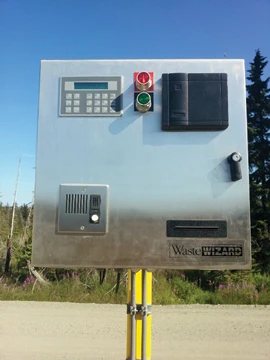
WasteWIZARD allows automatic access.
“LEED reporting is really big in California and is starting to become very popular throughout the country as well. On our systems, we own the codes, there is no reselling of software, and we have one of the largest, most skilled software development teams in the industry, so we are able to provide the necessary changes in a hurry.”
The company is very much focused on the waste and recycling business, covering all aspects of that industry. It provides the software for assisting municipal as well as private clients. As clients are looking to migrate off other systems, Soft-Pak Software Solutions has the resources to assist with that and make the transition as smooth as possible.
All Types of Facilities
Because a software like WasteWORKS, made by Carolina Software Inc., can be used at almost any type of waste or recycling facility, changes in wastestreams have a little less impact on it-as long as that wastestream continues, of course. If there is less waste headed to the landfill and more material headed to the recycling facility, this means WasteWORKS may have more customers using its system for recycling and possibly fewer using it for landfill transactions.
However, WasteWORKS still handles a transaction, and customers still have to track the information as well as print bills or do any other functions. “Clearly, there are nuances or differences with processing waste material and recycling, but WasteWORKS comes equipped to handle many types of transactions,” explains Jon Leeds, vice president Carolina Software Inc.
“Overall, we see more customers interested in technology, like our WasteWIZARD automation system, and in increasing efficiency at their sites. With tighter budgets over the past few years, landfill managers want to explore every angle possible to continue processing waste efficiently, while reducing expenses.
“Because our software is being used at all types of facilities, we don’t have as much exposure to changes in diversion. One thing we do see is more customers expanding the types of waste and recyclables they receive and process. More C&D recycling and diversion of greenwaste is occurring as solid waste managers try to maximize landfill space.”
Leeds sees an increased willingness by municipalities to process their own greenwaste and return this to their communities in the form of mulch and compost. A newer client of Carolina Software, the city of Las Cruces, NM, provides a high level of greenwaste service to its residents-picking up greenwaste from residents (up to 2 yards free) and then offering it back to them for free as compost and mulch.
“As someone who just paid $30 for a yard of compost, I can tell you I’m a bit jealous of those residents,” says Leeds. “The key here is that this whole process encourages residents to keep their properties maintained and saves landfill space. While there is certainly some cost for this level of service, there are also savings (landfill space) that make a big difference in the long run.”
Believe it or not, there are still folks out there processing scale transactions with pen and paper, according to Leeds. There are also sites that just use the scale indicator to print tickets and process trucks, and then enter this information into a spreadsheet or accounting software. Inevitably, these customers come to the realization that they need a dedicated package like WasteWORKS and that the investment pays off through a reduction of work and a reduction in mistakes.
People who process vehicles without WasteWORKS end up spending a great deal of time producing reports and bills-things that may only take a minute or two with WasteWORKS. “We don’t see as many sites like this anymore, but they’re still out there. In other situations, we’re selling software to people who are either using something homegrown (by their local IT department, for instance) or a package that they’ve simply outgrown.
“Another big reason that people buy WasteWORKS is our support. In my position with Carolina Software and simply as a consumer over the years, I’ve learned that almost no product or service can be good enough to defeat poor service. Customers want to know that you’re there for them and they are almost always willing to be patient with an issue or a question if they know that you and your support staff will see it through to resolution.
“People choose WasteWORKS because we have a time-tested, flexible package and the best support you’ll find anywhere. I had a customer from Canada ask me yesterday how long they’d been using WasteWORKS. I smiled when I told him 21 years…since 1993.”
Customers also turn to Carolina Software to enhance their existing WasteWORKS installations. If a customer has an additional lane to be turned into an automated express lane, or if they just have a single scale and want to handle after-hours traffic or run unmanned at certain times of the day, WasteWIZARD is an investment with a good record, according to Leeds.
“Hundreds of customers who have been using our software for over 15 years, and many over 20, would simply mention it to give confidence to a prospective client that they are going to be working with a company that takes pride in satisfying customers for the long haul. I like to tell people that if you are doing it, we’ve probably seen it before, and the software is ready to handle things.”
The city of Las Cruces, NM, operates a clean fill and yardwaste facility. This is located on the site of the Old Foothills Landfill, closed to solid waste disposal for over 13 years. The clean fill is used for landfill closure and the vegetative or biomass waste. Instead of going to a landfill, this material is now composted and the product is available to city residents free of charge.
“Recent warm weather in our area has helped with the composting process,” according to Klaus Kemmer, Las Cruces solid waste administrator. “While other regions of the country were dealing with frigid temperatures and bad weather, we’ve been able to concentrate on getting our new WasteWORKS system installed at the city’s clean fill landfill. This software replaced an older software system with limited abilities. The implementation focused on WasteWORKS ticket processing.”
Kemmer found the technical support time extremely knowledgeable and helpful throughout the implementation. Stored procedures were created to generate daily cash transactions and monthly billing data to feed the city’s central ERP system, called Munis, where billing and cash deposits are processed.
“From the start, we found WasteWORKS easy to learn and to use,” adds Kemmer. “Scale users immediately noticed the benefits over the old software system. Initial training over the phone went well, as did the setting up of materials and customers. The time it took was actually less than half of the time we’d scheduled. A WasteWORKS support team member was right onsite on the go-live dates; all questions and technical issues were handled quickly. Our scale house team says they never want to go back to the old software systems.”
With Built-in Scale Protection
Developed by Fairbanks Scales, Intalogix Technology provides a unique defense system that works with most scale applications and is specially engineered to isolate and guard your scale from dangerous power surges and lightning strikes.
The heart of this technology is a true digital signal that’s up to one million times stronger than a conventional analog signal, maintaining constant communication with a scale’s individual load cells, detecting any abnormality or deviation in performance. Should moisture or some other problem be found with a load cell or other electronic component, Intalogix Technology will alert you and tell you where the trouble is located.
Another benefit of Intalogix is its optical load cell isolation. Creating a surge-stopping barrier between a scale’s load cells and its supporting electronics, isolating the load cells from harmful surges and electrical spikes. Intalogix Technology boasts an electrical isolation design. This method of isolation ensures that any surge which happens to enter the system is diverted to “earth ground,” instead of impacting all the scale electronics.
Intalogix Technology can be used in all makes of scales, new and old, including scales in which conventional instrumentation was previously used.
CompuRoute is an add-on module to the ever-powerful CompuWeigh System. The CompuRoute module allows you to develop and maintain residential and commercial routes, track and maintain your container inventory, create dispatches, maps and you have complete control of all pricing associated with your operation.
If a facility is comprised of curbside pickup and/or dispatching and a landfill, transfer station, etc. you can track the load from the point of pick-up to the disposal at your site.
The CompuWeigh System is an integrated Account, Truck, Transaction, Reporting, Posting (to external and optional integrated accounting package) and Shift Totals management tool. With a standard user interface, the user controls at the bottom of the page appear on all edit windows. These controls allow the end user to easily search, filter, save, and browse through the data.
The search button allows a user to search for specific data relating to a record. The user can use the search function to look up information based on any field in the database. The filter button allows a user to drill down on a specific type of field.
For example, a user could use the filter function to view only customers who are in a specific zip code or have a specific bill cycle. Multiple criteria can be selected in order to narrow down the filter. The user can use the remaining buttons to maneuver through the data. Customers have the ability to move forward, backward, to the first record, to the last record, and also to save a record.
Today’s weighing market is looking for automated solutions. Unattended weighing, or weighing without a human scale operator, coupled with credit card payment processing are features that lie at the heart of features provided by Mettler Toledo’s DataBridge MS. This is
Latest from Waste Today
- Worn Again Technologies unveils Accelerator plant to advance polycotton recycling
- Nashville Waste Services launches new digital route system
- ACUA landfill expansion project unanimously approved
- Clean Energy announces multiple RNG deals with fleets nationwide
- Interchange 360 to operate alternative collection program under Washington’s RRA
- Waste Pro files brief supporting pause of FMCSA CDL eligibility rule
- New Way Trucks expands US network with Joe Johnson Equipment
- Tire Industry Project publishes end-of-life tire management guide