The US Environmental Protection Agency (EPA) requires landfill operators to capture and control landfill gas (LFG) in their New Source Performance Standards (NSPS). These EPA rules are focused on reducing methane-rich gas emissions from municipal solid waste (MSW) landfills no matter whether the landfills are new, modified, or reconstructed. Landfills are required to conduct surface emissions monitoring (SEM) to identify potential emission exceedances. Currently, there are several technologies used for performing SEM, including flame ionization detectors (FIDs) and photoionization detectors (PIDs). A new tunable diode laser absorption spectroscopy (TDLAS) technology has several significant advantages over other older technologies.
Overview of Landfill Surface Emissions Monitoring Requirements
The EPA’s NSPS regulations require MSW landfills to minimize methane emissions by operating a gas control and collection system (GCCS). The regulations (40 CFR part 60 subpart XXX) require landfills to perform quarterly SEM to identify potential emissions greater than 500 parts per million by volume (ppmv). Landfills must also ensure that the collection and control system is operating as it should. If emissions are detected above specified allowable levels, the landfill must take steps to correct the issue.
Usable instruments for the quarterly SEM are regulated by EPA’s Method 21—Determination of Volatile Organic Compound Leaks. With regards to instrument specifications, Method 21 requires that the instrument must:
- Respond to the compounds (e.g. methane) being processed
- Measure the leak definition concentration specified in the regulation
- Have an instrument scale that is to +/- 2.5% of the specified concentration
- Be equipped with an electrically-driven pump to ensure that the sample is delivered to the detector at a constant flow rate
- Be equipped with a probe or probe extension for sampling not to exceed 1.25 inches in outside diameter, with a single opening for sample admission
- Be safe for operation in explosive atmospheres
- Have a response time equal to or less than 30 seconds
Instruments used for SEM must meet the above Method 21 guidelines for instrument specifications as well as calibration and performance.
Suitable Technologies for Conducting Required SEM Monitoring
Acceptable SEM devices that fit the Method 21 criteria include but are not limited to catalytic oxidation, flame ionization, infrared absorption, and photoionization.
Flame ionization detectors (FIDs) have been generally accepted as the standard technology for SEM. An FID operates by detecting ions formed during the combustion of organic compounds in a hydrogen flame. Ion generation is proportional to the concentration of organic species in the sample gas stream.
There are some disadvantages to using FIDs in addition to their benefits. FIDs use an open flame, and if the flame goes out they can be difficult to restart. Technicians must carry around highly flammable bottled hydrogen. Hydrogen must be obtained locally since it cannot be shipped to locations as standard calibration gases can. The FID devices also weigh as much as 12 pounds, which creates strain and fatigue on operators who carry the devices throughout the entire day.
Many detection methods require the use of two separate devices. One device is used to stake the sample and the second is used to save the data and the GPS coordinates, which must be reported along with the sample. This means that technicians are responsible for tracking the status of two batteries to be sure each is charged and ready to use.
Finally, FIDs are susceptible to a cross-gas effect: false readings due to, or influenced by, the presence of other gases or hydrocarbons. This is a risk inherent in the device’s ability to read many types of hydrocarbons.
Another technology that can be used for SEM is photoionization detectors (PID), which use high-energy photons’ ultraviolet-range (UV) to break molecules into positively charged ions. As compounds enter the detector, they are bombarded by high-energy UV photons and are ionized when they absorb the UV light. Their electrons are ejected, thus forming positively charged ions. The ions produce an electric current, which is the signal output that the detector reads. The greater the concentration of the component (in this case, methane), the more ions are produced, and the stronger the current. The current is amplified and displayed on a digital concentration display called an ammeter.
PIDs can detect multiple gases rapidly and are commonly used to detect volatile organic compounds (VOCs). However, PIDs do require frequent cleaning and the UV lamps wear out and require replacement.
A more recently developed SEM technology uses tunable diode laser absorption spectroscopy (TDLAS). This technology uses a combination of laser absorption spectrometry and applied electronic signals. An electronic signal is applied to increase the accuracy of the laser tuning range, which means the device can focus on just the methane within the spectrum of the sample. The device filters out any other VOCs so that they will not register and cannot influence or affect the methane concentration readings.
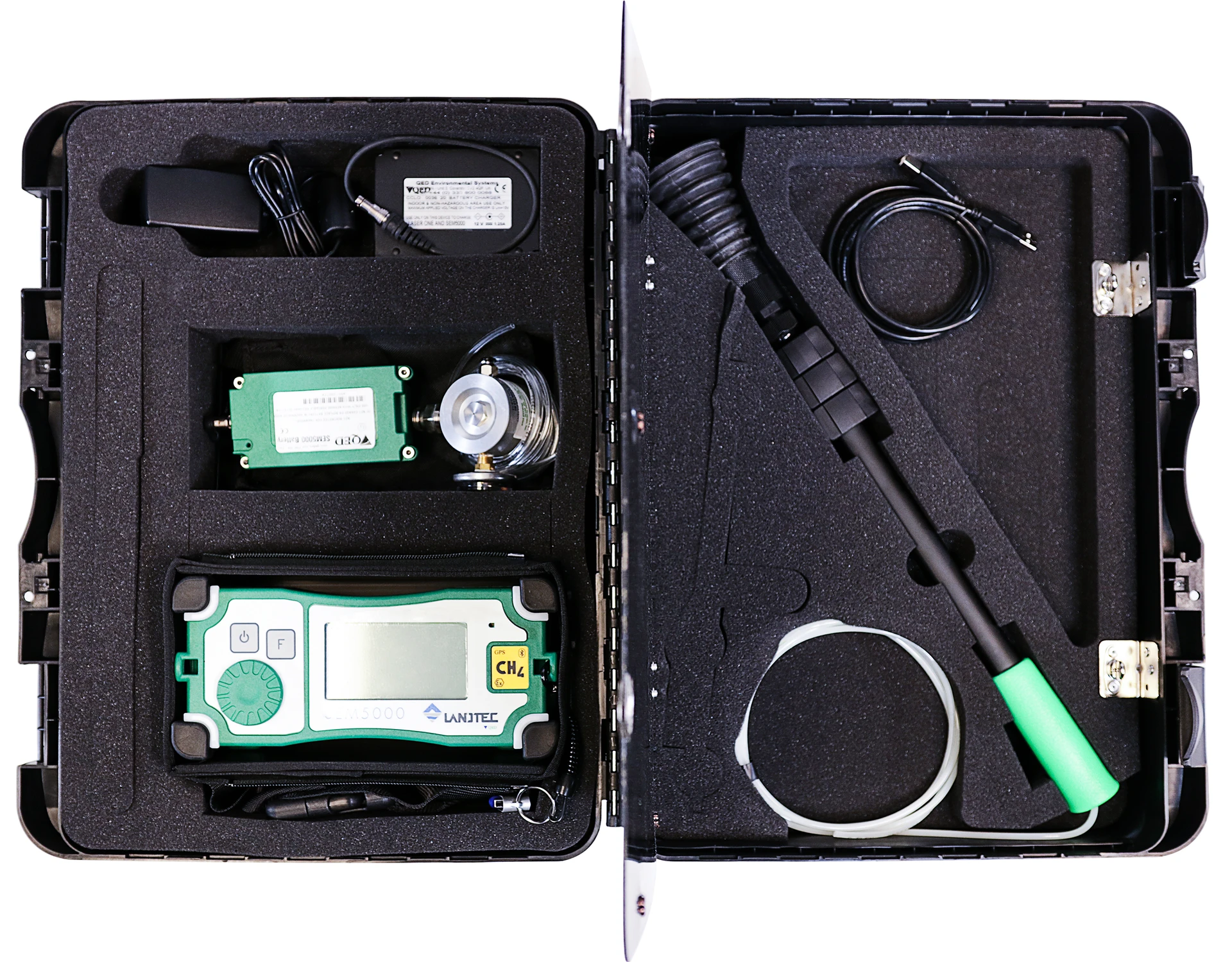
An example of this technology is the LANDTEC SEM5000 methane (CH4) detector from QED. This is a laser-based device that is accurate down to 0.5 ppm. The fact that flame is not required is a benefit for sampling in a potentially explosive environment. It does not require an external gas bottle for operation, and the laser technology eliminates the risk of flame out, so the user does not lose time relighting. It comes with an integral GPS and Bluetooth that eliminates the need for a secondary device for data storage and GPS. The detector holds up to 480 hours of scan data. It weighs only 3.5 pounds.
The detector also features a “hot swap”—a removable and rechargeable battery—which means users charge the battery, not the instrument. When the charge from one battery has been depleted, users can simply swap to a fully charged battery to continue their work. A single charge provides about 10 hours of operation. Readings can be saved to your computer using the proprietary SEMsoft software package, which comes with multiple reporting functions and choices, easy upload for site maps and scan paths, and customizable indicator points based on the scan. The software formats the scan data into the standard .csv report and auto-fills industry-standard background reports.
New Laser Technology Improves SEM Results
EPA regulations about landfill emissions make it incredibly important to capture, control, and measure landfill gases. Quarterly surface emission monitoring is required, though not all technologies approved to perform SEM are designed equally. New laser-based technology, like the SEM5000, meets and exceeds EPA Method 21 requirements. The device’s versatility and convenience help landfill operators to meet the EPA’s SEM requirements without other technologies’ drawbacks on safety, efficiency, and ease of use.
Latest from Waste Today
- Worn Again Technologies unveils Accelerator plant to advance polycotton recycling
- Nashville Waste Services launches new digital route system
- ACUA landfill expansion project unanimously approved
- Clean Energy announces multiple RNG deals with fleets nationwide
- Interchange 360 to operate alternative collection program under Washington’s RRA
- Waste Pro files brief supporting pause of FMCSA CDL eligibility rule
- New Way Trucks expands US network with Joe Johnson Equipment
- Tire Industry Project publishes end-of-life tire management guide