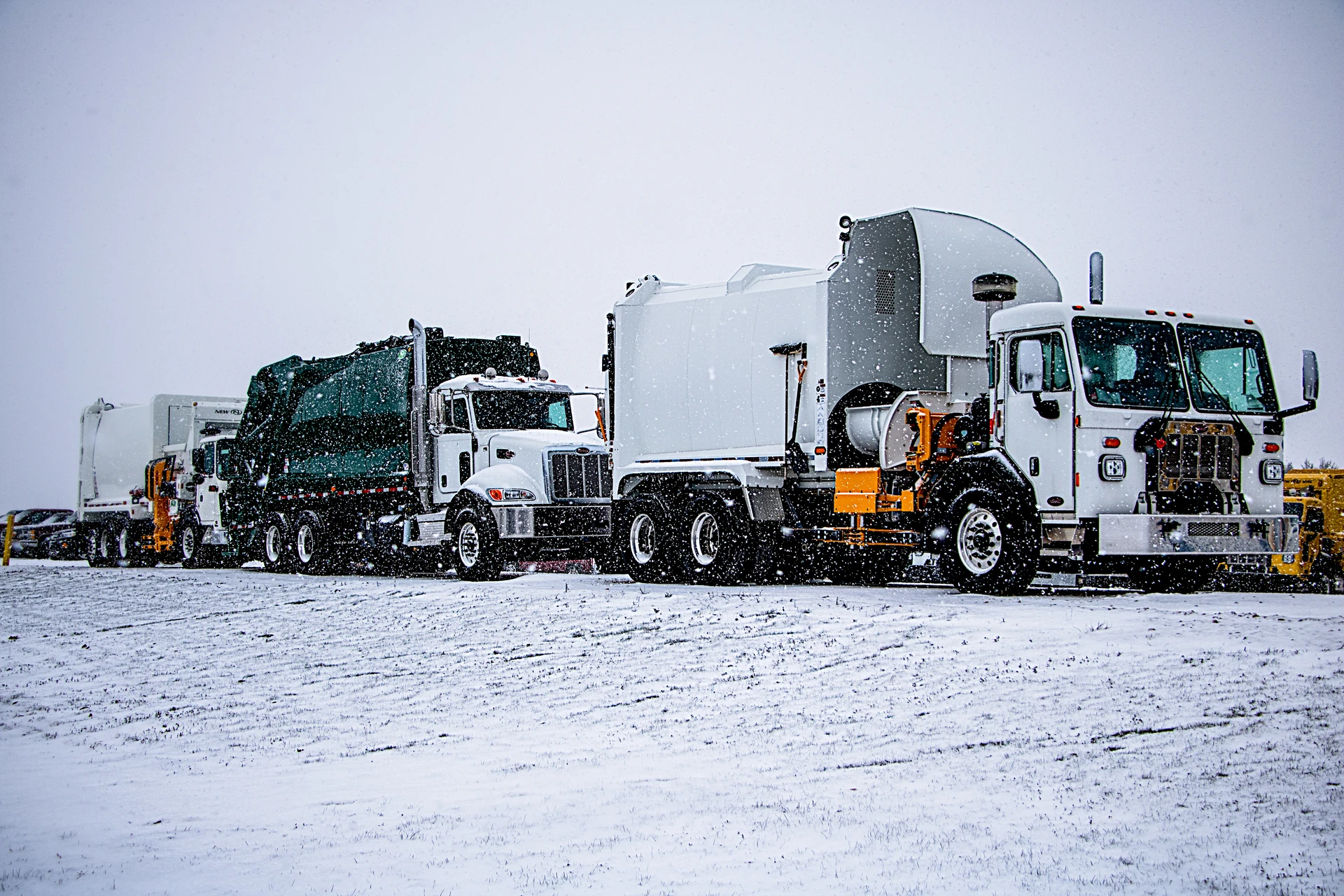
The primary action any fleet manager can take to prepare and maintain trucks for the winter weather is the same approach year-round: have a quality preventative maintenance program, notes Jerry Milano, Autocar Trucks’ director of field service.
“Having a quality PM program is paramount to a reliable and low-cost operation, preventing breakdowns causing excess expense,” he adds. "Use a detailed checklist on a regular interval following the manufacturer's recommendations. Repair worn or defective parts before a failure that will cause a breakdown."
Maintenance specific to cold climate winter weather on solid waste fleets should be done before the first snowflake hits the ground.
Josh Seiferth, Mack Trucks refuse product manager, notes that proper operation of a Mack Truck to ensure it operates in the toughest of conditions for which it is designed means that drivers and fleets stay current on all regularly scheduled maintenance, including fluid and filter changes and tire maintenance, among other factors.
Additionally, caution should be taken when washing road salt and grime off of trucks in the winter.
“Doors can ice and freeze shut after washing, potentially causing seals to be pulled loose when opening,” notes Seiferth. “Also, door lock cylinders can freeze, making them difficult—or even unable—to be unlocked.”
“In preparation for winter, maintenance should be done on the hydraulic system: new suction strainer, return filters, breather, and an ISO viscosity grade of 32 or 46 can be used depending on the ambient temperature the packer is operating in,” says Don Woerdehoff, New Way Trucks service manager.
Checking the coolant and antifreeze level and concentration is a prime consideration in winterizing a fleet.
"A 50/50 mix is recommended unless operating in extremely cold climates," Milano says. "Check cooling system hoses and clamps. Replace worn hoses and clamps. Pressure test cooling system in checking for leaks."
Additionally, fleet managers should check the HVAC system for proper operation, check and replace wiper blades as needed, check windshield washers for proper operation, and check block heaters for proper operation.
“Consider the use of fuel heaters or other fuel heating devices to reduce the likelihood of untimely fuel filter plugging issues as certain engines may not reject enough hot return fuel to the tank to keep the fuel adequately warm in cold weather,” notes Brian Liimatta, customer support manager for Cummins.
“Make sure that bunk heaters and engine pre-heaters are ready for when the operators need them” also is critical, notes Daniel Erck, regional sales manager for the Northern East Coast Region, customized solutions, Americas Region, Webasto Group.
Adding accessories such as fuel tank, filter, and hydraulic warmers to an engine preheating system can reduce the possibility of fuel filters gelling and the load on hydraulic pumps from cold thick oil, he adds.
Engine pre-heating can be a huge cost saving in the winter months, notes Erck.
“Most modern diesel engines will start even when it is below freezing,” he says. “However, by pre-heating you do reduce the load on engine bearings with warm free-flowing oil and by getting the engine to operating temperature sooner, you also reduce the load on diesel engine emission systems (DPF and DOC).”
That also saves on the cost of a service call or a tow truck, says Erck.
Erck notes that for those who have or plan to use fuel-operated coolant heaters, they should be run once a month for 20 minutes to keep fresh fuel through the burner.
“Understand that bio-diesels tend to have higher cloud points, worse cold flow properties, and more affinity to carry water so that should be taken into consideration,” says Liimatta.
He advises those who use a fuel additive (cold flow improvers) to address gelling/waxing concerns to be certain to read and understand the proper procedure to mix with the fuel.
“Hand dosing is usually not very accurate and effective,” Liimatta adds. “Improper addition of the additives can make the issue worse. You want to ensure the additives are added before waxing/gelling occurs.”
It’s important to make sure the electrical system is ready for cold weather, Milano points out. Make sure batteries are in good condition and cable connections are clean.
“Be sure you understand the health of the batteries before cold weather and ensure you have proper cranking capacity,” says Liimatta.
Brett Miller, engineering manager of Optronics International and USA Harness International, a heavy-duty commercial wiring harness manufacturer, recommends that preventative maintenance prior to the onset of winter includes inspecting all of the over-molded and hardshell connectors to ensure they’re fully engaged with each other.
“Review all of the cable and wire routings," Miller adds. "Inspect it for abrasion that may have occurred over the course of time as well as over-the-road vibration that causes things to shift.”
Miller also advises checking for damage from road debris that gets kicked up by the tires or jammed up against the underside of the body.
“Look for accumulations of soil, debris, grease—anything that contributes to further damage to any cable or wire that needs to be cleaned out,” he adds.
It's critical to have a closed system that doesn't allow moisture in as it can wick through the system—including a pinprick hole—and start causing corrosion.
If something needs to be spliced, it’s important to cover the area with shrink tubing or a shrinkable sleeve butt connector that can help seal the connection point, says Miller, adding the entire splice area should be covered to protect it even further, up to triple protection.
General maintenance should include ensuring hoses aren’t weather-cracked and can move freely, notes Alan Kamies, Link Manufacturing inside sales specialist.
Link Manufacturing offers auxiliary lift axles of various capacities in non-steer and steerable versions for different applications.
An issue that can arise in colder months is moisture development in the air-line system which can travel through some of the components such as brake relay valves and lift control modules, says Kamies.
“If you’re running in extremely cold conditions, that water can freeze, which would either make the lift not function properly,” says Kamies.
Pre-trip and post-trip walkarounds are also advised to ensure the air tanks are draining regularly to keep moisture out of the system and prevent something freezing up, he adds.
Ensure exposed lines that could contain water vapor are well insulated and out of the way of cold blasts, notes Liimatta, adding the crankcase breather systems require particular attention.
Kamies also advises that solid waste truck operators ensure there is not a major snow or ice buildup that will interfere with the truck’s braking and that there isn’t a significant build-up on air lines that could cause them to tear or break and create a leak.
Hoses and airbags can become more brittle and more prone to problems during the wintertime.
“It’s very important to have good tires and that tire chains are in good repair and accessible in snow climates," says Milano.
Other tips noted by David Stafford, executive vice president of operations for Big Truck Rental, include:
- Choose the correct engine oil for the condition
- Maintain the engine block heater
- Inspect the air dryer
- Check fuel stabilizer or run winter-blended fuel
- Keep fuel tanks at least half a tank full
- Top off window washer tank with winter-grade washer fluid
- Follow federal/DOT inspection guidelines
Issues that need repair or replacement in the winter should be addressed immediately, says Miller.
“Particularly in the Northeast and around the Great Lakes, the road salt and chemicals used on the roads can easily infiltrate any spot because it's going to be clotted up in there and it'll further deteriorate the harness or the wiring system, which could also knock out critical safety lightings such as strobes and warning lights,” he adds.
“When they salt the roads with calcium chloride or magnesium chloride, that stuff gets clotted up on the underside of the carriages of trucks and trailers. That stuff regurgitates itself and if there's a chance for getting it in somewhere, it's going to start corroding metal, particularly soft copper.”
Equipment that all fleets should have on hand for winter maintenance includes antifreeze hydrometer, coolant test strips, a battery load tester, a block heater tester, a tire gauge and tools required to meet state and federal DOT inspections, notes Stafford.
In most cases, common hand tools used by mechanics can do the trick in wintertime maintenance, notes Miller.
“If there is a particular hardshell connector set that needs to be replaced, many times people will take hand pliers and try to crimp the terminals onto the wire. But they're not going to get a proper crimp that way,” he says. “They need to get specialty tooling that's designed specifically for those kinds of terminals.
“If you crimp it too loose, the wires are going to have just as much tendency to pull right back out of that terminal and cause a worse problem. If you crimp something too tight, you can crush the copper strands. If you start breaking strands away, you increase the resistance and create a hotspot on that point.”
In extreme cold, hydraulic tank heaters are a good option to add, says Woerdehoff.
“If not equipped with one, warm up the truck before starting the route and run all functions of the body to ensure proper operation and to warm the hydraulic fluid. Be sure that the air system is free of moisture,” he adds.
Today’s trucks don’t require special equipment to operate in winter weather, Seiferth says.
"Winter fronts or shutters that are commonly seen on truck grilles years ago are no longer recommended for use on current Mack models as our Mack MP engines are designed to operate effectively without them,” he says.
There can be exceptions for applications in extremely cold conditions, Seiferth notes, adding solid waste truck operators should consult with their local Mack dealership for more information.
Although safety is a year-round concern, there are special safety procedures that take center stage in cold-climate winters.
“Safety protocols start with a thorough inspection of the truck body,” says Woerdehoff. “Inspect the body and tailgate for any damage or failures, paying close attention to the tailgate lock mechanism and tailgate seal condition. Check all proximity switches and safety mechanisms are clean and free of debris.”
The Technology and Maintenance Council has numerous recommended practices for winter fleets including general cold weather operation, fuel specifications, cold flow characteristics of diesel fuel, fuel additives, fuel filters and water separators, notes Liimatta.
Kamies reminds drivers to allow themselves extra time and extra room on the roads in hazardous driving conditions.
"You want the lighting to work for visibility so you don't have accidents, especially on the snowy roads where it's sometimes difficult to see vehicles in front of you or from the side. You want to make sure all the lighting and the safety equipment is operational,” says Miller.
Miller points out that in the solid waste industry, there are a lot of frequent stops and starts for curbside pickup.
“Visibility is that much more important in poor weather,” he adds.
Keeping windows and lights clean from snow and salt treatment stains extends the life of the vehicle.
“But how about making sure that if your drivers are stranded by a breakdown that they are safe while waiting for the service company or weather to clear?” Erck points out.
“Road closures due to snow events every winter involves trucks being stranded on highways for days. If your drivers can stay warm and feel safe in their vehicles, you have a better chance of retaining experienced operators for your fleet.”
Minimize idle—if possible—for extended periods, notes Liimatta.
“Try to keep idle under 10 to 15 minutes in a given period,” he says. “Consider modifying routes to achieve periods of more sustained or heavier operation to ensure aftertreatment temperatures get warm enough to accomplish successful regenerations.”
Don’t rush to get a route completed, Milano points out.
“Drive slowly because accelerating, stopping and turning all take longer on snow-covered or icy roads,” he adds. “Leave more distance than usual between your vehicle and the one just ahead of you to give yourself at least 10 seconds to come to a complete stop. Carry a snow shovel, broom, and ice scraper. Be aware. Be safe.”
Be mindful of idling when it’s cold and operators want to keep the cab warm, notes Seiferth.
“Excessive idling stresses exhaust aftertreatment components and can reduce their lifespan. We recommend shutting down engines and restarting when the truck is needed,” he adds.
It is critical to not use any type of starting fluid on current engines, Seiferth says.
“Today’s engines have pre-heaters, which can ignite starting fluid and cause severe damage, potentially blowing off intake pipes and sending debris down the intake,” he adds.
Drivers always communicate with each other about weather conditions, road conditions and traffic conditions, notes Erck.
“They also tell each other about the fleets that they operate for and the condition of the vehicles they drive,” he adds. “If you want to retain or find good drivers you need to make sure that your vehicles will keep them safe.”
Latest from Waste Today
- Vecoplan to present modular solutions at IFAT 2026
- Terex Ecotec appoints Bradley Equipment as Texas distributor
- My Green Michigan expands depackaging capacity
- Washington selects Circular Action Alliance as PRO
- Ten-8 Industrial opens new central Florida service center
- Triumvirate Environmental acquires Environmental Waste Minimization
- Official NYC Bin availability expands ahead of deadline
- US Food Waste Pact’s 2025 Impact Report shows decrease in food waste