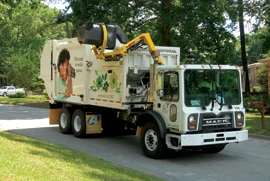
The cost and the complexity of collection trucks continue to increase. With deteriorating road conditions and higher pressure for performance, budget is no longer the only significant factor in a hauler’s purchase decision. Meeting the demands of an industry known for operating in the most severe conditions, a truck must also improve the efficiency and productivity of the operator, all while providing sufficient return on investment (ROI) to entice a hauler to purchase it.
“There’s no more difficult application out there,” states David Wright, director of sales for Autocar LLC. “It’s all we focus on.”
Because most haulers are going to keep a truck for 10 to 15 years, Wright points out several factors worth consideration. “You have to look at the metrics, the ROI, the operating costs. It’s a large investment.”
“The customer drives the specs,” declares Kevin Watje, CEO of Wayne Engineering.
And Watje has some advice for haulers: Don’t cut corners. “They operate in a severe duty environment. Trying to cut costs by cutting out heavy-duty components provides no rewards. The truck just wears out sooner. Everyone looks at budget, but it’s a case of ‘pay me now or pay me later.’”
Similarly, Wright claims that it’s the municipalities driving the specs. Based on experience, climate, region, and the local geology, they choose options on their trucks to suit the situation. For example, a rural versus urban route might result in the choice of dust covers on brakes for gravel roads. A route that sends a truck to the landfill could influence a hauler to opt for lug-style tires with heavier ply, whereas a truck going only to a transfer station would suffice with a road tire. “Each situation is unique,” he says. “This is not a cookie cutter industry—a front loader doesn’t work everywhere. You have to customize.”
The Right Route
The biggest factor in specifying vehicles for both public and private haulers lies in understanding the routes, region, and equipment available. The goal is to collect trash in the most cost-effective way possible.
“Specifying both the correct chassis and body starts with route auditing,” says Nathan Anderson, vice president of sales for BodyWorks Equipment Inc., the only Heil-certified dealer in southern California.
He believes haulers need to know and understand certain factors in order to purchase the right equipment to deliver the best ROI. First is determining if the correct truck for each route is an automated front loader, automated side loader, rear end loader, or front end loader. Multiple factors determine this choice, such as traffic congestion, both to and from the route and while on the route; type of fuel used—diesel, CNG, or LNG; local weight/height laws and their effect on legal payload and overall laden weight during daily operation; and local support from both chassis and body manufacturers for new sales, parts, and service.
“[It’s] crucial to have dealers [who] understand your business, from building the right vehicles, to keeping them on the road,” says Anderson.
It’s also important to know what kinds of roads your trucks will be traveling on, notes John Davis, vice president at Heil of Texas. Are they congested, tight city streets and alleys, residential neighborhoods, or rural roads far from landfills? “Route optimization requires units to be on the roadways less because there are fewer vehicles running for the same amount of routes,” adds Davis. “This will minimize the impact on infrastructure and help to save our roadways.” It also saves wear-and-tear on the trucks.
What’s the customer’s goal? Wright says it’s important to assess the goal and the application. Is it residential or commercial? Are the trucks automated or manual? Does the hauler pick up everything?
Latest from Waste Today
- Worn Again Technologies unveils Accelerator plant to advance polycotton recycling
- Nashville Waste Services launches new digital route system
- ACUA landfill expansion project unanimously approved
- Clean Energy announces multiple RNG deals with fleets nationwide
- Interchange 360 to operate alternative collection program under Washington’s RRA
- Waste Pro files brief supporting pause of FMCSA CDL eligibility rule
- New Way Trucks expands US network with Joe Johnson Equipment
- Tire Industry Project publishes end-of-life tire management guide