For decades, fabric structures have been a go-to structural solution for many industries. The fact that they provide a versatile design and low cost per square foot allows operations to obtain a building that best complements their operation without the large investment in time and money that often accompanies traditional buildings. Since they provide natural ventilation and can be built just about anywhere, there is perhaps no better industry for the use of fabric structures than the waste and recycling industries.
Fabric structures have continued to prove their versatility in recent months, as they have been widely deployed in the fight against COVID-19. Geoff Ching of ClearSpan Structures answers questions about why these structures are so useful for waste and recycling and about how his company has been helping with the current pandemic.
Ching is the director of sales at ClearSpan. He has worked on countless waste projects and has years of extensive experience working on building projects of all kinds. His company recently retooled its manufacturing facility to be able to rapidly deploy buildings to be used as testing sites and auxiliary hospital buildings. Currently, his company is helping Americans return to work by providing custom social distancing solutions for the workplace. Although supplying medical facilities is the pressing concern right now, ClearSpan is still providing solutions to the waste and recycling industry, just as they have for the past four decades.
Seeing as that this pandemic is the biggest story in the world right now, let’s dive right into some questions about fabric structures and how they are being used during the Coronavirus.
Due to COVID-19, has there been an increase in the use of fabric structures?
Ching: Yes, we have seen photos of fabric structures becoming more prominent all over the USA. Fabric structures can be manufactured and installed in a fraction of the time of conventional construction and provide equivalent structural integrity and stability, so they’re a really good option for emergency response and other applications where quick construction is an essential factor.
What are the benefits of using fabric structures as medial and/or testing facilities?
Ching: In addition to being rapidly deployable, ClearSpan’s design versatility allows facilities to optimize the sidewall and peak heights, creating the ideal building for any need. There are also foundation options that can be easily installed on open ground or asphalt parking lots with almost no required site work. These types of structures are also available for rental if the long-term need is uncertain.
One of the benefits of fabric structures is the fact that they can be built just about anywhere, and their foundation options are what makes this possible. Ching pointed out the helical anchoring system, which drills directly into the ground and creates a firm and dependable foundation. This style of foundation doesn't require poured concrete or an existing pad, and to prepare for this type of foundation, very little work is needed. Helical anchors allow the buildings to be constructed just about anywhere and are an essential feature to quick construction timelines.
How fast can fabric structures be deployed to facilities that need them?
Ching: We have pre-designed, select models from 5,000 to 10,000 square feet that can be shipped within 24 hours when emergency facility installation is urgent.
Before we move on, are there any other uses for fabric structures during the pandemic?
Ching: The meat processing industry has been hit pretty hard by the pandemic, so ClearSpan has been working with multiple meat processing facilities to offer storage and lunchroom facilities. It's been difficult for these facilities because they depend on a large workforce that needs to work close in proximity; we’re working to allow these plants to spread out their operations and promote distancing and a safer work environment.
While COVID-19 has been dominating the news, it’s important to point out that these buildings can also be particularly helpful to waste and recycling facilities.
Let's switch gears and talk a little bit about how fabric structures can be used for landfills, transfer stations, and maintenance facility and recycling purposes.
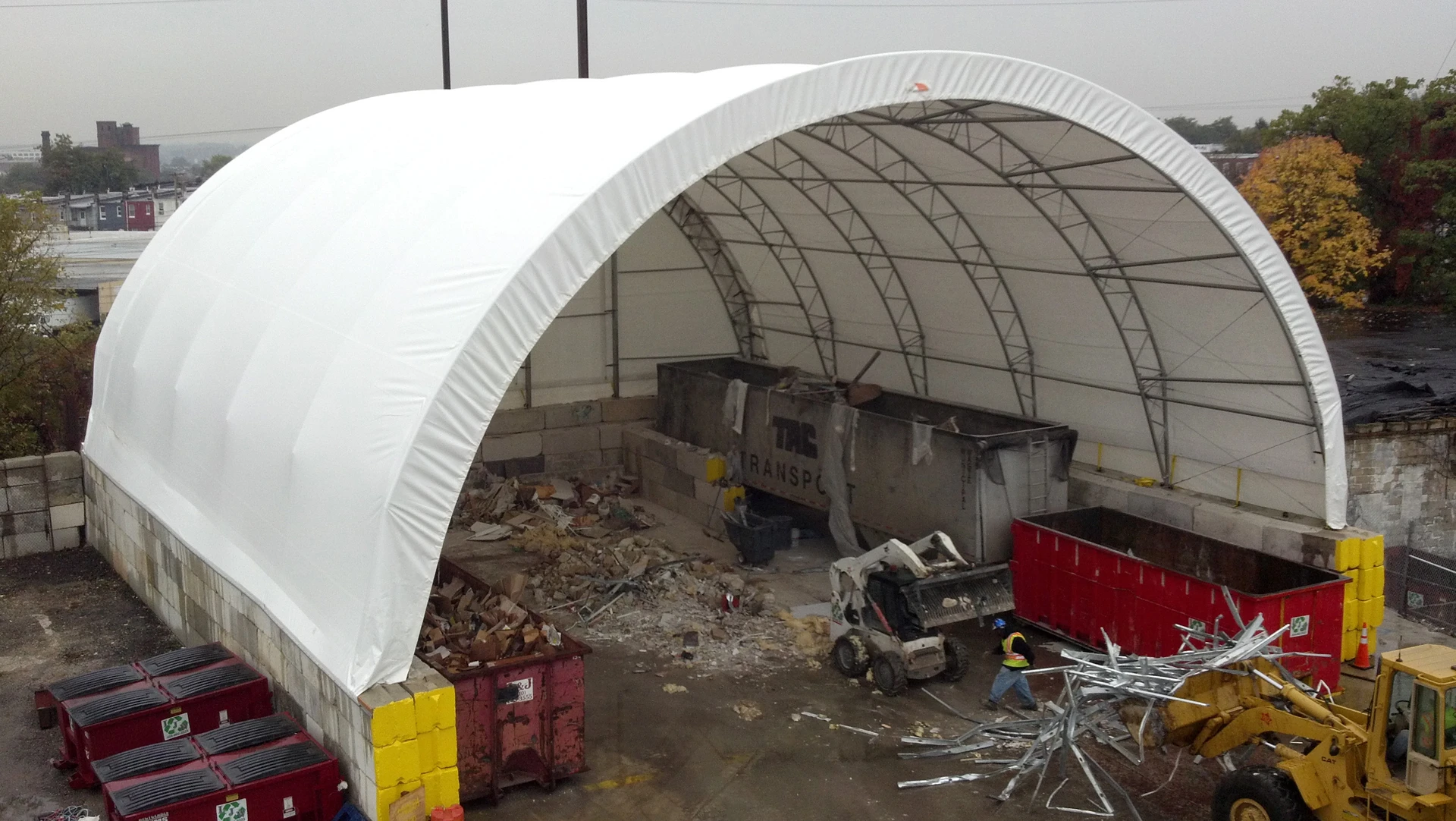
Ching: Definitely. We've designed and installed hundreds of fabric structures for recycling, maintenance, and transfer stations. The appeal is for our designs to easily raise peak and eave heights to allow operations to cover specialized sorting equipment and loaders, while also providing the ability for this equipment to be used within the structure itself. The translucent fabric found with these buildings also reduces the need for artificial lighting during the daytime hours, which reduces energy costs.
How can a fabric structure directly benefit an operation in the waste and recycling industries?
Ching: With a lower cost per square foot needed for the building, more funding can be allocated towards expanding indoor storage or procuring superior sorting equipment and transport vehicles.
What are the most important features a structure should have in these industries?
Facility managers should consider the expected storage sizes that are needed, as well as the height of any raised loaders, so that the designers can raise the building height to promote a smoother, more efficient operation. We recommend open-ended buildings to allow for easier equipment mobility, and then also integrate the sidewall openings and doors that each operation needs. While increased height can help with internal maneuverability, the higher peak creates a cathedral effect and also optimizes interior ventilation.
In a lot of cases, there is still some skepticism with regards to how fabric structures stack up against more traditional building solutions, so Ching weighed in on that as well.
What are some advantages of using a fabric structure compared to a traditional brick and mortar building?
Ching: The lower cost and faster manufacturing and installation time, without compromising frame and building strength, is a big one. The last point there is crucial because ClearSpan commonly engineers recycling facility buildings to be under prevailing local wind and snow load requirements.
How does construction for fabric structures differ from traditional buildings? Are there any benefits to constructing a fabric structure versus a traditional building?
Ching: The speed of construction allows customers to design, engineer, and install a 15,000- to 20,000-square-foot structure in as little as 60 to 90 days. Besides the cost savings, this is why so many waste and recycling facilities repeatedly seek out fabric building solutions.
What are some of the environmental benefits of fabric structures pertaining to the waste and recycling industries?
Ching: Definitely the natural lighting. The natural light penetration eliminates lighting costs during the daylight hours, thereby reducing the carbon footprint of the operation. A brighter building is also a safer building and one less likely to be infested by rodents.
We saw that your company offers two styles of frames; what would be the best type of frame for waste and recycling?
Ching: ClearSpan now offers I-beam frames for fabric-clad structures, along with welded-truss designs that utilize tubular steel. Our recommendation typically hinges on the width and height needed. Some of the round, Quonset designs in the range of 45 feet wide to 65 feet wide are exceptionally cost-effective, and they’re easy to mount onto concrete blocks or shipping containers. When width extends beyond 75 feet wide, the I-beam designs offer a lower cost per square foot and the ability to customize side and peak height more easily.
You also have several fabric cladding options. How do those stand out from their competitors?
Ching: We now offer Armor Shield fabric with an industry-leading 30-year warranty. We are convinced this 29-ounce vinyl fabric is the absolute best fabric cladding available at a remarkably competitive price.
Latest from Waste Today
- Vermeer announces plan to build new facility in Des Moines metro area
- Buffalo Biodiesel shares updates on Part 360 application to DEC, Tonawanda facility progress
- Capstar Disposal expands roll off dumpster rental services
- Supreme Court strikes down IEEPA tariffs
- Casella details facility closures, expansion efforts
- Zero harm: Building a SIF prevention program for waste and recycling operations
- Casella posts a loss in Q4 2025
- McNeilus names Haaker Equipment first Dealer Partner of the Year