As every municipality has come to realize, managing bulky waste can be problematic. Special handling, as well as special equipment, is required for items too large to be bundled or placed in containers. While this waste might commonly be green waste, mattresses, furniture, appliances, or building materials, it can also involve items downed or damaged by severe weather and disastrous storms.
Cities have similar goals in the handling and disposal of bulky waste, especially in regards to the top three, which are safety, efficiency, and expense.
Let’s take a closer look at the efforts to improve areas and some recent developments that may make work life a little more productive for all.
Safety is Priority #1
According to Kirk Sander, VP of Safety and Standards with the National Waste & Recycling Association (NWRA), “When companies push safety, that’s when safety improves.”
Smart companies and communities invest in creating a culture of safety. In addition to increasing employee morale, loyalty, and efficiency, the risk-reducing measures they enlist will decrease injuries, the cost of disability benefits, and the possibility of expensive lawsuits.
One especially dangerous aspect of bulky waste collection work involves rear-loading equipment that requires waste truck employees to be in the street. Being backed over by the truck or struck by another vehicle are potential problems to consider. Now with the increase of distracted drivers, the possibilities for serious or life-threatening injuries are only exacerbated.
Kirk Sander of the NRWA agrees. “What we talk about most regarding safety is that anytime we can keep employees or workers in the truck, that’s the safest place for them to be.” He continues, “Automated bulk pickup has provided added protection to workers. As a whole, this industry focuses on building a way to eliminate the hazard of engaging with what potentially could be a harmful interaction.”
These issues also impact the communities’ expenses since insurance claims and lawsuits are costly.
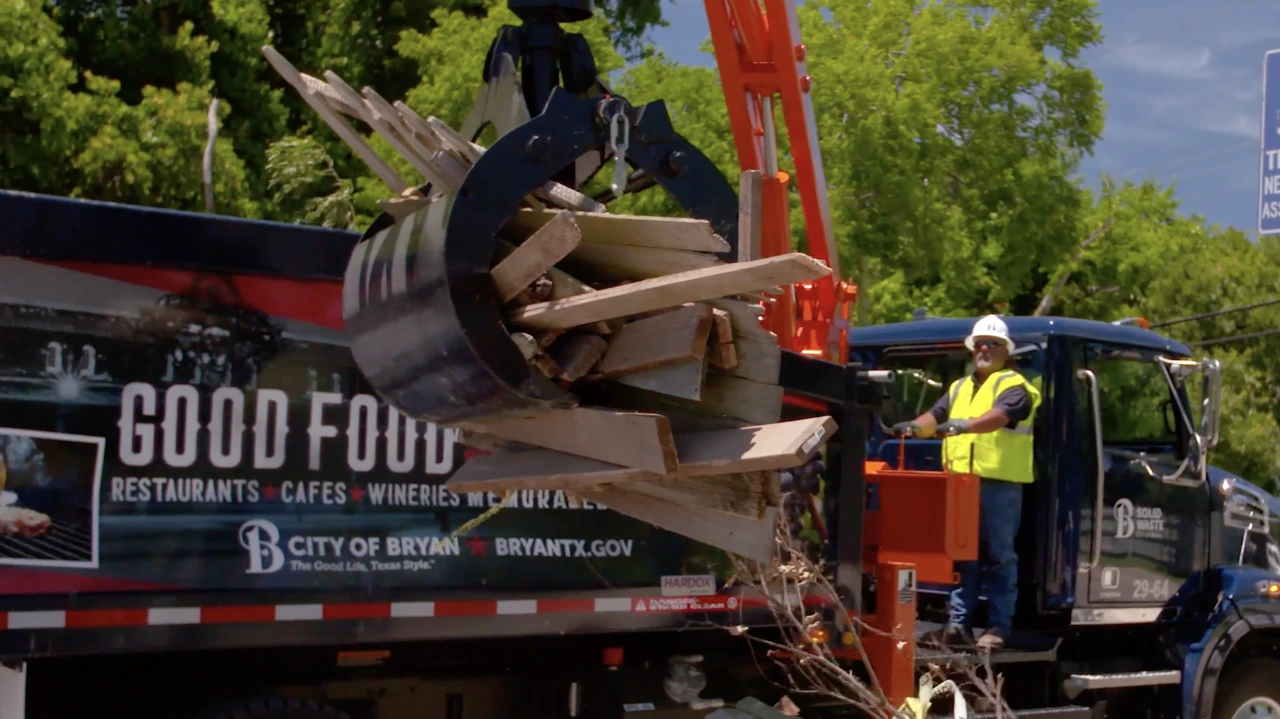
But as a result of new equipment and technologies, this difficult work is becoming safer. As an efficient solution that increases safety and reduces labor costs, most cities have now incorporated grapple trucks into their refuse fleets to make what has been a multi-person job into a one-person task. They make a difficult job easier and lessen risk because operators can lift thousands of pounds without concern for menaces such as glass, thorns, or dangerous critters in the pile. And it’s all done from the safety of the operator’s platform.
Michael Gordon, Solid Waste Manager for the City of Largo (Florida), reports his department is already realizing the safety advantages.
As a customer of Petersen Industries Inc., Largo currently runs four of the standard TL-3 dump body vehicles with grapple and two rear loaders for the smaller items. But he explains his excitement about another product, too. “When somebody finally developed a side trough, we included three of their new Route Assistant product in our fiscal 2018 budget.”
The product is available with both conventional and stand-up-right-hand-drive chassis. Gordon comments on the SURHD variation: “With any new product, there’s always a learning curve. Three gentlemen on our staff volunteered to operate these three trucks and their responses have been so positive, we plan to buy five more in 2021. We believe they will be safer in the long run because the driver stands upright and has better visibility. Also, by taking this load off the manual backpacker or traditional three-man garbage truck, it’s ergonomically better on the collector’s back. We expect to see our workmen’s compensation claims decrease as well.”
Like Gordon, Bill Pickrum of the City of Dunedin, FL, is always interested in creating a safer work environment. As Solid Waste Director, he also decided to purchase a new Route Assistant vehicle. Dunedin currently uses the claw truck for larger items, but with the Route Assistant in use for smaller items, he has high expectations for increased safety and financial feasibility.
“As opposed to the two- or three-man team required to operate the rear loader,” he shares, “the ability for one man to load from the side and never be in the direct route of a possibly distracted driver will be a big advantage.”
This physically and mentally demanding work with heavy equipment in congested streets requires skill and focus. In addition to experiencing overexertion, workers can be struck by, strike against, or be compressed in the heavy equipment. In its 2016 National Census of Fatal Occupational Injuries, the Bureau of Labor Statistics indicated 33 fatalities per every 100,000 trash/recycling workers—more than police officers, construction workers, and miners.
Realistically, one operator cannot monitor everything going on around a large piece of equipment while distractions such as adverse weather conditions, time constraints, other vehicles, obstacles, people, and pets require his attention. Obviously, with equipment and drivers essential to any fleet’s safety, productivity, and long-term profitability, investing in the best combination can help maintain a successful and safety-conscious business.
Choosing equipment to give drivers the maneuvering advantage in those tight situations and tough weather will always be a smart move. Progressively and with today’s waste handling organizations integrating a wide range of systems, technologies, and advanced equipment, safer operations retain their best employees. Together with the innovations by manufacturers and product suppliers, fleets and their operators can work toward better serving their communities and removing the industry from the most dangerous list.
“Grapple trucks are still a new or foreign concept to many who don’t live in the Southeast,” shares Sam Petersen, Vice President of Petersen Industries. “The misconception is that grapple trucks are used only for storm cleanup or by storm chasers, a thought that couldn’t be farther from the truth. Grapple trucks are used as daily route vehicles to pick up anything over the 50-pound mark, piles that are sketchy, or those that are just covered. As with residential curbside automated collection, if we can eliminate the need to put our hands on the garbage, we reduce most of the unknown and dangerous variables in our industry.”
Efficiency Lowers Expenses
If cities do not efficiently collect bulky waste, the public will find other disposal solutions. Two examples include illegal burning and illegal dumpsites. While these may solve the home or business owner’s immediate problem, ultimately the cities’ waste management departments are responsible for the cleanup.
Every customer has varying degrees of need and the industry has progressed enough to meet many of them. 40 years ago, if you bought a grapple truck, it was a 16-foot boom with an 18-foot dump body—that was it. Today with the availability of different boom and body sizes, control locations, and lift capacities, communities small and large have great flexibility in integrating the right grapple truck style for their need.
The most common style is a great all-purpose “self-loader” grapple truck. These incorporate a grapple loader and a dump body in which to load the items. With the convenience and efficiency of being a one-person operation., they can be used in route situations or special pickups.
For the high-volume customers with defined routes, incorporating a dedicated loader with haul trucks is a great way to keep the loader on the route while the haul trucks drive back and forth to the landfill. The most popular style of this type can be driven and operated from the operator cab, a capability that has helped some of the nation’s largest cities become extremely efficient at loading bulky items.
Grapple trucks are a necessary piece of equipment for a bulky waste collection program since this refuse is not easily quantified. With trash of different materials, shapes, sizes, and weights, operators generally have no idea what will be waiting for them at the next stop. Grapple trucks do these efficiently by eliminating the need for workers to handle the waste and be in the street, where many of the truly tragic injuries occur.
Knowledge and Teamwork Lead to Innovation
The City of Hampton, VA, experienced an extremely large snowstorm in the winter of 2016, a highly irregular event for a coastal municipality. Thankfully, the city’s fleet of grapple trucks, used for the automated bulky garbage collection program, were able to manage the severe condition, access the routes, and lift and haul the large amounts of snow piling up around the city to nearby parking lots.
When Jason Mitchell, Hampton’s Public Works Director, shared the story with Petersen Industries’ co-owners Sam Petersen and Casey Hardee at the next annual Waste Expo, he posed a great question. He asked if a cart-tipping mechanism could be incorporated onto the grapple units, which was something equipment manufacturers had not previously tried.
Given the long history of Hampton and Petersen’s relationship in pioneering the automation of bulky garbage collection, Sam and Casey worked toward a solution with their sales and engineering teams. Ultimately, the company’s efforts produced the Route Assistant into the waste industry. This sideloading option allowed the city’s personnel to empty garbage carts, as well as the handloading, non-back-breaking items that didn’t warrant the deployment of the grapple loader. Pleased with the idea’s results, the city of Hampton acquired the innovation for its fleet of grapple trucks.
Today, the hugely popular “Route Assistant” not only provides the ability to empty residents’ carts in abnormal situations, but it also increases the efficiency of smaller item pickups frequently present on bulky collection routes. Beyond this innovation’s utility, all concerned realized again the value of industry relationships. Through this dialogue, an adverse scenario set in motion a product solution that has benefited collection services that strive continually to improve their operations.
Most certainly, progress for the waste collection industry relies on input from all involved—the manufacturers, the vendors, and the end-users who are on the frontlines every day to keep America’s cities clean. What one learns and shares can benefit the multitudes.
Ultimately, the goals of safety and efficiency mean a better country for all.
Latest from Waste Today
- Vecoplan to present modular solutions at IFAT 2026
- Terex Ecotec appoints Bradley Equipment as Texas distributor
- My Green Michigan expands depackaging capacity
- Washington selects Circular Action Alliance as PRO
- Ten-8 Industrial opens new central Florida service center
- Triumvirate Environmental acquires Environmental Waste Minimization
- Official NYC Bin availability expands ahead of deadline
- US Food Waste Pact’s 2025 Impact Report shows decrease in food waste