While there have been many improvements to the waste industry since regulations were first adopted, the industry has been stuck with an archaic and poorly performing way to close landfills. There has essentially been no innovation to improve reliability and performance, leaving owners and state agencies saddled with a never-ending and non-predictable, long-term care liability. The industry has shown that it can prove to be somewhat slow when it comes to innovation that does not fit the regulatory prescribed design. It requires proof, credibility, and time. However, when a new technology finally makes its mark, it usually represents significant performance and operational improvement.
One notable technology can be found in final landfill closures. Traditional prescriptive final covers have now been replaced with newer technology that far exceeds the performance objectives of the regulations and removes the lack of predictability of long-term performance. This technology is an engineered geosynthetic turf and structured geomembrane composite system that solves issues like poor soil performance (i.e, erosion, slope failure, sediment transport, etc.), lowers leakage rates, and provides for a more efficient gas collection. This system has shown to lower financial and environmental liabilities with over a decade of proven performance and over 2,000 acres installed on MSW, C&D, Industrial, CCR landfills, and impoundments in a wide range of climatic and topographic conditions.
A More Advanced Technology
The engineered synthetic turf system is comprised of a structured geomembrane, an engineered turf, and a specified infill. The structured geomembrane provides both drainage and high interface friction for stability. It serves as the barrier layer to minimize infiltration through the cover system into the waste. The engineered turf is made of synthetic grass blades tufted into two layers of geotextile backing. It is the protective layer that covers and protects the underlying geomembrane from ultraviolet (UV) degradation and wind uplift. The specified infill provides additional UV protection and allows the system to withstand traffic loads.
The Dawn of a New Era
The very first engineered synthetic turf final cover systems, called ClosureTurf, were installed in the south and the southwest US in 2010. It was created as an alternative to the EPA, Subtitle D Compliant prescriptive vegetative cover, and designed to address and solve soil erosion, slope integrity, gas emission, installation/maintenance cost control, and longevity of structure and appearance. Now, it is the go-to solution that has set technical performance milestones in many facets of landfill construction and operations. Some of those include:
- Installing at least twice as fast as traditional vegetated covers
- Reducing the production of leachate by approximately 100,000,000 gallons on larger projects due to a faster closure timeline
- Saving approximately 550 truck trips (225 round trips) of soil per acre which prevents land destruction of offsite borrow sources and keeps community roads safe
- Eliminating a 2-foot soil layer that can provide more than 80,000 cubic yards of potential airspace for a typical 25-acre project
- Reducing the carbon footprint by approximately 80% (210,000 kg of CO2 per acre) when compared with traditional soil/vegetative covers
- Reducing long-term maintenance activities by over 90% compared to a traditional soil cover
- Reducing turbidity by 90% on sites resulting in cleaner water
- Surviving severe weather events with no erosion damage, including a record 500-year rain event in Pensacola, FL, and multiple hurricanes
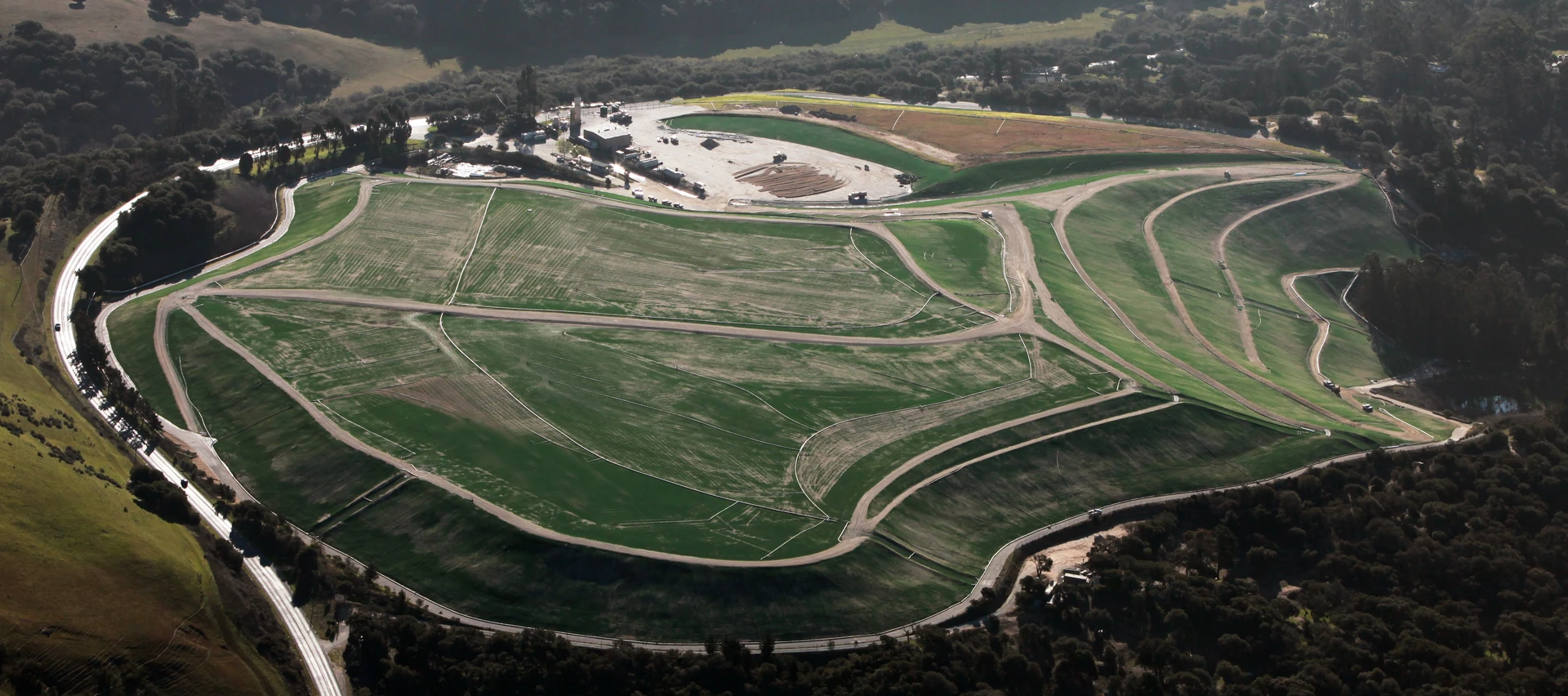
Perhaps one of the most significant milestones is that the engineered synthetic turf system was recently chosen for the landfill closure method at the Mississippi Phosphates Corporation Site (MPC) in Pascagoula, MS, marking the second time an engineered geosynthetic turf cover system will be used for an EPA Superfund site. The first EPA Superfund site, Crazy Horse Landfill, is a 68-acre site located in Salinas Valley, CA.
EPA Endorsed & Applied
At the MPC Superfund Site in Mississippi, the engineered synthetic turf system is being used to cover existing gypsum storage facilities by sequestering the contaminants from surrounding bayou and the Grand Bay Estuary Reserve. The scope of the project includes 220 acres of total closure that will be completed in phases over two years. Construction on phase one is now underway and all three phases are scheduled to be completed by 2021.
The engineered synthetic turf system will eliminate the need for 1.2 million cubic yards of dredged material or soil that would have been required for a traditional vegetated cap. This translates to eliminating 42,700 truck trips saving $4.6 million, a significant reduction in carbon footprint, and improved safety on local roads. Further, the system requires almost no maintenance which is expected to yield an additional $1.4 million in savings due to no sediment cleanup and regrading after storms, no revegetation, and no mowing. With the MPC site falling in the infamous Hurricane Alley, the system will be critical in protecting against rill erosion and complete washout.
According to the EPA, 2 to 4 million gallons of wastewater are treated per day at this site, costing $1 million per month. The use of the engineered synthetic turf system will limit leachate and improve the cleanliness of stormwater runoff, ultimately reducing the state’s need to manage and store 500 million gallons of water by 98%. This will result in a savings of $40,000 per day in wastewater treatment once the project is completed.
Severe Weather-Proven Durability
The components of the engineered synthetic turf system work in conjunction to effectively seal the waste mass from nature's forces such as rain, wind, snow, and seismic activity. With traditional solutions, these forces could result in complete washout, failure, and rebuilding of slopes.
Wind tunnel testing was conducted at Georgia Tech Research Institute to evaluate the wind uplift of engineered turf. The wind created a downward force on the turf, and it resisted a hurricane-force wind of 120 mph without being lifted. Many of the engineered synthetic turf system installations have experienced significant, if not historic, weather events, including hurricane-force winds and record-setting rainfall. For example, a closure project in South Carolina endured a 1,000-year rain event when a hurricane swept through the area and a Florida panhandle project experienced a historic 500-year storm event where 5.68 inches fell in a single hour (26 inches total in 24 hours). No damage to the system was incurred.
Additionally, northern installations with an engineered turf system have also provided opportunities to evaluate its performance in areas that encounter cold, high wind and snow conditions. The system performed exceptionally well in each of these extreme weather condition scenarios.
Soil Construction Factors
The engineered synthetic turf system eliminates the need for high-maintenance vegetative soil covers, and the importance of this cannot be overstated. Since final cover soils can be challenging in quality, difficult to locate, and expensive to place, the resulting savings can be significant.
Eliminating the need for a 2-foot soil and vegetative cover layer improves safety while reducing the carbon footprint of the closure as there is no need to transport soil to the site. This means the removal of thousands of trucks from local roads as geosynthetic turf closures eliminate the need for approximately 550 truck trips (275 round trips) per acre that would otherwise be needed to transport soil to and from a borrow site. Less equipment also means reducing the carbon footprint of the closure by approximately 80% compared to traditional soil/vegetative covers.
The reduction in size, number, and duration of equipment also means an overall increase in safety on both the project site and local roads, as well as reduction of dust at the site, mud on the roads, and noise impacts to the surrounding community. Most traditional closures also require the destruction of land for project soil sources, resulting in additional environmental impact and loss of future land use.
Reduced Environmental Impacts
One of the biggest considerations in choosing a final cover is how future rainfall will impact your landfill, as well as the land and livelihood of those surrounding your landfill. It is important to keep water out of the waste, but you must also ensure that nothing detrimental comes off the surface and lands in the water carried off your site. Considering the average size of landfills, the opportunity exists for significant sediment pollution through erosion that is often an inherent part of traditional soil covers.
Engineered synthetic turf systems provide clean runoff with very low turbidity because they do not have a soil layer, except for the thin (0.5-inch thick) layer of sand infill. The sand acts as a natural filter as the water moves down the slope and channeling areas. As a result, sites have experienced a 90% reduction in turbidity resulting in cleaner water. The system also significantly reduces sediment loading to surrounding channels and sedimentation detention basins either onsite or offsite. This produces a positive impact on overall stormwater quality, allowing effluent levels to meet (or be well below) the regulatory turbidity limits. Most importantly, it can consistently provide repeatable water quality results for every design storm event.
Reduced Maintenance and Post-Closure Costs
Another benefit of using an engineered synthetic closure system is that it requires very little post-closure maintenance compared to alternative soil systems. The cost of maintenance is estimated to be as much as 90% less as a result of the reduction in maintenance activities including vegetation, mowing, fertilization, irrigation, re-vegetation, erosion repairs, and stormwater pond cleaning associated with traditional soil covers.
Common erosion, stormwater, and siltation problems are prevented—even during severe weather events such as intense rainfall, hurricane-force winds, and earthquakes. Further, it protects against driving forces and severe weather conditions such as drought and heat.
How Long Will It Last?
Perhaps the most frequently asked question (and the most important one) about the engineered synthetic turf system is: “How long does it last?” What’s the point in all of the many benefits of the Geosynthetic closure system if the longevity of the product is insufficient to make a difference long-term?
We have found that, if properly maintained, the engineered synthetic turf layer will have at least 100 years or more of functional longevity. The results of 10 years of independent weathering data for the synthetic turf yarns have told us that the projected half-life of the engineered turf layer far exceeds 176 years. This longevity has been independently evaluated by multiple organizations that are experienced in the longevity performance of geosynthetics. The underlying geomembrane will last much longer because the engineered synthetic turf layer protects the structured geomembrane so that it is not exposed to the environment. Studies by the Geosynthetic Institute show that the geomembrane can last more than 400 years under covered conditions.
Post-Closure Beneficial Use: Renewable Energy
In recent years, it has been discovered that installing solar generation on capped landfills has proven an effective way to deploy large systems on typically unused space. Landfill owners are given the opportunity to generate revenue from what might be otherwise undevelopable land. Such sites are usually located near roads and electricity distribution infrastructure. Areas with larger populations tend to have high energy demand. Opportunities exist to lease the land, sell energy to a local utility, and/or generate state renewable energy credits (SRECs).
Yet another massive benefit of using an engineered synthetic turf system comes in the form of a new technology called PowerCap. PowerCap provides a revolutionary new approach to solar on landfills and impoundments. Because the panels are directly attached to the system with no penetrations, racking material is eliminated, installation becomes easier, the entire site can be utilized including side slopes, and maintenance is dramatically reduced. Best of all, the power per unit area is increased by more than 35%.
Challenges to deploying solar panels on vegetated caps include fugitive dust, grass clippings, and the potential damage from mowing equipment. Additionally, panel systems might move or break due to settling caused by erosion impacts to a vegetated cap. The engineered synthetic turf system provides the ideal foundation for capping environmental waste and significantly reduces the expenses related to vegetation and erosion. Panels operate in a clean environment and are easily accessible. Best of all, it allows for the installation of panels on slopes in addition to top decks for maximum output.
Other Engineered Synthetic Turf Technologies
Engineered synthetic turf has expanded into other cover technologies as well with much success. In areas where an intermediate cover is needed (+/-10 years), a new system exists that stops water infiltration and reduces erosion without the use of sandbags or tie-down strips. It’s simply anchored trenched in the dirt and stays in place. The aesthetics blend in with the surrounding environment, and maintenance such as seeding and mowing are eliminated. It can be used as an intermediate cover, in landfill down chutes, and drainage channels, and it assists with landfill gas collection.
In permanent closures, a cementitious infill can be added to the engineered turf system in stormwater applications where high concentrated flows of water are directed. This advanced approach protects against 40-feet-per-second velocity with no instability or damage. It is intentionally designed to be flexible with an expected settlement.
Whether intermediate or permanent coverage, both systems can be used instead of hard armoring systems that can crack or sink, such as pipe, flexible mats, fabriform, or rip rap.
Predictable Outcomes Now Come Standard
A reliable Best Management Practice (BMP) has arrived. There is no question that new and advanced technology has replaced what was a low, and unfortunately widely accepted, standard in landfill design. From local landfills to utility sites to superfund sites, engineered synthetic turf systems are now the new standard and BMP for final landfill covers. With performance and operational challenges solved, owners and engineers have moved to this technology for predictable results. No longer does one have to lay awake at night or watch the weather channel worrying about what environmental and financial impacts the latest storm event has caused.
Latest from Waste Today
- My Green Michigan expands depackaging capacity
- Washington selects Circular Action Alliance as PRO
- Ten-8 Industrial opens new central Florida service center
- Triumvirate Environmental acquires Environmental Waste Minimization
- Official NYC Bin availability expands ahead of deadline
- US Food Waste Pact’s 2025 Impact Report shows decrease in food waste
- Coastal Waste & Recycling expands recycling operations with Machinex
- Reconomy acquires German-based GfAW